
Pick up a smooth knitted fabric with a little body, press it between your thumb and finger, then let go. Some fabrics flatten almost immediately. Others offer a slight resistance and recover part of their thickness when the pressure is released.
That cushioned feeling is one reason designers use fabrics sold as “air-layer” knits. They can give a garment volume, a rounded fold or a cleaner silhouette.
Internal Construction
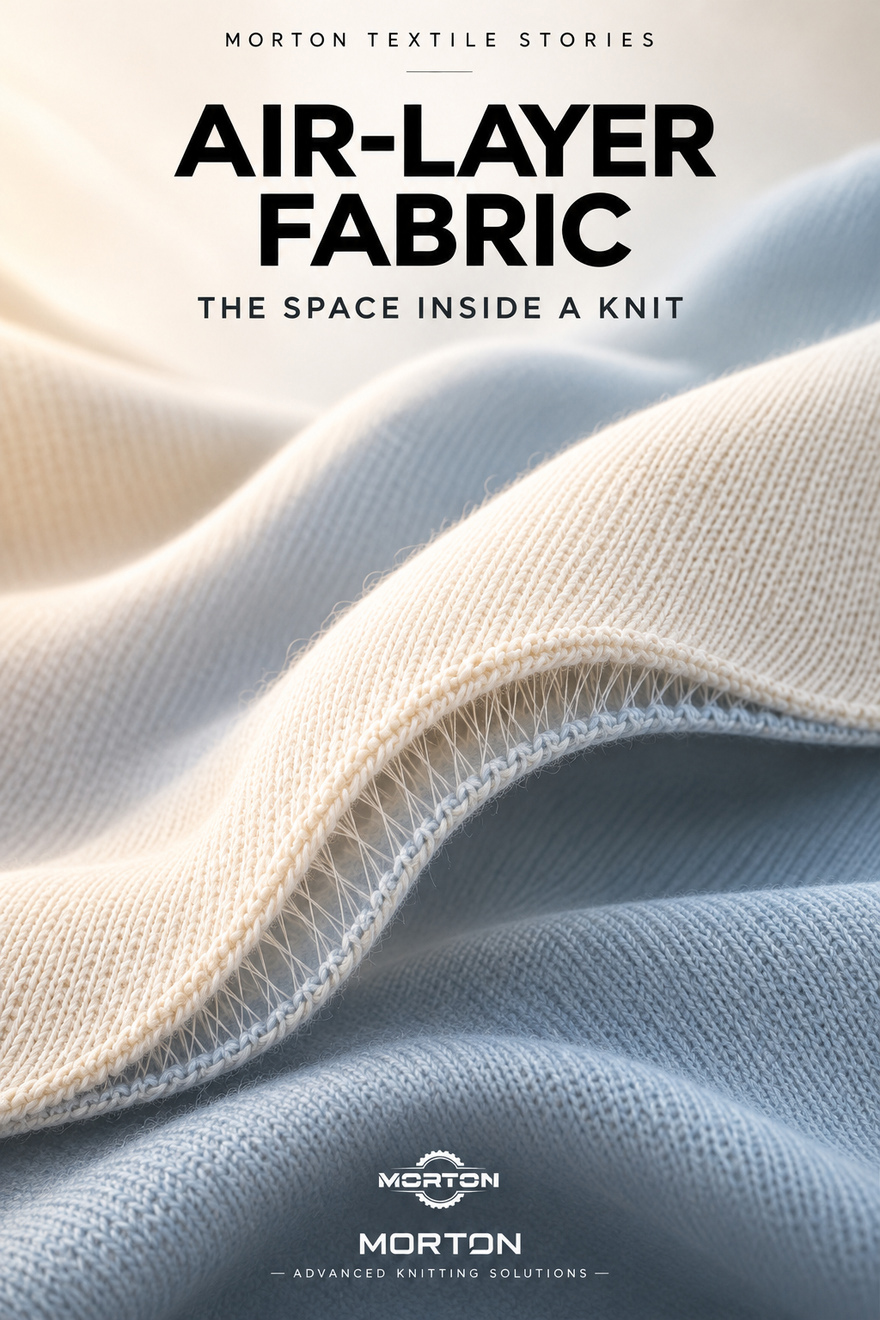
The name suggests an empty space inside the cloth. The construction is more interesting than that.
In a knitted spacer fabric, two surface layers are joined by connecting yarns. Those yarns hold the faces apart and leave space within the fabric. The layers can be knitted together in one continuous process, rather than made separately and bonded afterwards.
The connecting yarns help explain what happens under your fingers. As you press the fabric, they bend and the distance between the faces decreases. Their material and arrangement influence how much force is needed and how the fabric behaves when the pressure is removed.
Research & Performance
Research on weft-knitted spacer fabrics has shown that spacer yarn type, density, thickness and surface construction affect compression behaviour and thermal properties. Two fabrics with similar faces can therefore feel quite different when squeezed or folded.
“Air-layer” needs a little care as a buying term. Suppliers use it across a range of apparel knits, and the label alone does not specify the internal structure. A compact fabric intended for a sweatshirt may have very different requirements from an open spacer material intended for cushioning.
A useful specification describes the face and back, the yarns joining them, and the required thickness. It also says what the fabric must do in the garment.
For Structured Jackets
For a structured jacket, a designer may want enough body to hold a curved sleeve.
For Softer Garments
For a softer garment, the same resistance could make the fabric feel bulky at a seam. A fabric that feels pleasant as a single swatch can become cumbersome where several layers meet.
The air inside the structure can contribute to insulation, provided the construction limits heat loss appropriately. CottonWorks describes a double-knit spacer example with cotton-and-spandex faces joined by nylon monofilament, developed as an insulating fabric for activewear. That is a specific construction, rather than a performance promise for every fabric carrying the air-layer name.
Breathability needs the same attention. Internal space does not tell us how easily air or water vapour can pass through the outer faces. A dense surface and an open mesh surface create different conditions, even when both have a connecting layer.
Knitting Technology
For the knitting mill, this brings the discussion back to how the layers are made. On a suitably configured double-jersey circular knitting machine, the cylinder and dial provide two sets of needles for forming the fabric faces. The knitting sequence and connecting yarn arrangement establish the relationship between them. Spacer production can require a specific machine configuration or conversion equipment.
There is plenty to assess before cutting a garment:
- ✓ Thickness and weight (Starting measurements)
- ✓ Compression recovery and stretch
- ✓ Behaviour after laundering
Then sew a test seam. Fold a hem. Press them under the intended production conditions and inspect them again. The broad, smooth area of a swatch may look convincing; the cuff and seam allowance reveal whether that volume will work in the clothes.
Advanced Knitting Solutions
Post time: Nov-07-2026