
Walk into almost any gym or yoga studio today and you’ll see the same thing.
Leggings.
Sports bras.
Stretch tops.
It feels so natural that it’s hard to imagine a time before yoga clothing existed.
But it wasn’t that long ago.
For thousands of years, people simply practiced yoga in whatever they happened to be wearing—loose cotton garments, wraps, or comfortable everyday clothes. There were no performance fabrics, no compression leggings, and certainly no activewear collections.
Even when yoga became popular in Europe and North America during the 1960s and 1970s, people wore whatever felt comfortable. Leotards, tights, oversized T-shirts, even sweatpants.
Yoga wear hadn’t been invented yet.
Stretch Changed Everything
The real breakthrough wasn’t fashion.
It was fabric.
As nylon, polyester, and elastane became more widely available, textile manufacturers suddenly had the ability to create fabrics that stretched, recovered, breathed, and remained comfortable through constant movement.
For the first time, clothing could move with the body instead of restricting it.
That changed everything.
By the late 1990s, yoga pants were no longer just something people wore to exercise.
People wore them shopping.
To cafés.
To airports.
To work.
What started as sportswear quickly became everyday clothing, creating one of the fastest-growing categories in the apparel industry.
Behind Every Great Pair of Yoga Pants
When someone buys a pair of yoga leggings, they usually notice how soft the fabric feels.
How well it stretches.
How quickly it dries.
What they don’t see is everything happening underneath.
Modern yoga fabrics have to perform several jobs at once.
They need four-way stretch.
Excellent recovery.
Moisture management.
A smooth surface.
Resistance to pilling after hundreds of washes.
None of those characteristics happen by accident.
They’re created during knitting.
It Starts on a Circular Machine
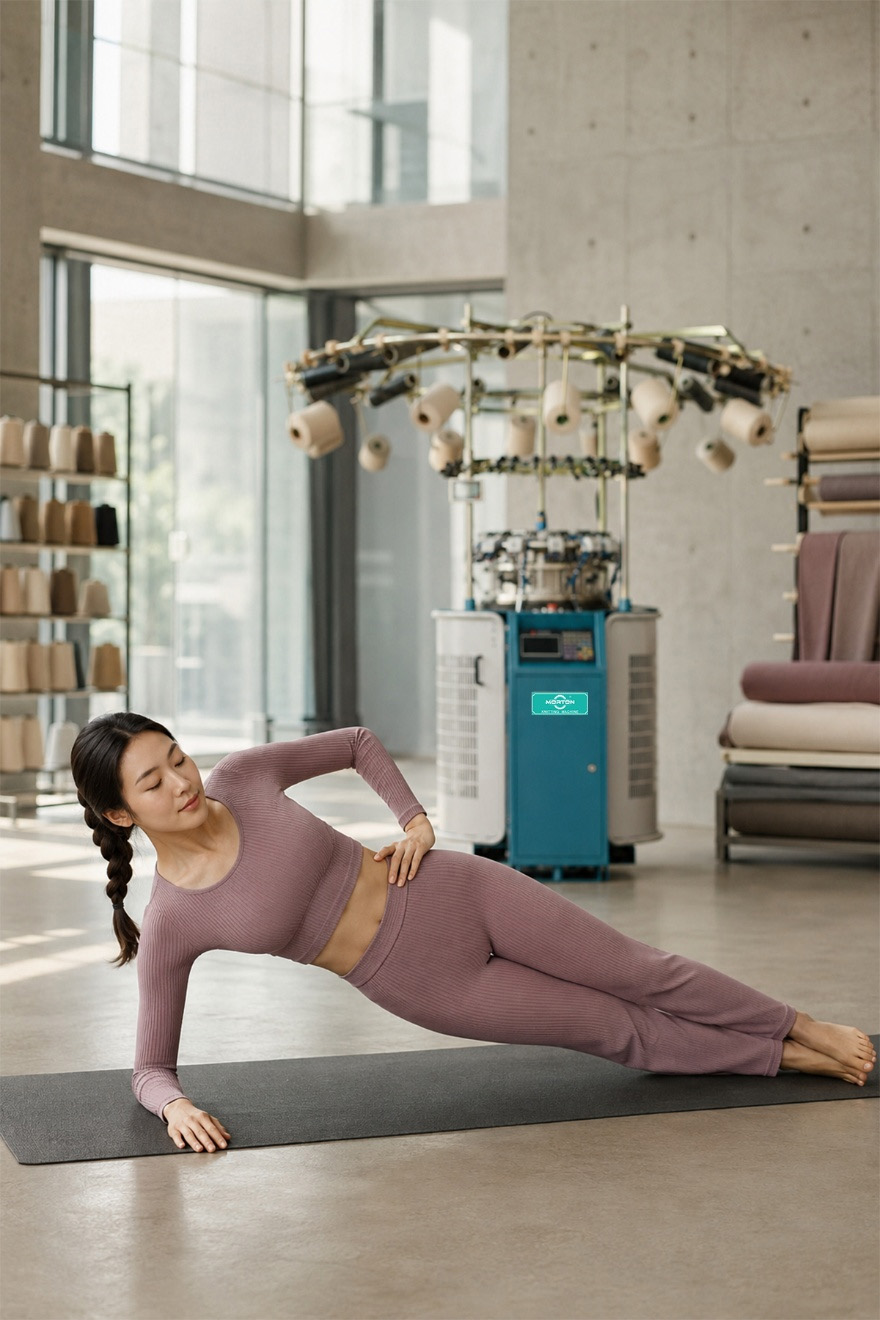
Most premium yoga fabrics are knitted on a Circular Machine or an Interlock Machine using blends of nylon, polyester, and elastane.
The yarn matters.
But equally important is how that yarn is knitted.
A well-configured Circular Machine produces consistent loops, stable tension, and smooth fabric that stretches evenly across the entire garment.
For premium activewear, many manufacturers choose fabrics produced on an Interlock Machine because the structure is denser, more stable, and better at maintaining its shape after repeated washing and stretching.
The machine doesn’t just produce fabric.
It determines how that fabric performs for years after it’s sewn into a garment.
Small Adjustments, Big Differences
In our workshop, we often remind ourselves that two machines using the same yarn can produce fabrics that feel completely different.
A slight change in yarn tension.
A different cam setting.
A small adjustment to the take-down system.
These are tiny changes on the machine, but they can noticeably affect how a pair of leggings feels after months of wear.
That’s why machine setup matters just as much as material selection.
Good fabric isn’t only about choosing the right yarn.
It’s also about building the right machine to knit it.
Behind Every Stretch Is a Knitting Machine
The global activewear industry has grown into a market worth tens of billions of dollars.
Millions of yoga pants are produced every year.
Behind almost every one of them is a knitting machine quietly producing fabric hour after hour.
Most people will never see that machine.
They’ll only notice how comfortable the leggings feel.
And that’s exactly how it should be.
At Morton, we build Circular Machines and Interlock Machines that help textile manufacturers produce the high-performance knitted fabrics modern activewear depends on.
Because long before a customer puts on a pair of yoga pants, the fabric has already begun its journey on a knitting machine.
MORTON — Advanced Knitting Solutions
Post time: Jun-29-2026