
A new fabric does not always begin with a designer sitting in front of a computer. Sometimes it begins with an old T-shirt, a small piece of cloth cut from a garment, or a customer walking into a factory with a very simple request: “Can you make something like this, but a little softer?”
That sentence sounds straightforward. The customer already has a fabric they like. Surely the factory only needs to find the right yarn, put it on a knitting machine and make a few adjustments.
In practice, the conversation is rarely that simple. What does “softer” actually mean? Does the customer want a smoother surface, a lighter fabric, or something that drapes more naturally? Can the new material still meet the original shrinkage requirements? Will it survive repeated washing? And perhaps the question that eventually decides everything: can the factory produce it at a price the customer is willing to pay?
These are some of the questions behind fabric development. By the time a new T-shirt or sweatshirt appears in a clothing store, the material may have gone through several versions that consumers will never see. Some samples were too stiff, others shrank too much, and a few probably looked excellent until they went through dyeing.
It Usually Starts With a Garment, Not a Machine
Imagine a clothing brand wants to develop a summer T-shirt. The team has found an existing shirt with a fit they like, but there is a problem. It feels comfortable in an air-conditioned shop and becomes unpleasant after an hour outside. The new version needs to feel lighter and less clingy, but the designer doesn’t want to lose the clean shape of the original.
At this point, the knitting mill does not yet have a complete fabric specification. It has a problem to solve. The first job is to translate that problem into something the factory can actually develop. The team may examine the original fabric’s fiber composition, yarn count, weight, structure and finished width.
An existing fabric sample is often more useful than a page full of adjectives. People can disagree about what “premium” or “breathable” means, but they can put two pieces of cloth next to each other and discuss the difference.
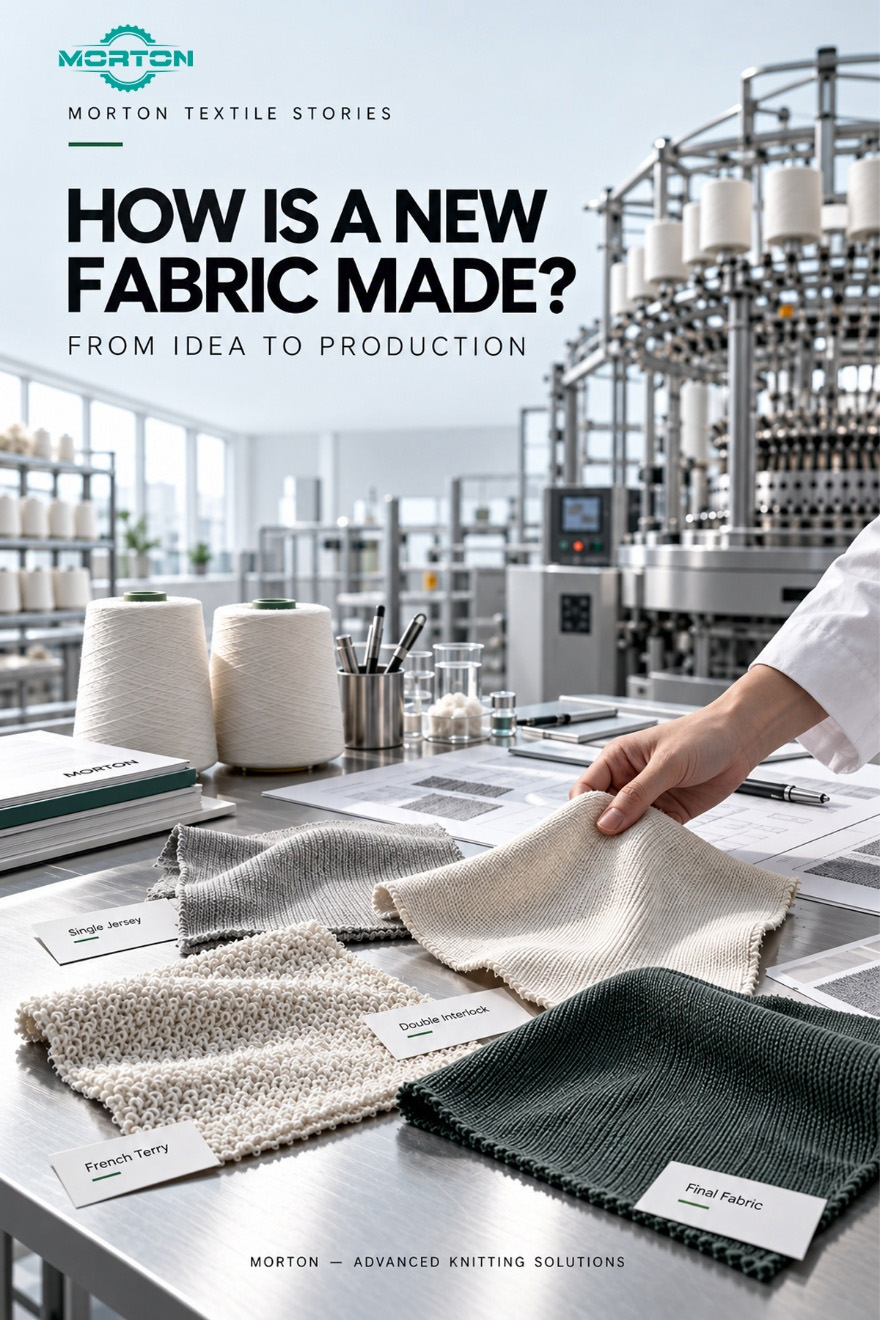
Many mills already have a library of established constructions. A customer may be able to reach the desired result by modifying an existing Single Jersey, Interlock or French Terry fabric rather than starting from nothing.
Choosing the Yarn Is Only the Beginning
Material & Structure
Two cotton yarns can behave differently. Yarn count, spinning method, and twist all influence the knitting process. A Single Jersey fabric might be for a lightweight T-shirt, but Interlock or Piqué provide different stability and texture.
Technical Specifications
Target GSM, fabric width, and stitch length need to make sense together. Reaching weight is useless if the width is unsuitable for cutting or the garment shrinks excessively.
Commercial Reality
A technically possible fabric is not necessarily a commercially useful one. Developers must balance specialty yarns with realistic costs for the clothing brand.
The First Sample Is Usually a Question
Once the factory has a direction, it can begin sampling. The first fabric often answers a few questions while creating several new ones. Perhaps the surface looks exactly as expected, but the fabric is too heavy. This is where experienced technicians become valuable, knowing which variables to investigate.
Dyeing and Finishing
The fabric has not yet become the material that will appear in a clothing store. It may go through preparation, dyeing, washing, drying, heat setting, compacting, or brushing. A sweatshirt fabric’s loops must be suitable for brushing to achieve the final fleece interior.
Surviving Real Life
Testing requirements include dimensional stability, colorfastness, pilling, and abrasion resistance. A fabric can drape beautifully as a sample and behave awkwardly once it is cut and sewn.
The Real Test: Repeatability
Bulk production needs to maintain the agreed result over long runs. If a fabric can only be produced under perfect circumstances, it is not ready for commercial production.
When a customer approaches MORTON with a new fabric idea, the most useful information is often the fabric sample itself. We think of the machine as one part of the larger fabric development process. Its responsibility is to provide the knitting conditions needed to produce the intended structure consistently.
A new fabric is rarely the result of one brilliant idea. More often, it is what remains after the people developing it have worked through all the versions that weren’t quite right.
Post time: Oct-28-2026