
I have T-shirts that looked old after six months, and others that somehow survived for years.
Most people are probably the same. There is always one shirt that has been washed countless times but still feels fine, and another that starts looking tired surprisingly quickly. The collar spreads, the body twists a little, or the fabric becomes so thin that you can almost see through it under bright light.
So when should you actually replace a T-shirt?
I would not use a calendar.
There is no useful rule that says a T-shirt should be thrown away after one year or two years. Someone wearing the same shirt three times a week is giving it a very different life from someone who wears it once a month. Washing habits, fabric weight, yarn, garment construction and even the way you move during the day all make a difference.
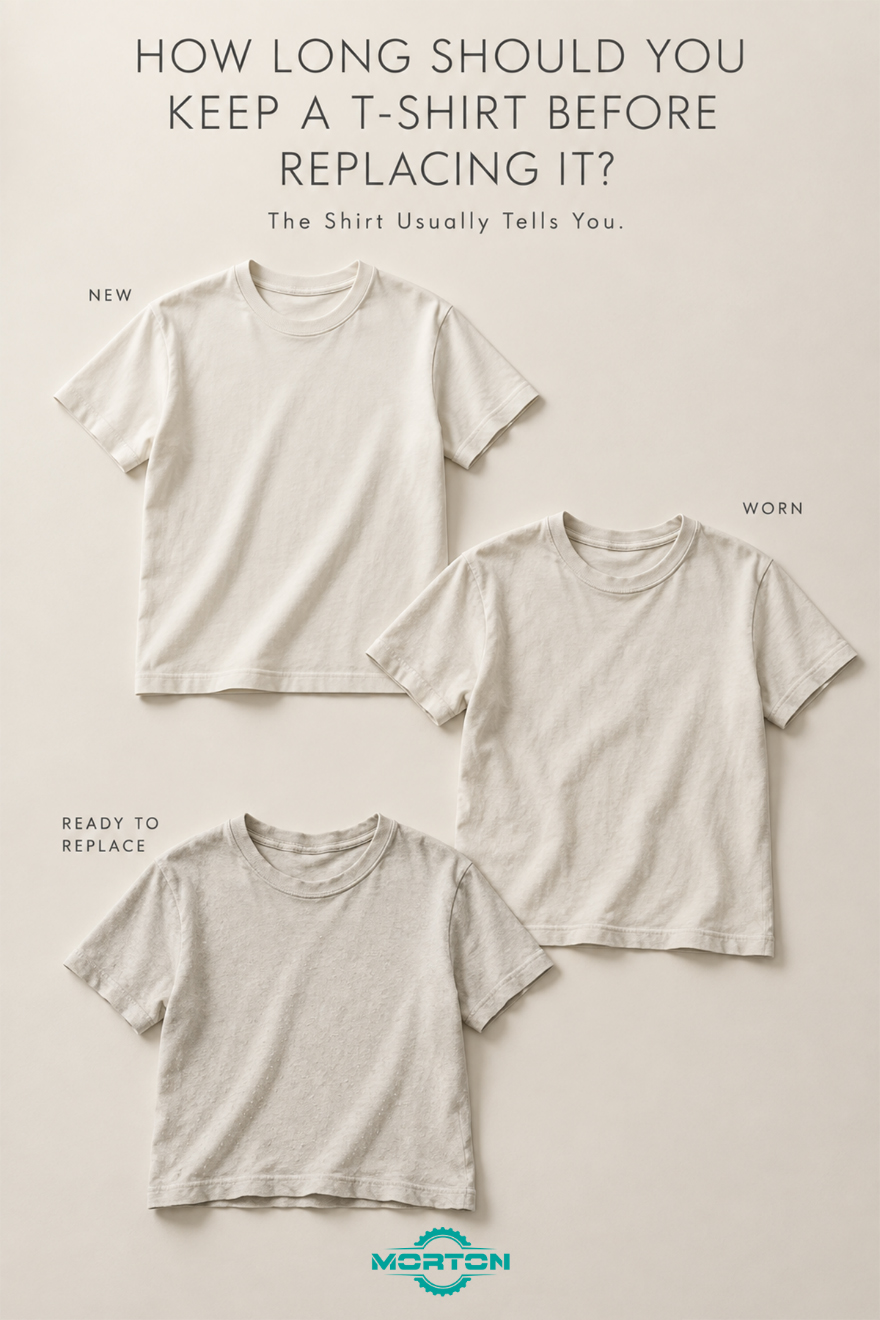
The shirt itself usually gives better clues than its age.
The collar is often the first place I notice.
A new Rib collar should stretch when you pull the shirt over your head and then recover reasonably well. After enough wear and washing, some collars stop doing that. They start sitting wider, develop waves or lose that clean shape around the neck.
This does not mean the shirt is suddenly unusable. Plenty of people keep wearing a comfortable old tee with a slightly tired collar at home.
But if you are wondering why an otherwise decent-looking shirt suddenly feels old, the neckline is often the reason. It has a difficult job. Every time you put the shirt on, that small piece of Rib has to stretch much farther than most of the body fabric. Then it has to come back. Multiply that by a few hundred wears and washes and you begin to see why collar quality matters.
The body of the shirt ages differently.
One thing worth doing with an old T-shirt is holding it up toward a window. You may notice that the fabric is no longer equally dense everywhere. Areas around the waist, under the arms or across the shoulders can become thinner because they experience more rubbing.
This usually happens so slowly that you do not notice it while wearing the garment. The T-shirt did not suddenly become thin last week. Fibers have been rubbing, bending and going through wash cycles for months or years. Eventually there is simply less material left in the areas that have done the most work.
Lightweight Single Jersey shows this quite clearly.
That does not make lightweight Single Jersey bad. A summer tee is supposed to feel light. It just means a 140 GSM shirt and a heavy 220 GSM shirt should not automatically be expected to age in exactly the same way if you treat them identically.
Weight is not the whole story either. A heavy fabric can still be poorly made, and a lighter fabric can last a long time if the yarn and construction are good and the shirt is treated reasonably.
This is why price alone does not tell you much about lifespan.
I have seen inexpensive basic tees stay in good shape for years, while some expensive fashion shirts lost their shape quickly. Branding can change the price much more than it changes the physics of knitted fabric.
Holes and Structural Integrity
If you find one tiny hole, I would not throw the shirt away immediately. It may have caught on something, rubbed against a belt buckle or been damaged locally. If the surrounding fabric still feels strong, a small repair can make perfect sense.
Repeated holes are different.
When you fix one and another appears nearby a few weeks later, the fabric may simply be getting weak. At that point you are not really repairing an isolated accident anymore. You are repairing one symptom of a fabric that has already lost strength across a larger area.
You can usually feel the difference with your fingers. Old fabric often becomes softer in a way that people initially like. A favorite T-shirt can become much more comfortable after dozens of washes. Eventually, though, there is a point where “soft” turns into “thin and tired.”
Pilling is less clear.
Some people stop wearing a shirt as soon as pills appear because it makes the garment look cheap or old. But pilling does not necessarily mean the structure underneath has failed. It is mostly a surface issue caused by fibers working their way out of the yarn and becoming tangled through friction.
If the shirt still holds its shape and the fabric underneath remains strong, pilling alone is not a very convincing reason to throw it away. You can often remove pills and keep wearing the garment.
Odor and Maintenance
Smell is another part of this that people do not talk about as much. Some older shirts start holding odor even after washing. Sportswear can be especially noticeable because sweat, body oils and residues interact differently with different fibers. Polyester and cotton do not behave exactly the same way here, and washing habits matter a lot.
Before deciding a shirt is finished, I would first try changing the way it is washed. Sometimes detergent buildup or poor drying is the real issue. But there comes a point where you put on a freshly washed shirt and almost immediately feel that it no longer feels clean.
If you do not enjoy wearing it anymore, there is not much value in keeping it just to reach an imaginary lifespan.
Washing itself has a large influence on how quickly a T-shirt ages.
Two identical shirts can look very different after a year if one is regularly exposed to high heat and aggressive tumble drying while the other is treated more gently. The same happens when one shirt is worn and washed constantly and the other rotates through a larger wardrobe. Clothing does not only wear while it is on your body. Every laundry cycle is part of its life too.
The Textile Perspective
This is something textile people think about because knitted fabric keeps changing after it leaves the knitting machine. It goes through dyeing and finishing, then cutting and sewing, perhaps a garment wash, and eventually years of consumer washing. The fabric coming off a Circular Knitting Machine is only the beginning.
By the time you decide whether to keep an old T-shirt, that fabric has been through far more than anything we can reproduce by looking at it for a few minutes in a factory.
The Final Decision Checklist:
- ✓ Does the collar still look acceptable?
- ✓ Does the body still have enough weight and coverage?
- ✓ Are the holes isolated accidents or are they becoming a pattern?
- ✓ Does the fabric still return after being stretched?
- ✓ Does it smell clean after washing?
- ✓ Do you still reach for it when you open the wardrobe?
If a T-shirt is technically wearable but has spent a year at the bottom of the drawer because you never want to put it on, its useful life as a T-shirt is probably already over. It does not necessarily have to go straight into the trash. Old cotton tees are good workshop clothes, cleaning cloths or material for other uses. Some places also have textile recycling systems.
Replacing a T-shirt and wasting a T-shirt are not exactly the same thing.
From our side of the textile industry, what interests us is why some garments reach this stage much sooner than others. The answer usually does not come down to one factor. Yarn quality matters. Fabric structure matters. GSM matters. Knitting consistency matters. The collar construction matters. Finishing matters. Then everything that happens after the shirt is purchased matters too.
At MORTON, our part of that story is near the beginning. A Circular Knitting Machine has to form the fabric consistently enough that the mill starts with a stable product. After that, the fabric still has a long journey through finishing, garment production, shops, wardrobes and washing machines.
Years later, somebody may hold that same T-shirt up to the light and decide it has finally had enough. There is no exact number of months for that moment.
If it still feels good, still holds together and you still like wearing it, keep it. The shirt will usually tell you when it is time.
MORTON — Advanced Knitting Solutions
Post time: Oct-12-2026