
Most people know the shirt.
They know the logo on the chest. They know the feeling of wearing something lightweight during a workout. They know it dries faster than the cotton T-shirt they used to wear.
But very few people think about where that fabric actually comes from.
Before a performance shirt reaches a sports store, before a designer cuts the first piece of fabric, there is a knitting machine running somewhere, producing the material that makes all of this possible.
And that story started with a problem.
A Wet Cotton T-Shirt Was the Problem
In 1996, Kevin Plank was a football player at the University of Maryland.
Like many athletes at that time, he trained in cotton T-shirts.
Cotton was comfortable when it was dry.
The problem came later.
During a hard training session, the shirt absorbed sweat, became heavier, and stayed wet against the body.
For athletes who spent hours practicing, that small problem became a daily frustration.
Plank started looking for a better solution.
He wasn’t trying to create a fashion brand.
He was trying to make one piece of clothing that worked better.
The first prototypes were simple — different synthetic fabrics, different constructions, different tests.
He gave them to teammates and asked for honest feedback.
The response was clear.
People noticed the difference.
The Fabric Was Simple. The Details Were Not.
The idea behind the original performance shirt was not complicated.
A polyester and spandex blend.
One fiber helped manage moisture and maintain durability.
The other provided stretch and recovery.
On paper, it sounds easy.
But anyone who works in textile production knows that choosing the yarn is only the beginning.
The same polyester-spandex yarn can create completely different fabrics depending on how it is knitted.
The machine setup decides many important details:
How tight the fabric feels
How much it stretches
How quickly it recovers
How smooth the surface becomes
How comfortable it feels against the skin
That is where the knitting machine becomes important.
Where the Circular Machine Makes the Difference
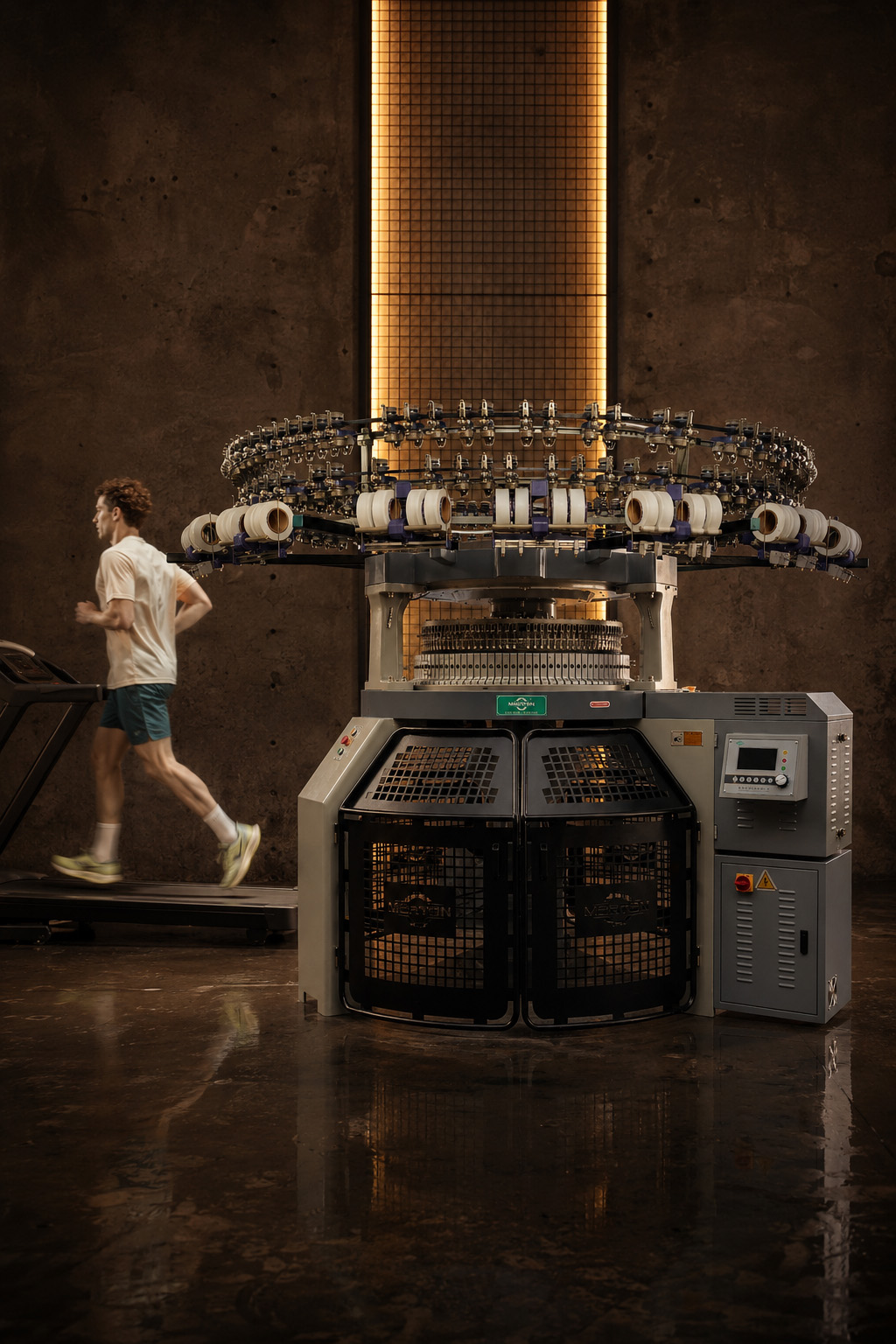
Performance fabrics like these are commonly produced on a Circular Machine.
Compared with ordinary jersey fabrics, polyester-spandex blends require much more control during production.
Spandex is elastic and sensitive.
If yarn feeding is not stable, the fabric can lose consistency. One area may feel tighter, while another area may have different stretch.
For manufacturers producing sportswear, consistency is everything.
A shirt might look perfect in one sample.
But producing thousands of meters of fabric with the same performance requires a machine that can maintain stable conditions hour after hour.
That is the real challenge.
The Work Happens Before the Shirt Is Made
When a textile mill develops a new performance fabric, the process usually starts with testing.
The yarn combination is selected.
The machine parameters are adjusted.
The first fabric sample is produced.
Then technicians check the fabric weight, appearance, stretch, and recovery.
Sometimes the first sample is not exactly what they want.
Maybe the fabric needs more body.
Maybe the stretch recovery needs improvement.
Maybe the surface needs to feel smoother.
So adjustments are made, and another sample is produced.
This cycle continues until the fabric performs the way the customer expects.
The Logo Gets Attention. The Machine Does Not.
Brands like Under Armour became successful because they understood what athletes needed.
But behind every successful performance garment is a much longer story.
A story about fibers.
A story about fabric construction.
A story about machines running accurately every day.
Consumers feel the result when they put on the shirt.
They feel the comfort.
They feel the stretch.
They feel the difference.
But they rarely see the equipment that created it.
At MORTON, we build Circular Machines for textile manufacturers producing modern knitted fabrics, including polyester, spandex blends, and performance apparel materials.
Because every great fabric has a starting point.
And long before it becomes a shirt, it begins on a knitting machine.
MORTON — Advanced Knitting Solutions
Post time: Jul-14-2026