
A waffle thermal top and a houndstooth jacket might sit in the same wardrobe without seeming to have much in common. One looks relaxed and tactile. The other brings to mind tailoring, wool coats and carefully matched seams.
Put their fabrics under a magnifying glass, though, and they raise an interesting question: how much does a familiar pattern actually tell us about the way a fabric is made?
The Waffle Texture
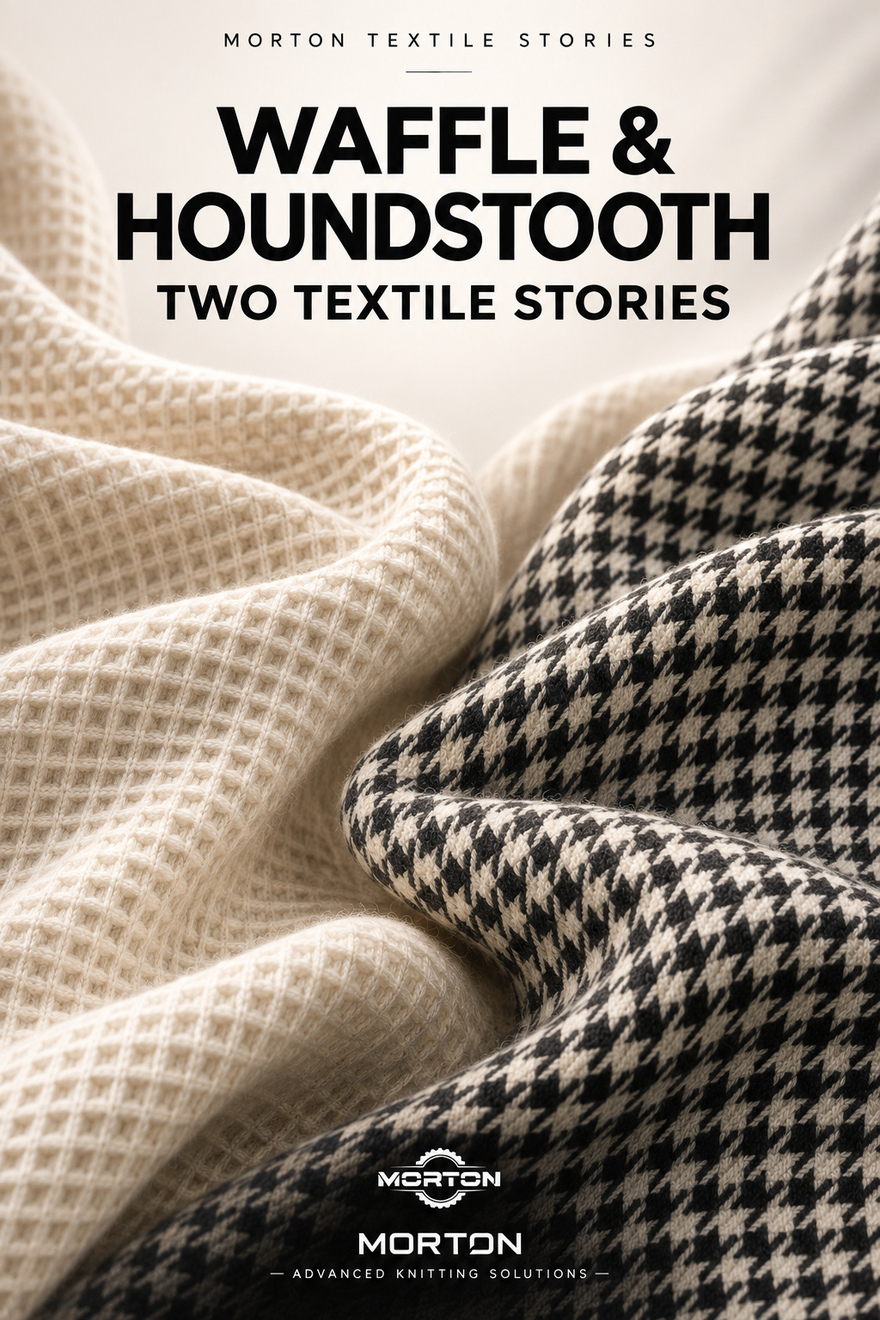
With waffle, your fingers can find the answer before your eyes do. Raised borders surround shallow recesses, giving the surface its recognisable grid. Turn the fabric towards the light and shadows collect inside the squares.
The name comes easily from its resemblance to the food. In textile production, however, “waffle” leaves several possibilities open. A woven waffle and a knitted waffle can have a similar surface while being constructed quite differently.
In a knitted version, the relief can be developed through an arrangement of knit and tuck stitches. A needle performing a tuck retains its existing loop while receiving another yarn, then knits them off in a later action. Repeating these actions in selected positions changes the shape and relationship of neighbouring loops.
The arrangement matters. Research on circular-knitted tuck structures has found that the number and position of tuck stitches affect properties including thickness, width and porosity. The texture is part of the fabric’s construction, with consequences beyond its appearance.
That helps explain why two waffle knits can feel so different. One may be compact and springy; another may be soft enough to fold into a small bundle. CottonWorks documents waffle thermal fabrics in different weights and stretch versions, showing how much variation can sit beneath one familiar name.
Houndstooth Evolution
Houndstooth has a different starting point.
Its recognisable feature is the broken outline of the check. The shapes have pointed extensions that seem to reach into the surrounding colour. In traditional woven houndstooth, alternating groups of light and dark yarns work with a 2/2 twill to produce those jagged edges. Modern houndstooth is associated with Scottish Lowland tweeds and nineteenth-century clothing.
By the middle of the twentieth century, it could be found in very different wardrobes. The John F. Kennedy Presidential Library and Museum holds a Dior houndstooth silk tie worn by Kennedy. Ohio State University’s collection preserves a Dior ensemble from autumn-winter 1959: a wool skirt suit with a matching overcoat and scarf. The same pattern could be a small detail at the neck or cover almost an entire outfit.
The outline also travels well between manufacturing methods. A houndstooth design can be recreated in knitwear, where the knitter translates its pointed corners into stitches and courses. CottonWorks includes knitted houndstooth examples in its development collection.
For a circular jacquard knitting machine, that translation involves needle selection and the sequence of coloured yarn feeds. Pattern scale becomes a practical decision: a small tooth has fewer stitches available to describe its corners.
Technical Comparison
Waffle asks the knitter to control surface relief. Houndstooth asks for a recognisable outline, although a knitted version can have its own texture as well. Both need to be judged in the finished fabric.
Lay the samples flat, then stretch them gently. Watch the waffle recesses open and the houndstooth points widen. On a garment, that movement happens at elbows, shoulders and across the body. A successful design has to survive being worn.
MORTON — ADVANCED KNITTING SOLUTIONS
Post time: Nov-06-2026