
Buying a comfortable T-shirt sounds easy until you actually start comparing them.
You can pick up two shirts that both say “100% cotton” on the label and get completely different results. One feels soft the moment you touch it but becomes hot after an hour. Another feels slightly firmer in the shop but turns out to be the shirt you keep reaching for every week. Then there are sports T-shirts made from polyester that feel cooler during exercise than some thin cotton ones.
A comfortable T-shirt is usually the result of several decisions lining up properly. The yarn matters. So does the fabric structure, weight, density, finishing and the way the garment is meant to be worn. That is why asking “Which material is the most comfortable?” is a little like asking which shoes are the most comfortable without saying whether you are going running or walking around an office.
The Cotton Reality
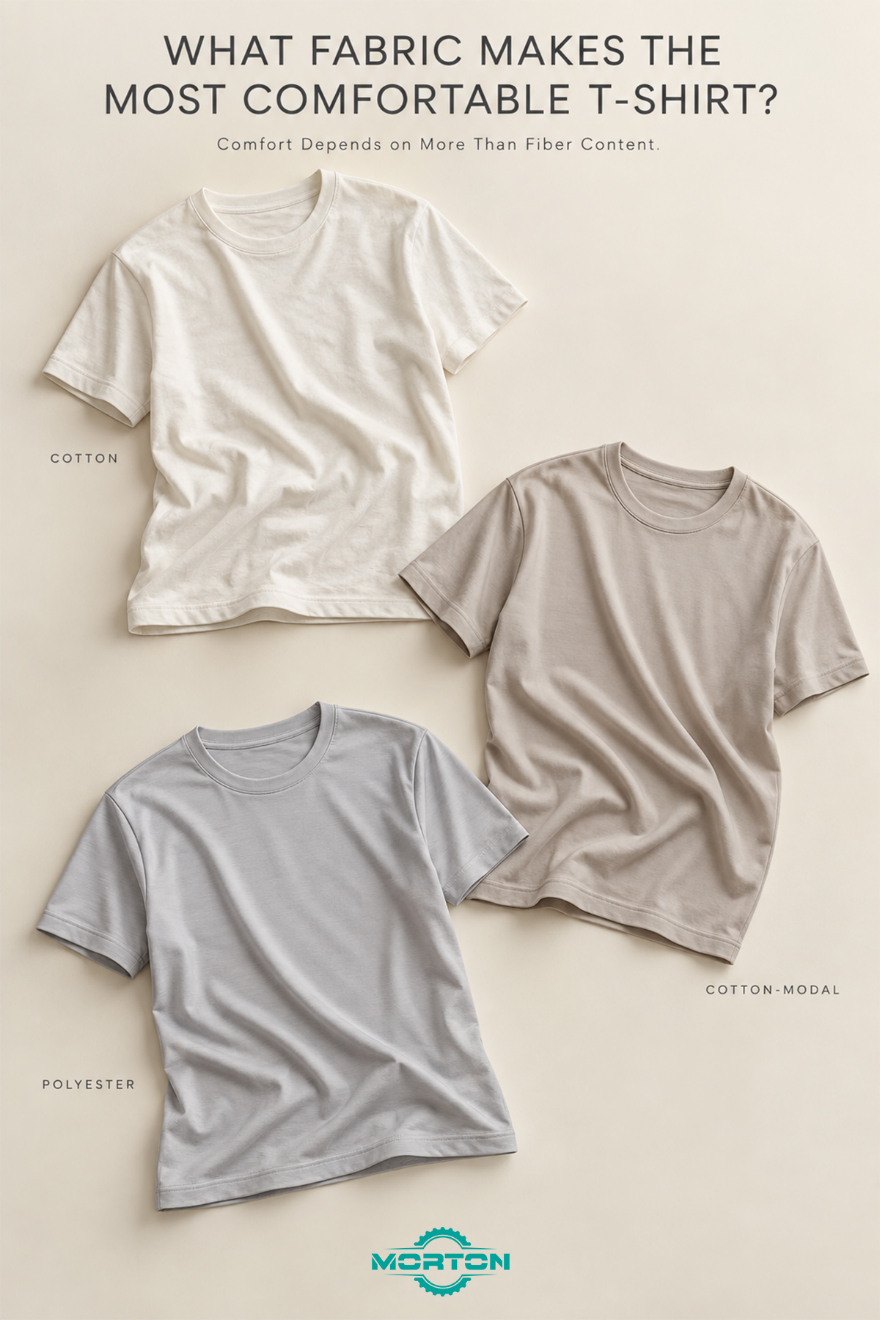
For an ordinary everyday T-shirt, cotton is still a very sensible place to start. It feels familiar against the skin, absorbs moisture and generally works well for casual clothing.
But “cotton” covers a huge range of fabrics. A light Single Jersey made with fine yarn does not feel much like a heavy 220 GSM cotton tee, even though both labels may say exactly the same thing.
I have seen people compare two T-shirts and assume the softer one must use better cotton. Sometimes it does. Sometimes the difference comes from finishing, yarn count or how the fabric was knitted. A slightly longer loop length, a different density or a different finishing process can change the hand feel more than people expect.
This is also why buying by composition alone can be disappointing. If the product page only says “100% cotton,” you still do not know whether the shirt is light or heavy, firm or fluid, compact or loose.
For summer wear, many people prefer something lighter because it does not sit as heavily on the body. But very light is not always better either. Some lightweight fabrics feel almost transparent, cling to the skin or lose their shape faster after repeated washing. A little more weight can make a T-shirt hang better without making it feel heavy.
If you live somewhere hot and humid, a thick heavyweight tee that looks great in photos may feel unpleasant after half an hour outside. In a cooler environment, that same weight may feel substantial and comfortable.
Modal & Blends
A cotton-modal T-shirt usually has a smoother, softer hand and more fluid drape. If your idea of comfort is something soft against the skin, Modal can be very appealing. However, a very fluid fabric may hang differently around the shoulders and waist.
Performance Polyester
Polyester gets blamed for feeling hot, but a well-designed synthetic sports fabric can move moisture and dry much faster than cotton. During a long workout, your opinion on polyester can change very quickly.
The fabric construction is doing a lot of the work here. At a knitting mill, people are talking about yarn count, gauge, stitch length, GSM, machine diameter, finished width and fabric structure. These details are there because they change the cloth.
Most everyday T-shirts use Single Jersey. A tighter fabric feels stable; a looser construction feels relaxed. Add Spandex for recovery and fit.
How to Choose
- ✓
Everyday: Medium weight cotton Single Jersey. - ✓
Extra Soft: Cotton blended with Modal. - ✓
Exercise/Travel: Moisture-managing Polyester. - ✓
Fitted Look: Cotton with a small amount of Spandex.
Then ignore the label for a moment and use your hands.
Hold the fabric up. Does it feel too thin? Stretch it gently and see how it comes back. Look at the surface under decent light. Rub it between your fingers. Does it feel pleasant because it is genuinely smooth, or because it has been given a temporary finishing treatment?
There is another small detail I like to look at: whether the shirt disappears from your attention once you put it on. Some clothing sticks, pulls, or traps heat. A good T-shirt does the opposite. After a while, you stop thinking about the fabric.
At MORTON, customers sometimes come to us asking which machine can make a certain T-shirt fabric. Before talking about the machine, we usually want to know what that fabric is supposed to feel like and how it will be used. The machine only makes sense once the fabric target is clear.
Do not buy a shirt just because the label says cotton, Modal or polyester. Buy the one whose fabric suits the way you actually live in it.
Post time: Oct-13-2026