
Take a T-shirt out of your wardrobe and turn it inside out. Look along the sides, from the bottom of the sleeve down to the hem. On many T-shirts, you will find a seam joining the front and back panels together. But if you check a few more shirts, especially basic cotton tees, you may eventually find one where that seam simply isn’t there.
The first time you notice it, it feels slightly strange. A T-shirt obviously has a front and a back, so somewhere along the way those two sides must have been joined together. Except, in this case, they weren’t.
The explanation begins long before the T-shirt reaches a sewing factory. It begins with the way the fabric itself is knitted.
Some T-Shirt Fabric Is Made as a Tube
Most people picture fabric coming off a machine as a wide, flat sheet. That is true for many textile processes, but it is not the only way knitted fabric can be produced.
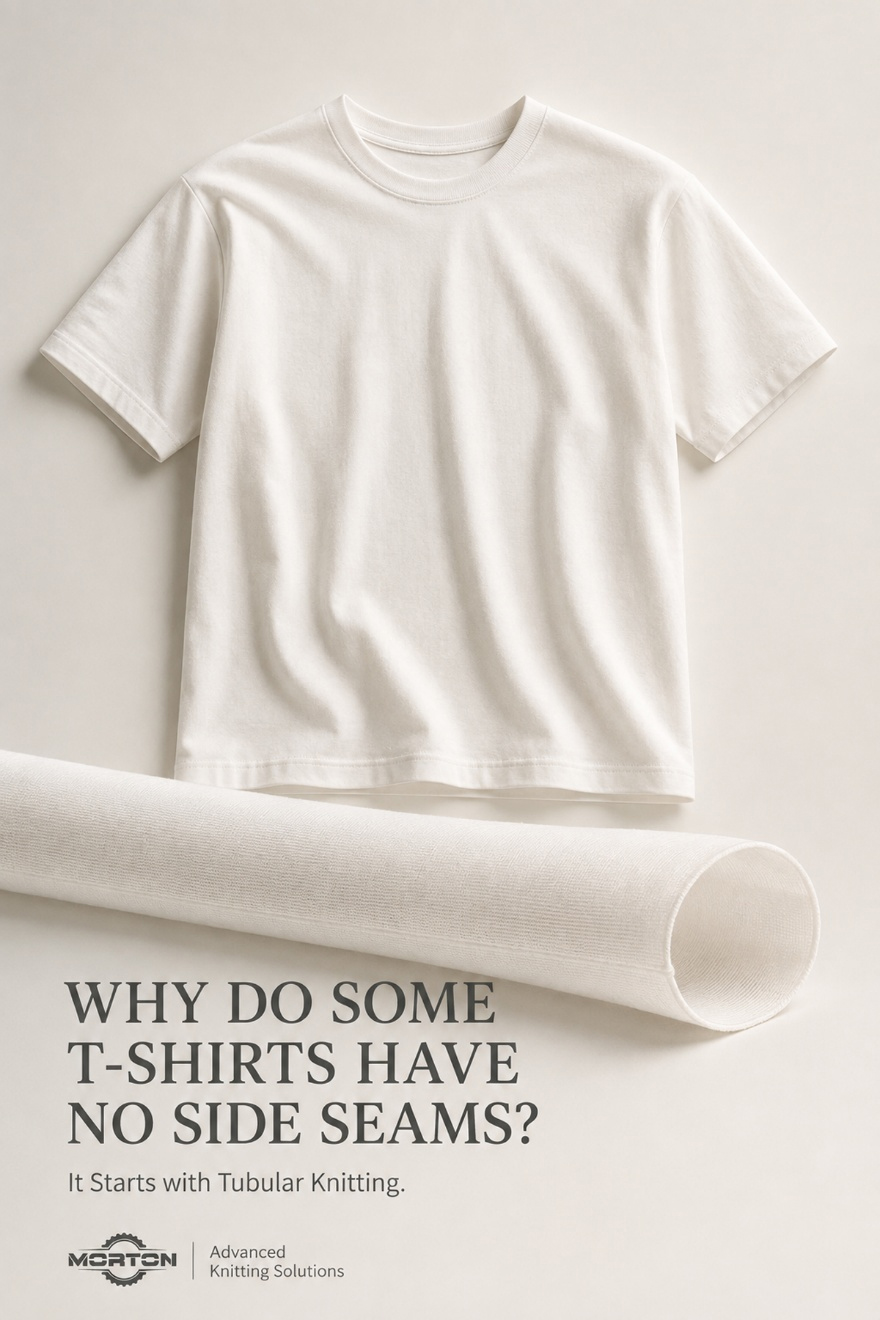
A circular knitting machine arranges its needles around a cylinder. As the machine operates, yarn is continuously formed into interconnected loops around that circular needle bed. Instead of producing two separate pieces for the front and back of a shirt, the machine can produce a continuous tube of knitted fabric.
If you have ever seen grey fabric coming directly from a Circular Knitting Machine, you will recognize the shape immediately. Before it is opened, processed and turned into a garment, it can look more like an enormous fabric sleeve than the flat rolls of cloth most people imagine when they think about textile manufacturing.
For certain T-shirts, that tubular form is kept through the garment-making process. The body can be cut from the tube at the required length, with openings created for the neck and arms. Sleeves, collar and other parts still need to be attached, but the two long seams normally required to join the sides of the body are no longer necessary.
That is how a T-shirt can have a front and a back without having two pieces of fabric sewn together at the sides. The body was already connected before anyone started sewing it.
Why Don’t All T-Shirts Use Tubular Fabric?
Once people discover seamless-sided T-shirts, a natural question follows: if we can make them this way, why bother with side seams at all?
The answer has more to do with garment manufacturing than with one method being universally better.
Tubular fabric works particularly well when the required garment dimensions match the available tube circumference. Basic T-shirts are an obvious example. If the knitting diameter and the finished fabric dimensions are suitable for the garment size, manufacturers can take advantage of the tube and reduce the amount of side sewing required.
The difficulty appears when a clothing brand wants more control over the shape of the garment. Modern T-shirts are not always simple rectangles. Some are narrow at the waist, wider through the chest, oversized through the shoulders or deliberately shaped to create a particular silhouette. Once the front and back need to be cut into specific contours, working with separate panels can make more sense.
Sizing creates another practical consideration. A knitting mill can produce tubular fabric in different diameters, but one tube size cannot efficiently become every T-shirt size. Garment factories producing a broad range of XS, S, M, L and XL products need to consider how the available fabric widths fit their cutting plan.
There is no rule that says a T-shirt without side seams is automatically better than one with them. They are simply two different ways of turning knitted fabric into a garment, and each makes sense under different production conditions.
The Interesting Part Happens Before Sewing
Side seams seem like a sewing detail, but they reveal something important about textile manufacturing: many characteristics of a finished garment are decided much earlier than consumers realize.
By the time someone in a sewing factory joins the shoulder, attaches the sleeve or finishes the collar, the fabric already has a structure, width, weight and mechanical behaviour. Those characteristics began with the yarn, the knitting structure and the machine on which the fabric was produced.
Single Jersey is one of the most familiar examples. It is widely used for T-shirts because it can produce a relatively light and comfortable knitted fabric with the stretch people expect from everyday clothing. On a circular knitting machine, Single Jersey can be produced continuously in tubular form, which is one reason the construction of a seemingly simple T-shirt can be closely connected to the diameter and setup of the knitting machine used much earlier in production.
This relationship is easy to miss when looking at the finished garment. In a shop, we see a black T-shirt or a white T-shirt. In a knitting mill, the conversation is much more likely to involve yarn, gauge, machine diameter, fabric structure, GSM and finished width.
The T-shirt is the same object. We are simply looking at it from two different stages of its life.
A Missing Seam Doesn’t Mean the Shirt Is Completely Seamless
There is one small distinction worth making here because the terminology can be confusing.
A T-shirt made from tubular fabric may have no side seams, but that does not necessarily make it a completely seamless garment.
Look more closely and you will usually still find stitching around the sleeves, shoulders and neckline. The collar may be made separately from Rib fabric and then sewn onto the body. Labels, hems and other details also require additional garment construction.
True seamless garment manufacturing is a different subject and can involve different knitting technologies and production methods.
So when someone describes a conventional T-shirt as “seamless” simply because there are no seams running down its sides, the more accurate observation is that its body was made from tubular knitted fabric.
It is a small difference in wording, but in manufacturing it is quite a big difference.
The Tube Has to Be the Right Tube
Producing tubular fabric does not mean that any tube coming off any circular machine can become any T-shirt.
Suppose a customer brings us a finished T-shirt and asks what machine should be used to produce the fabric. Looking only at the fiber composition is not enough. Knowing that the shirt is “100% cotton” tells us something about the yarn, but very little about the complete production requirement.
We would also want to understand the fabric structure, GSM, yarn count, gauge, required finished width and how the garment factory intends to cut and sew the material. If the customer wants to keep the fabric tubular for a particular garment size, machine diameter becomes especially relevant because the circumference of the knitted tube has to work with the intended finished dimensions.
Finishing complicates the picture further. Grey fabric does not necessarily leave dyeing and finishing with exactly the same dimensions it had when it came off the knitting machine. Relaxation, dyeing, washing, compacting and other finishing processes can change the width and length of knitted fabric. A mill therefore has to think about the final target, not simply the dimensions visible at the knitting stage.
This is one of those areas where a specification sheet can look deceptively simple. “Cotton Single Jersey T-shirt fabric” may sound like enough information to someone outside the industry. For the people actually producing it, several decisions are still hiding inside that sentence.
Next Time You Buy a T-Shirt, Check the Sides
One of the enjoyable things about working in textiles is that after a while ordinary clothes stop looking quite so ordinary.
A polo shirt makes you notice piqué. A sweatshirt makes you think about the loops or brushed surface hidden on the inside. A T-shirt collar makes you wonder why Rib behaves differently from the fabric used for the body. Even a missing side seam tells you something about how a knitting mill and garment factory decided to make that particular product.
Most people will never see the circular knitting machine that produced the fabric in their wardrobe, and there is no reason they should need to. But traces of the manufacturing process remain in the clothes themselves.
At MORTON, this is also why we prefer to understand the fabric a customer wants to produce before talking too much about the machine. Machine diameter, gauge and configuration are not isolated specifications. They make sense only in relation to the yarn, fabric structure, finishing process and final product the customer is trying to make.
Sometimes that final product is something as ordinary as a T-shirt.
Turn it inside out, and the absence of two simple seams can tell you quite a lot about where it came from.
MORTON — Advanced Knitting Solutions
Post time: Sep-05-2026