
Cylinder diameter is one of those things you lock in the moment you buy the machine. Unlike gauge, which can be changed (expensive, but possible), or feeders, which can be retrofitted, the cylinder diameter is the machine frame. You don’t change it later. You live with the decision for the life of the equipment.
For circular knitting mills serving Turkey, Central Asia, and global textile markets, diameter touches everything — fabric width, cutting efficiency in garment making, output per machine, floor space utilization, and the range of products a factory can actually offer. Buy the wrong diameter, and you’re either leaving money on the floor or pushing fabric widths your customers don’t need.
Diameter and Fabric Width: The Basic Math
A Circular Machine knits a tube. The circumference of that tube equals the circumference of the cylinder. When you slit that tube open for open-width fabric, the unfolded width is roughly half the cylinder circumference, minus some allowance for relaxation and shrinkage.
Plug in a 30-inch machine: (π × 30 × 2.54 × 0.5) × (1 – 0.12) ≈ 105 cm finished open width. For a 34-inch machine, the same calculation gives you about 119 cm.
Those numbers assume standard single jersey in cotton. The relaxation factor shifts depending on fiber — cotton typically 10-15%, polyester 8-12%, viscose 12-18%. Fabric structure matters too. Don’t skip this adjustment or you’ll end up with widths that don’t match the cutting table.
If you’re producing in tubular form — like a lot of T-shirt body blanks — the finished tubular circumference in cm is roughly π × Diameter × 2.54 × (1 – Relaxation Factor). A 30-inch machine gives you a finished tubular circumference around 210-220 cm (flat width 105-110 cm), which covers body sizes up to about XL. For 2XL and above, you’re generally looking at a 34-inch machine or larger.
Standard Diameters and Where They Fit
| Diameter (inches) | Open Width (cm) | Total Needles (24G) | Typical Products |
|---|---|---|---|
| 26″ | 85-95 | 1,960 | Collar ribs, cuffs, kids’ wear |
| 28″ | 93-102 | 2,111 | Women’s tops, children’s wear, narrow fabrics |
| 30″ | 100-110 | 2,262 | Standard T-shirts, polos, knit tops, underwear |
| 32″ | 107-117 | 2,412 | Men’s T-shirts, lightweight outerwear |
| 34″ | 114-125 | 2,563 | Men’s XL+, sportswear, home textiles |
| 36″ | 121-132 | 2,714 | Plus-size garments, bedding, drapery |
| 38″ | 128-140 | 2,865 | Bed sheets, wide apparel, industrial fabrics |
| 40″ | 135-148 | 3,016 | Bed sheets, wide industrial textiles, upholstery |
Picking Diameter by Product Type
T-shirts and Underwear (30″ – 34″)
The 30-inch Circular Machine is the global workhorse for T-shirt fabric. It delivers an open width of 100-110 cm — about 50-55 cm flat when the tube is laid double — which lets you nest two body panels side by side with minimal waste. For a standard men’s L-size T-shirt, that’s about as efficient as it gets.
In the Turkish market, where European sizing standards apply, 30-inch machines serve the S through XL range well enough. Mills targeting XXL and above consistently move to 32-inch and 34-inch machines. At MORTON — Advanced Knitting Solutions, our 30-inch and 34-inch single jersey machines are the configurations Turkish mills ask for most often.
Sportswear and Casual Wear (30″ – 36″)
Sportswear patterns are more complex — multiple panels, sleeves, collars, cuffs — and they eat up more fabric width on the cutting table. A 34-inch machine producing 120-125 cm open-width fabric gives pattern makers the room they need. The usable width for multi-panel sportswear designs typically needs to hit 110-120 cm, and a 30-inch machine can’t always get there.
Watch out for spandex blends. Compression and performance fabrics with 5-12% elastane relax differently. That 34-inch machine running a cotton-spandex blend might only give you 110-115 cm finished width, compared to 120-125 cm in 100% cotton. Build that into your width planning or you’ll end up short on the cutting room table.
Home Textiles (34″ – 40″)
Bed sheets and mattress covers want the widest fabric you can produce. A single-width sheet for a standard single bed needs 140-160 cm minimum. You either seam two narrow panels together or you cut from a single wide fabric off a 38- or 40-inch machine.
For sheet manufacturers, 38-inch and 40-inch machines are the preferred configuration, delivering 128-148 cm open-width fabric. MORTON’s large-diameter series (36-40 inch) is engineered with reinforced frames specifically to handle the higher rotational inertia these diameters generate.
Narrow Specialty Fabrics (26″ – 28″)
Smaller diameters solve specific problems: collar and cuff ribs for garment accessories, narrow fabrics for children’s wear where small pattern pieces don’t need wide fabric, and specialty applications like medical bandages or cleaning cloths. Total needle counts are lower, daily output per machine is lower, but they serve niche segments that bigger machines can’t address economically.
How Diameter Hits Production Economics
Needle Count and Output
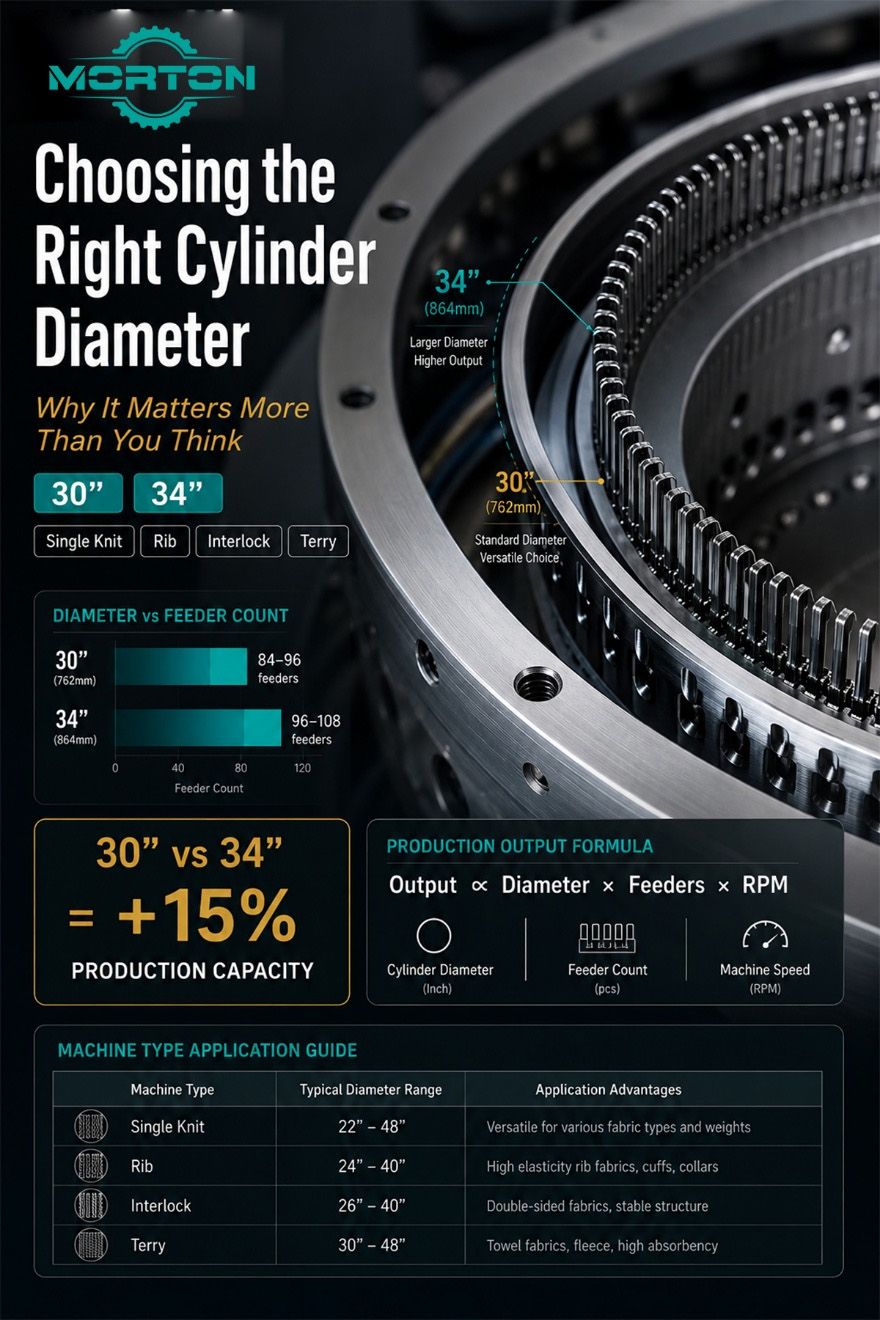
For a given gauge and RPM, output scales roughly with diameter. A 34-inch, 24-gauge machine carries about 13% more needles than a 30-inch, 24-gauge machine (2,563 vs. 2,262). Assuming identical RPM, that’s roughly 13% more fabric per revolution and per day.
But larger diameters usually run at lower RPM due to speed factor limits, so the net gain from 30-inch to 34-inch, after adjusting for typical RPM differences, is closer to 8-11%.
Post time: Jul-22-2026