
Walk into a busy apparel factory today and you’ll see knitting machines running at a pace that’s hard to wrap your head around. But that capability didn’t arrive overnight. For most of history, knitting was slow, quiet, and deeply personal. A single garment could take days. Every loop depended on nothing more than the skill and patience in a pair of hands.
The strange thing? After all those centuries of disruption, the core goal hasn’t really budged. We’re still doing the same basic thing: taking a strand of yarn and turning it into something comfortable, flexible, and tough enough for daily life.
How It Started: From Ancient Craft to the First Machines
The earliest knitted pieces we know of come from the Middle East, well over a thousand years ago. As the craft moved into medieval Europe, socks and caps weren’t everyday items — they were luxuries, precisely because they took so long to make, one stitch at a time.
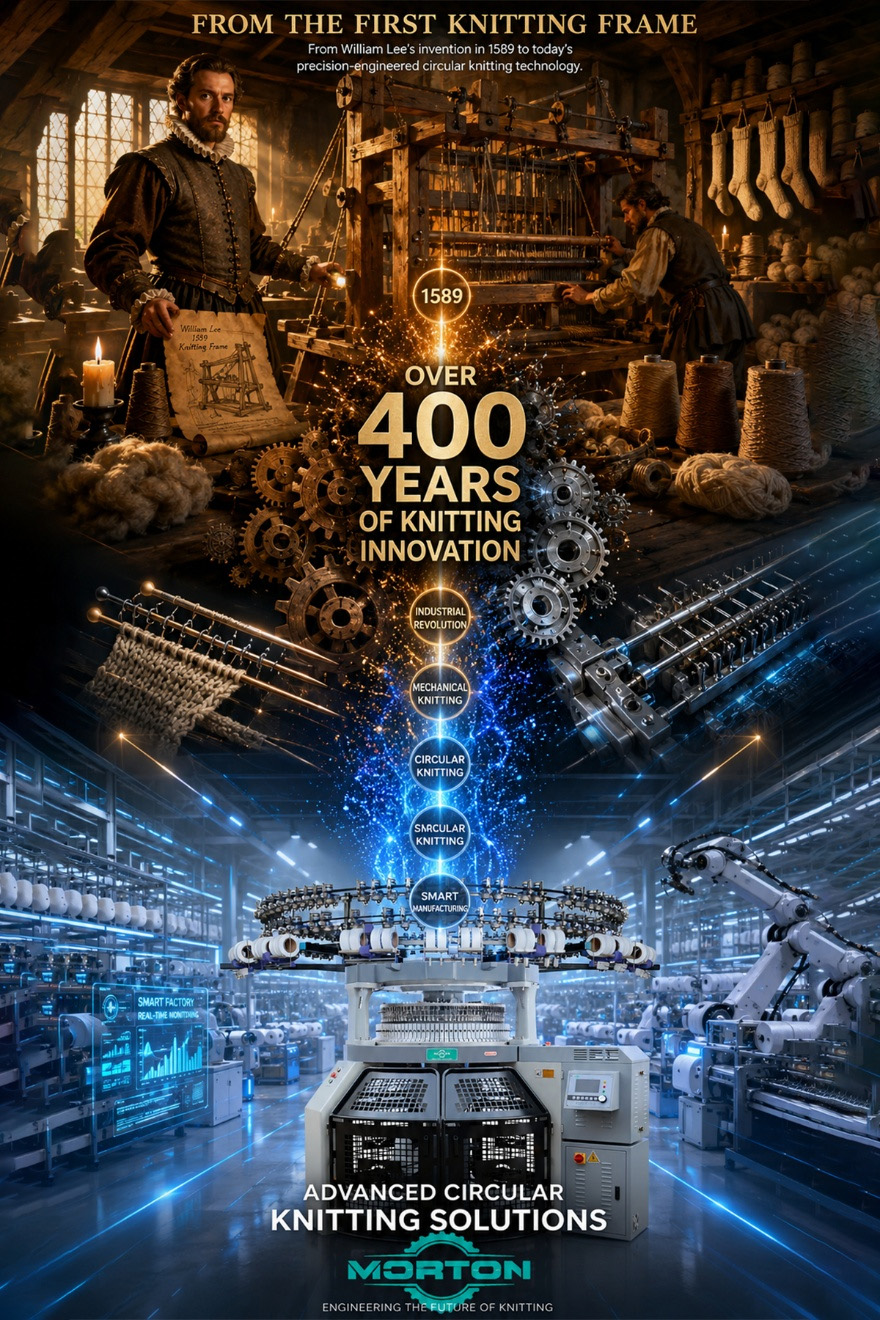
As populations grew and trade routes expanded, hand knitting simply hit a wall. It couldn’t keep up. The real turning point came in 1589, when an Englishman named William Lee built the first mechanical stocking frame. It was crude by today’s standards, but that machine broke the speed barrier for good. From that point on, consistency, output, and speed became the measures that mattered.
The Circular Machine: A Different Way of Thinking About Production
Flat-bed machines tried to copy the back-and-forth motion of a hand knitter. The circular machine took a completely different path. By arranging the needles in a rotating cylinder, it could knit fabric in a continuous tube — no stopping, no seams. That one idea rewrote the economics of knitwear manufacturing.
Over decades, these machines got faster, stiffer, and far more versatile. They moved from basic tube-knitters to systems that handle Single Jersey, Rib, Terry, Fleece, engineered Jacquards, and high-end double-knits without missing a beat. A modern interlock machine can churn out thousands of meters in a single shift, with a level of stitch-by-stitch uniformity that early engineers would have laughed off as impossible.
What Mills Actually Need Today
Raw speed alone doesn’t cut it anymore. Mills in different parts of the world face the same hard realities: they need machines that stay up, waste as little yarn as possible, and adapt quickly when yarn counts or market trends shift. The pain points are similar, but they show up in different ways:
Activewear in India pushes high-gauge limits with fine synthetic filaments. A dropped stitch means a rejected batch, so precision isn’t optional.
Fleece production in Bangladesh puts real stress on machine frames. Heavy yarn tensions at high speed will find any structural weakness.
Fashion in Turkey and underwear in Latin America live and die on rapid pattern changes and flawless elastane plating. There’s no room for sloppy yarn control.
The brief is no longer “make as much as you can.” It’s “deliver identical quality, batch after batch, in a market that won’t tolerate second best.”
Where MORTON Fits Into This Story
At MORTON — Advanced Knitting Solutions, we don’t see ourselves as just another machine builder. We’re part of that long engineering lineage, and we take it seriously. Our daily work is about sweating the mechanical details that separate a reliable mill from one that’s always fighting problems.
Where do those details live?
Spend a few hours in our shop and you’ll see someone hand-filing microscopic burrs off a needle bed. It’s tedious, but it stops yarn snags before they ever happen.
Before any machine ships, we obsess over yarn feeding angles and calibration — because tension fluctuations have a way of ruining a production run.
And the structural rigidity we build in? That’s what lets our machines run around the clock in demanding factory environments worldwide, without shaking themselves apart.
Technology has changed knitting beyond anything William Lee could have imagined. But at its core, the job is the same: take a single yarn, and make something useful out of it. We just keep finding ways to do it a little better than the generation before us.
MORTON — Advanced Knitting Solutions
Post time: Jun-01-2026