
Before We Recommend a Circular Machine or Interlock Machine, We Look at the Fabric
Most customers already have a machine model in mind when they contact us.
They'll ask about a specific Circular Machine, an Interlock Machine, a gauge, or a machine diameter.
But before we talk too much about machines, we usually ask the same question:
Usually, the first thing we receive is a photo.
A WhatsApp message arrives with a short note:
"Can you make fabric like this?"
Sometimes it's a video taken inside a fabric warehouse. Sometimes it's a picture of a finished garment. Sometimes it's just a small fabric swatch sitting on someone's desk.
That's how most conversations begin.
But photos only tell part of the story.
Sooner or later, we ask the same thing:
What Happens When the Sample Arrives
When the fabric arrives at our factory in Quanzhou, it goes directly to our technical team.
Nobody rushes to a machine.
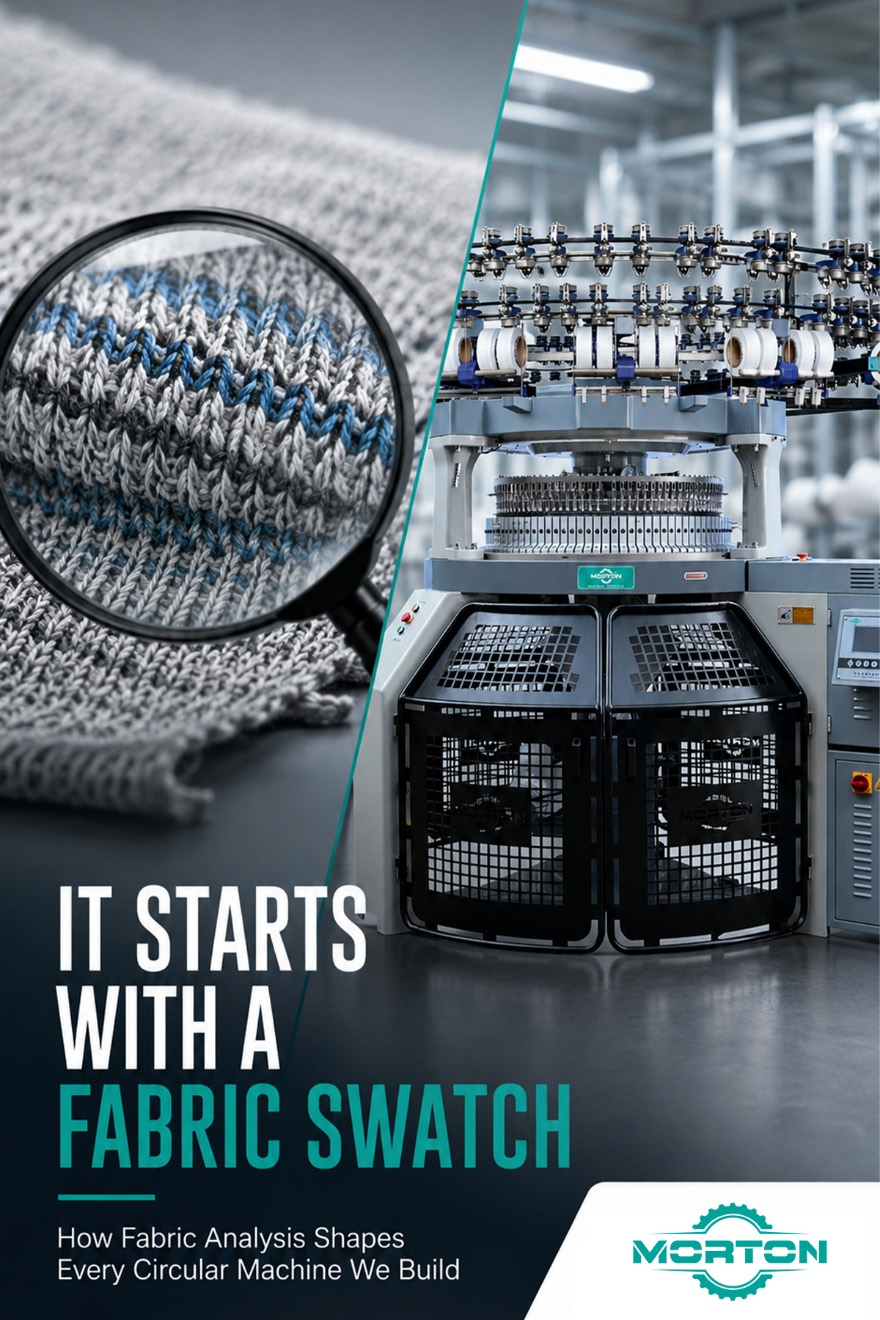
The first stop is always the inspection table.
Our technicians begin studying the fabric structure.
Every fabric leaves clues.
- The loop formation.
- The yarn arrangement.
- The density.
- The surface appearance.
Sometimes you'll see one of our technicians hold the fabric up against the light for a few seconds before saying anything.
Nobody is in a hurry.
They're looking for details that don't appear clearly in photos—loop shape, yarn coverage, surface consistency, and how the structure is actually built.
After years of doing this work, it becomes second nature.
A small piece of fabric can reveal a surprising amount of information.
- The machine gauge.
- The yarn count.
- The knitting structure.
- And whether a Circular Machine or an Interlock Machine will be the best solution for producing it.
Then We Build
Once the analysis is complete, the conversation moves from fabric to machinery.
We begin selecting the machine configuration.
Every decision is made with one objective:
To reproduce the fabric the customer originally sent us.
But assembling the machine is only part of the process.
The Part That Really Matters
When the machine is fully assembled, we don't immediately prepare it for shipment.
Instead, we knit.
We load yarn and begin producing fabric samples.
Then the customer's original fabric comes back onto the table.
Our technicians place the customer's sample next to the fabric produced by the machine.
Side by Side Comparison
- Same inspection lamp.
- Same magnifying glass.
- Side by side.
Sometimes the first result is close.
Often it isn't.
That's when the adjustments begin.
Another sample is knitted.
Then another.
And sometimes several more.
The process continues until the fabric coming off the machine closely matches the fabric the customer originally sent us.
Why We Take the Extra Time
Could we simply recommend a machine model and move on?
Of course.
Many suppliers do exactly that.
But over the years, we've learned something important.
Customers aren't really buying a Circular Machine or an Interlock Machine. What they're actually buying is a reliable way to produce a fabric they already know how to sell.
That's why we spend so much time studying a fabric sample that might fit in the palm of your hand.
Because long before the machine arrives at the customer's factory, we want to understand exactly what they're trying to create.
If we understand the fabric, we can build the machine around it.
And that's usually where successful projects begin.
Over the years, we've learned something simple.
Customers rarely remember the machine model number.
But they always remember whether the machine produced the fabric they wanted.
That's why every project at Morton starts the same way.
With a piece of fabric on a table.
And a group of people trying to understand it.
Post time: Jun-24-2026