
A circular knitting machine can be running normally and still produce fabric that does not look quite right.
There may be no broken needle, no machine alarm and no obvious mechanical failure. Production continues as usual, but when the operator looks carefully at the fabric, a faint horizontal line begins to appear. In another case, the surface may simply look less even than the approved sample. Sometimes the difference is so small in grey fabric that it is only noticed later, after dyeing or finishing.
When this happens, there are several places an experienced technician will investigate. One of them is the yarn feeding system.
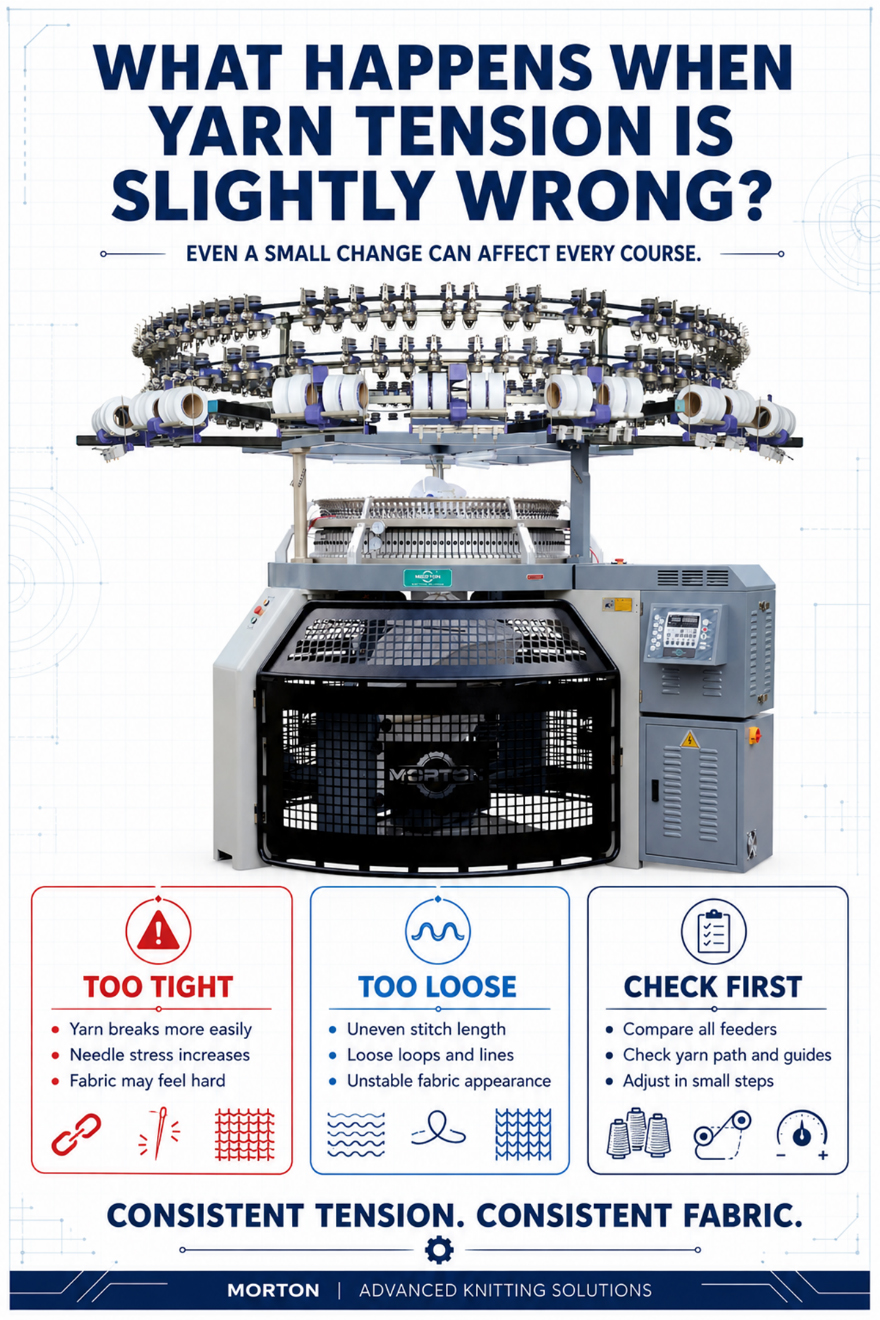
Yarn tension is easy to underestimate because the differences involved are often small. If the tension becomes extreme, the result is easier to understand: the yarn may break or the machine may stop. The more difficult problems are usually somewhere in between. The yarn is still feeding and the Circular Knitting Machine is still producing, but the conditions under which the loops are being formed are no longer as consistent as they should be.
That small change can eventually find its way into the fabric.
Yarn Has a Long Journey Before It Becomes Fabric
When we look at a roll of knitted fabric, it is easy to forget how much happens to the yarn before that fabric exists. Yarn starts from the package on the creel, travels through guides and tension-control components, passes through the feeding system and eventually reaches the knitting area, where needles form it into loops.
Throughout this journey, the objective is not simply to move yarn from one place to another. The machine needs to supply yarn to the knitting zone under suitable and reasonably consistent conditions.
This is why the positive yarn feeding system deserves attention during both machine adjustment and routine maintenance. If lint and fiber waste accumulate around a feeder, for example, the feeder may no longer rotate as freely as intended. The machine can continue operating, but the yarn delivery condition at that feed may begin to differ from the others.
For a knitting mill, this is an important distinction. A machine does not need to stop completely before something deserves attention. Stable fabric production depends on many parts continuing to work within the intended conditions.
What Does Yarn Tension Actually Change?
To understand why tension matters, it helps to look at what a Circular Knitting Machine is actually producing. The machine is not making a flat sheet of material directly. It is forming yarn into a continuous structure of interconnected loops.
The amount of yarn used in those loops, together with yarn characteristics and the knitting structure, influences the fabric that eventually comes off the machine. If yarn feeding conditions vary, loop formation can also vary. Depending on the fabric and the extent of the change, this may influence the appearance, density and weight of the knitted fabric.
This does not mean that every GSM problem or horizontal line can automatically be blamed on yarn tension. Textile troubleshooting rarely works that way. Similar-looking defects can have different causes, and a technician normally needs to inspect the complete production condition before making a judgment.
What yarn tension gives us is an important clue.
If one feed is behaving differently, or if yarn delivery changes during production, it makes sense to investigate what is happening before the yarn enters the knitting zone rather than immediately changing unrelated machine settings.
Why Horizontal Lines Often Lead Us Back to the Feeding System
Horizontal lines are among the fabric problems that knitting mills encounter during production. When they appear, the operator needs to determine whether the difference is related to yarn, feeding, machine settings, knitting components or another part of the process.
The positive yarn feeder is one of the areas worth checking.
This is also why we include feeder inspection in daily Circular Knitting Machine maintenance. During shift changes, operators should check whether lint has accumulated around the feeder and whether it rotates smoothly. If the feeder becomes obstructed by fiber waste, yarn delivery may become unstable and horizontal defects can appear on the fabric.
The important lesson is not simply “clean the feeder.” It is understanding why something that looks like routine housekeeping can eventually become a fabric-quality issue.
In textile manufacturing, mechanical condition and fabric quality are closely connected. A small change in the machine may first become visible not as an alarm on the control panel, but as a change in the cloth.
A Small Difference Repeated Thousands of Times Is No Longer Small
People sometimes ask how a slight tension difference can matter when the yarn itself appears perfectly normal.
The answer lies partly in repetition.
A knitting machine forms loops continuously. If the production condition is stable, that repetition is exactly what allows a mill to produce long rolls of consistent knitted fabric. But if one part of the process begins behaving differently, the same repetition can make the variation visible.
This is why experienced knitting mills become sensitive to small changes.
A feeder that feels slightly less smooth than yesterday, an unusual increase in lint or a fabric surface that looks a little different may not prove that something is wrong, but these signs are worth investigating before production continues for many more hours.
Catching a problem after a few meters of fabric and catching it after an entire production batch are very different situations.
The technical problem may be the same. The cost is not.
Why Measuring Yarn Tension Is Better Than Guessing
Experienced operators develop a good feeling for how a machine normally behaves, but some production conditions are better measured than judged by eye alone.
Yarn tension is one of them.
A yarn tension meter allows the technician to check the yarn under actual running conditions and compare readings rather than relying entirely on impression. When investigating a fabric problem, this can help determine whether the yarn feeding condition is consistent or whether one area deserves closer attention.
The way the measurement is taken also matters. The machine should first be allowed to reach a stable running condition. Yarn feeding, take-down, lubrication and the general fabric condition should settle before the operator treats a measurement as representative of normal production.
This is similar to checking fabric GSM. Taking a number immediately after changing a machine setting may tell you something, but it does not necessarily tell you what normal production will look like after the system has stabilized.
Measurement is useful when it represents the process accurately.
The Correct Tension Is Not One Universal Number
This is where discussions about yarn tension can become misleading.
People naturally want a number.
“What should the yarn tension be?”
It sounds like a straightforward question, but there is no single value that is correct for every knitted fabric.
Cotton does not behave exactly like Polyester. A fabric containing Spandex introduces different requirements again. Yarn count, knitting structure, machine gauge, yarn feeding arrangement and the fabric being produced all influence the working condition.
Even two Single Jersey fabrics may not use identical settings if one is a lightweight summer fabric and the other is a heavyweight T-shirt fabric.
The useful question is therefore not, “What is the standard yarn tension for every Circular Machine?”
It is, “What yarn feeding condition allows this machine to produce this fabric consistently?”
That question takes us back to the fabric.
Why Changing Tension Without Looking at the Fabric Can Create Another Problem
When a fabric problem appears, there is often a temptation to adjust the machine immediately. A technician sees a line, changes a setting and waits to see whether the line disappears.
Sometimes that is necessary, but experienced technicians tend to be careful about making several adjustments at once. If yarn feeding, take-down and other settings are changed simultaneously, it becomes difficult to understand which adjustment actually influenced the result.
A better troubleshooting process is usually more deliberate. Inspect the fabric first, identify where the difference appears, check the relevant machine areas, take measurements where useful and make controlled adjustments.
Then produce enough fabric to see whether the change actually improved the situation.
This may take a little more time at the beginning, but it gives the mill something valuable: understanding.
The next time the same problem appears, the technician has more than a remembered machine setting. They understand the relationship between the setting and the fabric.
Different Yarns Behave Differently on the Same Machine
A machine setting that works well for one yarn cannot always be copied directly to another production order.
Cotton, Polyester and Modal have different characteristics, while Spandex brings an entirely different type of elasticity into the knitting process. Yarn count, surface characteristics and even differences between yarn lots can influence how material travels through the feeding system.
This is one reason a knitting mill may need to make adjustments when changing an order even if the Circular Knitting Machine itself has not changed.
From the outside, the production plan may look almost identical: same machine, similar GSM and perhaps even the same general fabric category. On the knitting floor, however, the yarn may behave differently enough that simply loading the previous settings is not the end of the job.
The fabric needs to be observed again.
That habit is important because textile production is full of specifications that look identical on paper but behave differently in practice.
Grey Fabric Does Not Always Show the Whole Problem
One of the more frustrating situations in knitting is when a variation is difficult to see during production but becomes obvious later.
Grey fabric can hide subtle differences. After dyeing, the same variation may become much easier to recognize because color makes changes in surface appearance more visible.
By that stage, the fabric has already consumed additional processing time and cost.
This is why knitting mills try to control as much as possible before the fabric leaves the knitting floor. It is much easier to investigate a feeding issue while the machine and production order are still in front of the operator than after the fabric has passed through dyeing and finishing.
This does not mean every defect visible after dyeing originated in knitting. Dyeing and finishing have their own variables and their own potential problems.
The point is that good troubleshooting considers the entire production history rather than assuming the stage where a defect becomes visible must also be the stage where it began.
Yarn Tension Is Only One Part of Fabric Consistency
There is also a danger in focusing too heavily on one parameter.
Once people understand that yarn tension matters, it is tempting to treat it as the answer to every fabric problem. In reality, stable knitted fabric comes from several systems working together.
Yarn feeding needs to remain consistent, but so does take-down. Needles and other knitting components need to remain in suitable condition. The machine requires correct lubrication and routine cleaning. The yarn itself needs to meet the production requirement, while operators need to notice changes before they continue for too long.
This is why fabric troubleshooting often takes experience.
A horizontal line tells you that something changed.
It does not automatically tell you what changed.
The job of the technician is to work backward from the fabric and find the cause.
What Experienced Knitting Mills Pay Attention To
Spend time in a well-run knitting mill and you will notice that operators do not spend the entire shift staring at the machine speed display.
They look at the fabric. They check the yarn path. They remove lint. They watch the feeders and take-down system, listen for changes in machine operation and inspect anything that no longer behaves as expected.
Much of this work looks ordinary.
It is also where stable production comes from.
A Circular Knitting Machine is designed to repeat the same knitting action continuously, but repeatability depends on the conditions around that action remaining controlled. Yarn tension is one of those conditions, which is why checking the feeding system belongs both to machine maintenance and fabric-quality control.
The best time to find a small variation is while it is still small.
Start With the Fabric, Then Work Backward
When we troubleshoot a fabric problem at MORTON, we prefer to begin with what the fabric is telling us rather than changing machine settings at random.
Where does the defect appear? Is it continuous or intermittent? Does it repeat? What yarn is being used? Has anything changed in the feeding system? Is the positive yarn feeder rotating correctly? Is there lint buildup? Are other machine conditions stable?
Those questions help narrow the problem.
Sometimes yarn tension is involved. Sometimes it is not.
That distinction matters because a knitting mill does not need a technician who changes settings until the fabric happens to improve. It needs a production process that can be understood and repeated.
This is another reason we use the idea Machine follows Fabric when discussing Circular Knitting Machines. The fabric is not simply what comes out of the machine at the end. It is one of the most useful sources of information about what is happening inside the production process.
A small change in yarn tension may be difficult to see at the feeder.
After thousands of loops, the fabric may make it much easier to notice.
Post time: Sep-05-2026