
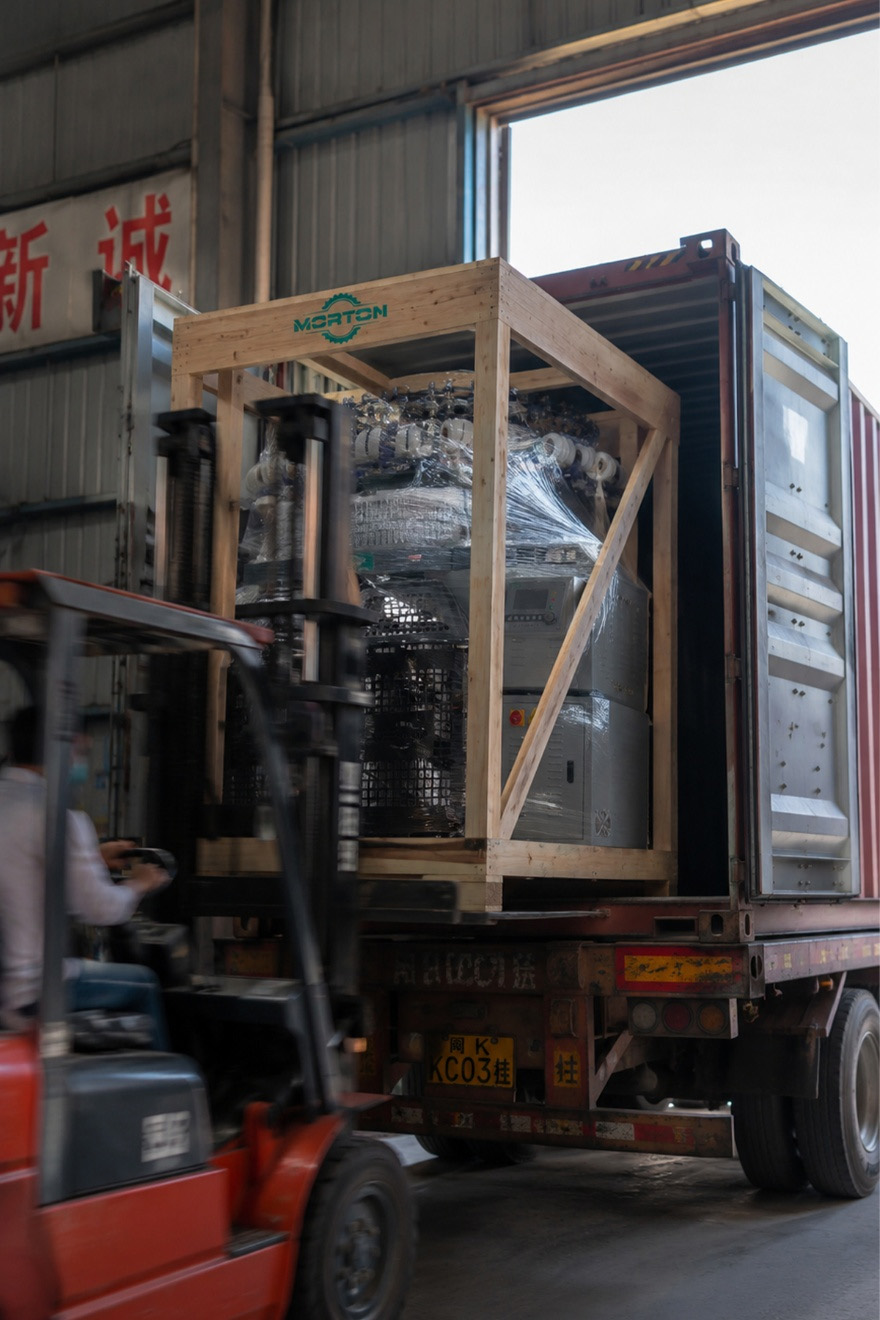
A few weeks ago, we were preparing a Circular Machine for shipment.
All that was left was the wooden crate
Someone asked: “Why do we still use wooden crates for every machine?”
Fair question.
Wooden crates cost money. They take time to build. They add weight.
Technically, we could skip them.
But after years of exporting Circular Machines and Interlock Machines around the world, we’ve learned something:
What happens during transportation matters just as much as what happens during manufacturing.
A Circular Machine is built for a factory floor. Heavy frame. Rigid structure. It’s not fragile.
But the journey? That’s a different story.
Once a machine leaves Quanzhou, it travels hundreds of kilometers by truck to Xiamen Port. Then it spends weeks at sea. Then it goes through port handling, customs clearance, and another truck ride to the buyer’s factory.
During that time, the machine gets moved. Multiple times. Forklifts. Cranes. Container loading. Port handling.
Most of the time, everything goes fine.
Sometimes it doesn’t.
Here’s something many firsttime importers don’t realize
Container space is valuable.
When cargo is consolidated, every cubic meter gets used. And that means—if your machine doesn’t have a solid crate with a proper top—things get stacked on top of it.
Years ago, we saw a shipment arrive with damage caused not by rough handling, but by someone else’s cargo sitting on top of the machine.
The machine could still run. But it wasn’t right.
Nobody wants to receive a machine that’s already been damaged before it even starts production.
That experience taught us: good packaging isn’t an extra. It’s part of the machine.
When we prepare a machine for export, it’s not just “put it in a box.”
It’s a process.
The crate absorbs impacts. It prevents other cargo from being stacked on top. And it adds a layer of protection against the humidity and temperature swings of ocean transport.
Most customers never see these steps.
By the time the machine arrives, the crate has already done its job.
At Morton, we spend a lot of time on machine quality.
But quality doesn’t stop when production ends.
A machine that leaves our workshop in perfect condition should arrive at the customer’s factory in the same condition.
That’s why every Circular Machine and Interlock Machine we export ships in a wooden crate.
Not because it’s the cheapest option.
Because after shipping machines around the world, we’ve learned that prevention is always easier than repair.
And we’d rather invest a little more time here than have a customer deal with a problem thousands of kilometers away.
A wooden crate isn’t the most exciting part of a knitting machine.
But it’s the reason the machine you receive is the same machine that left our factory.
Post time: Jun-23-2026