
Walk into any clothing store. Pick up ten different T‑shirts.
At first glance, they look almost identical. Same color. Same style. Same basic cut.
But the moment you touch them, the differences hit you.
Some are soft. Some feel cheap. Some have that heavy, premium weight. And some—you already know—will lose their shape after three washes.
So what actually makes a good T‑shirt fabric?
After years of working with textile mills around the world, here’s what we’ve learned.
It’s not one thing. It’s five. And if even one is off, the whole garment suffers.
It Starts with the Yarn
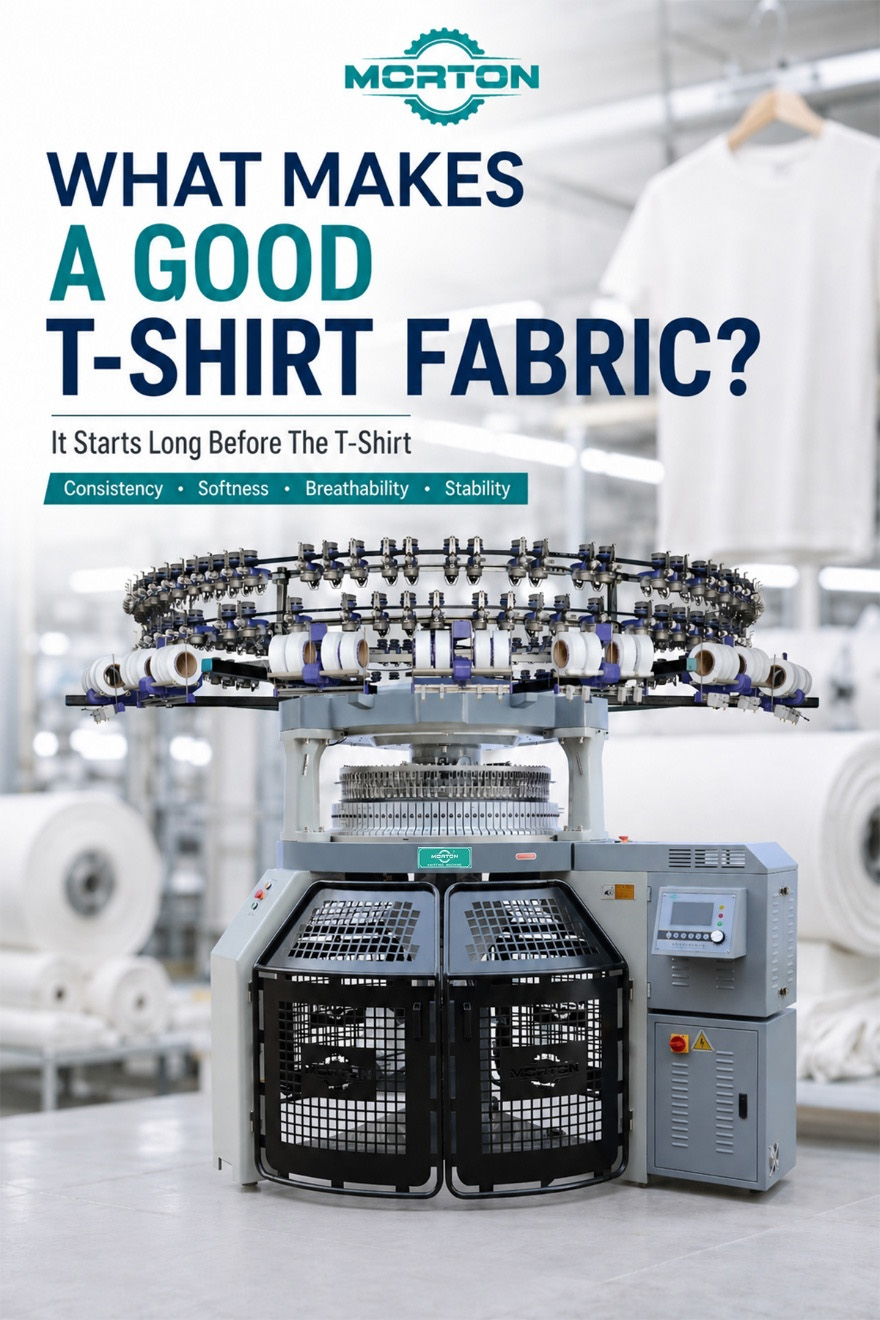
Before any fabric touches a Circular Machine, it starts as yarn.
And the yarn quality? It determines the ceiling for everything else.
Higher‑quality cotton yarns produce cleaner surfaces, fewer defects, and a noticeably softer hand‑feel. Combed cotton, for instance, removes the short fibers before spinning—giving you a smoother, more uniform yarn that simply feels better against skin.
That’s the floor.
The ceiling? Cotton isn’t the only game anymore. Today’s best T‑shirt fabrics use blends—cotton with polyester, modal, viscose, or elastane—to dial in exactly the performance characteristics the market wants.
But here’s the catch: no amount of blending fixes bad yarn.
Fabric Structure Matters More Than Most People Think
This is where things get interesting.
Two T‑shirts can be made from the exact same yarn and feel completely different. Why?
Fabric structure.
Most T‑shirts worldwide are produced on a Circular Machine using Single Jersey construction. Lightweight, breathable, cost‑effective. Perfect for everyday basics.
But premium T‑shirts? They increasingly use Interlock machines.
Interlock fabrics are:
- More stable
- Less prone to curling
- Thicker and more substantial
- Smooth on both sides
- Better at keeping their shape after washing
That’s not marketing talk. That’s the structural difference between a fabric that’s knitted with the face and back locked together versus a simple single‑layer loop.
You can feel it the moment you pick it up.
Weight Changes Everything
Here’s something most people don’t think about:
A fabric weighing 140 GSM and one weighing 220 GSM can be made from the same yarn, on the same machine—and they will feel like completely different products.
Lighter fabrics breathe better in hot climates. Heavier fabrics feel more durable, more substantial.
Neither is “better.” But choosing the wrong weight for the end use? That’s a mistake you can’t hide.
Here’s What Customers Actually Notice
Most consumers can’t tell you what machine gauge was used. They don’t know the yarn count. They’ve never heard of Single Jersey or Interlock.
But they notice when something is wrong.
They notice when a collar loses its shape.
They notice when the fabric twists after the first wash.
They notice when two of the “same” T‑shirt feel different.
Consistency is the difference between a T‑shirt that gets worn for years and one that gets pushed to the back of the closet after a month.
And consistency doesn’t happen by accident.
Why the Machine Still Matters
Here’s the hard truth:
Even the best yarn cannot compensate for unstable knitting.
A well‑configured Circular Machine maintains even loop formation, consistent tension, and uniform fabric quality across every meter. A properly set‑up Interlock Machine creates those smooth, stable structures that premium garments depend on.
That’s why fabric quality is never one thing.
It’s always a combination:
- Good yarn
- Right structure
- Appropriate weight
- Stable machine performance
- Careful production control
When all five work together, the result is a fabric that looks better, feels better, and sells better.
A great T‑shirt doesn’t start at the garment factory.
It starts with the yarn. It takes shape on a machine. And it depends on hundreds of small decisions made long before anyone sews on a label.
That’s what we build for at Morton.
Not just machines that run. But machines that help manufacturers create fabric people actually want to wear
MORTON — Advanced Knitting Solutions
Post time: Jun-18-2026