
One is running faster.
From across the factory floor, it looks like the obvious winner.
More revolutions should mean more fabric. More fabric should mean more production. And more production should mean more profit.
That logic is not wrong.
It is simply incomplete.
Ask someone who has managed a knitting mill for years and the conversation usually becomes more complicated.
They may ask how often the machine stops.
How much fabric is rejected.
Whether GSM stays within tolerance.
Whether the fabric looks the same from one roll to the next.
Whether operators have to keep adjusting the machine.
Whether the same fabric can still be reproduced when the customer places another order three months later.
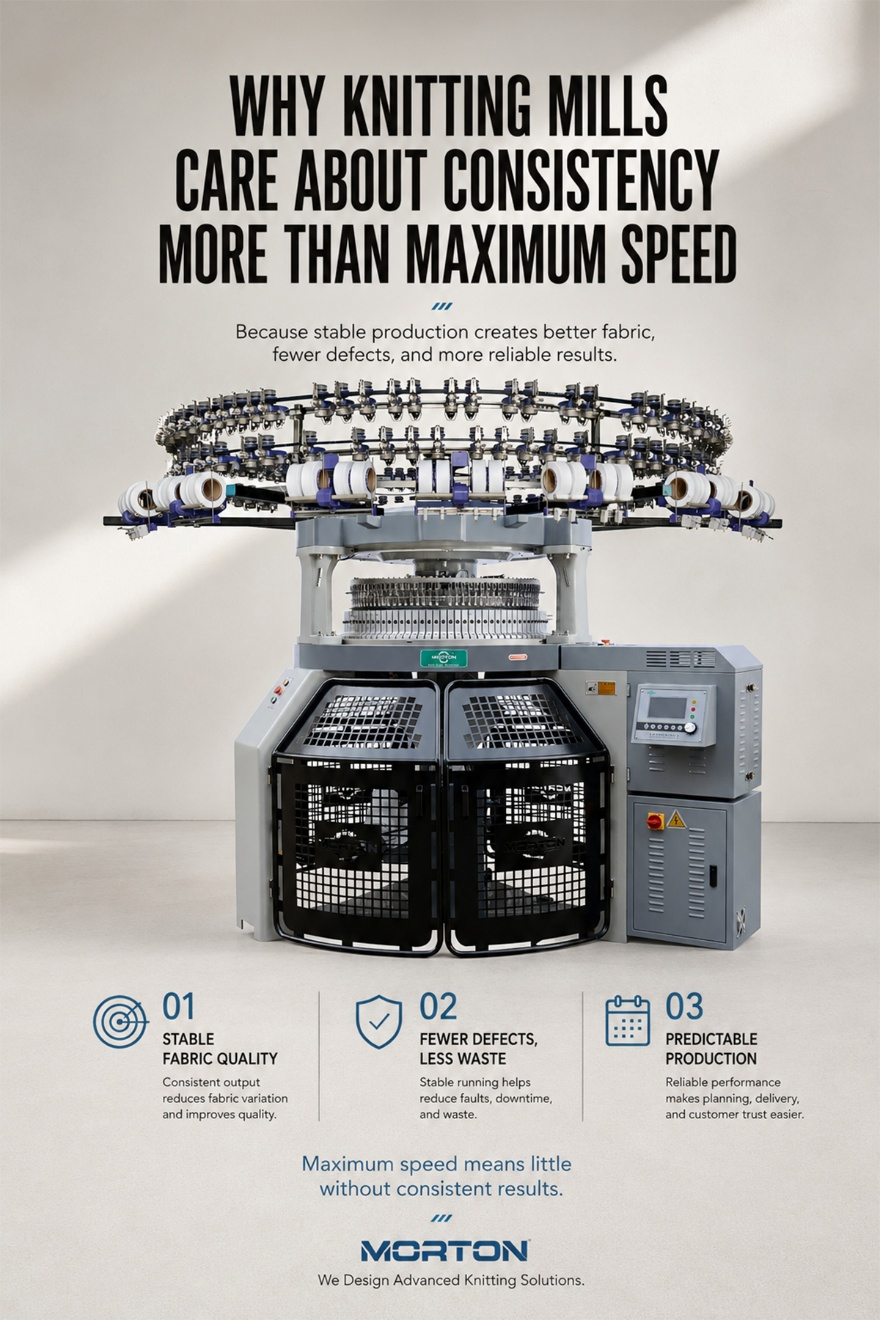
That is why experienced knitting mills rarely judge a machine by maximum speed alone.
The number that matters is not only how fast the machine can run.
It is how much acceptable fabric the factory can deliver at the end of the day.
Maximum Speed Is Easy to Put on a Specification Sheet
Machine speed is attractive because it is simple.
It gives buyers a number they can compare.
A Circular Machine running at a higher rotational speed has the potential to produce more fabric within the same period, assuming the other production conditions support it.
For mills dealing with large orders, productivity obviously matters.
Nobody buys industrial textile machinery hoping it will run slowly.
But maximum rated speed and useful production speed are not always the same thing.
A knitting machine operates as part of a much larger system.
Yarn quality matters.
Yarn feeding matters.
Machine diameter and gauge matter.
Fabric structure matters.
The condition of needles and other knitting components matters.
Maintenance matters.
Even the environment inside the factory can affect daily production.
The right question is therefore not:
“How fast can this machine run?”
It is:
“How fast can this machine run while maintaining the fabric we need?”
That small change in the question makes a big difference.
The Fabric Does Not Care About the Speed Number
A fabric buyer does not inspect the machine RPM.
They inspect the fabric.
If the approved sample is 220 GSM, they expect production to remain close to the agreed specification.
If the surface is supposed to be clean, visible lines or defects are not accepted simply because the machine was running quickly.
If the customer places several containers of fabric, the first batch and the last batch need to belong to the same order, not merely have the same product name.
This is why consistency becomes valuable.
The basic unit of weft knitted structure is the loop, and loop length has an important influence on knitted fabric dimensions and properties. The loop is formed on the machine under a combination of machine geometry, yarn behaviour, and tension. citeturn355143search0turn355143search3
For a knitting mill, controlling that process thousands and thousands of times is what eventually creates a stable roll of fabric.
Speed is useful only when that control remains intact.
What Does “Consistency” Actually Mean in a Knitting Mill?
Consistency sounds like a vague word until something goes wrong.
On the factory floor, it is much more practical.
It means a machine produces fabric today that is close to what it produced yesterday.
It means different rolls from the same order do not show unexpected changes in weight, density, appearance, or structure.
It means operators are not constantly stopping to correct problems.
It means the finishing department receives grey fabric it can work with predictably.
It means the garment customer does not discover that one batch behaves differently from another.
For a Knitting Mill, these differences eventually become money.
A defect may lead to fabric being downgraded.
An unstable GSM may require adjustment or reprocessing.
Unexpected stops reduce effective production.
A rejected batch consumes yarn, electricity, labor, finishing capacity, and delivery time before anyone realizes the fabric cannot be sold at the intended value.
This is why experienced mills become careful about chasing the last little bit of speed.
They have learned to count production differently.
The Fastest Machine Is Not Always the Most Productive Machine
Imagine one Circular Knitting Machine runs at a very high speed but needs repeated stops for adjustments.
Another runs slightly below that level but remains stable for long periods.
Which one produces more usable fabric over a full shift?
You cannot answer that question from RPM alone.
Actual productivity is what remains after stops, defects, repairs, rejected fabric, and production changes are taken into account.
This is not an argument for slow production.
Quite the opposite.
A good production system should run as efficiently as the yarn, fabric structure, machine condition, and quality requirements allow.
But there is a point where increasing speed may no longer increase useful output if the rest of the process cannot support it.
That limit is different for different fabrics.
A simple structure using a stable yarn may run under very different conditions from a demanding fabric using Spandex or multiple yarn systems.
The machine setting should follow the production reality.
Yarn Sets the First Practical Limit
Sometimes a customer asks why a machine does not run the same speed with every yarn.
The reason is simple: yarns are not identical materials.
Cotton, Polyester, Modal, and Spandex blends behave differently.
Yarn count changes the situation.
Yarn uniformity changes it.
Friction, strength, twist, and preparation also affect how the yarn moves through the feeding and knitting process.
At higher production speeds, the yarn still has to travel from the package through the feeding system and into the knitting zone reliably.
If yarn feeding becomes unstable, problems can appear in the fabric.
Variations in yarn tension between feeds are associated with visible faults such as barré, and process-control literature identifies input tension as an important variable in circular knitting quality control. citeturn355143search6turn355143search12
This is why an experienced operator listens to the yarn as much as the machine.
A machine cannot make unstable raw material disappear.
Loop Length Has to Stay Under Control
If there is one parameter that deserves more attention in knitted fabric production, it is loop length.
A knitted fabric is built loop by loop.
The length of yarn contained in each loop affects the geometry and properties of the finished fabric. In knitting science, maintaining loop length is considered fundamental to controlling knitted dimensions. citeturn355143search0
If loop formation changes, fabric behaviour can change with it.
This can influence stitch density, fabric weight, dimensions, porosity, hand feel, and other properties depending on the structure. Studies of Single Jersey fabric, for example, show clear relationships among loop length, courses and wales, tightness factor, and porosity. citeturn355143search2
This is one reason stable yarn feeding and stable knitting conditions matter more than an impressive speed number.
The goal is not simply to make the needles move faster.
The goal is to keep producing the intended loop structure while they do it.
Take-Down Is Part of the Same Conversation
Fabric does not stop being controlled after the loop is formed.
The newly knitted fabric has to move away from the knitting zone at a controlled rate.
That makes the take-down system part of fabric production, not just a mechanism for collecting cloth.
Take-down tension is one of the process variables considered in circular knitting quality control. citeturn355143search12
When mills change fabric structures, yarns, or production settings, they often need to think about how those changes interact with the rest of the machine.
This is where an experienced operator becomes valuable.
They are not simply pressing Start and Stop.
They are watching the behaviour of the entire process.
The First Roll Is the Easy Part
During machine adjustment, everyone pays attention.
The technician checks the fabric.
Measurements are taken.
Settings are corrected.
A sample is produced.
Once the fabric reaches the required result, the machine begins normal production.
But a knitting mill does not sell one perfect sample.
It sells production.
The challenge is keeping that result over many rolls and many hours of operation.
This is where small things begin to matter.
A needle gradually wears.
Lint accumulates.
A yarn feeder no longer behaves exactly as it did earlier.
Lubrication needs attention.
A belt changes tension.
A different lot of yarn enters production.
None of these events necessarily creates an immediate dramatic failure.
More often, the process begins to drift.
Experienced factories pay attention to this drift because they know the cost of discovering it too late.
A Defect Found Early Is Cheap
This may be one of the least glamorous truths in textile manufacturing.
Quality control is cheaper when the problem is still small.
If an operator detects an abnormal line while only a short length has been knitted, the machine can be checked.
If the same issue goes unnoticed through an entire roll, the loss is larger.
If it only becomes visible after dyeing or finishing, more money has already been spent on the fabric.
This is why machine stability and operator inspection work together.
No serious knitting mill expects a machine to remove the need for skilled people.
A well-built machine provides a stable platform.
Experienced operators keep that platform working correctly.
The combination is what creates reliable production.
The Dyeing Factory Will Find Problems the Knitting Floor Missed
Grey fabric can be deceptive.
Some variation is difficult to see before dyeing.
Once color is added, a subtle difference may become obvious.
A line that looked almost invisible in grey fabric can attract attention after finishing.
Dimensional behaviour also continues after knitting. Knitted loops relax, and later processing can change fabric width and GSM as the structure moves toward a more stable state. citeturn355143search5turn355143search7
This is why the best knitting mills think beyond the machine.
They know their fabric still has another journey ahead.
Dyeing.
Heat setting.
Compacting.
Brushing.
Washing.
Garment production.
A stable knitting process gives the later stages a better starting point.
Why Repeat Orders Are the Real Test
The first order can be difficult.
The repeat order can be even more revealing.
A customer returns six months later and says:
“We want the same fabric.”
They do not mean approximately the same fabric.
They mean the fabric their garment team already approved.
The same structure.
Similar GSM.
Similar width.
Similar hand feel.
Similar performance after finishing.
This is where consistency becomes part of a mill’s reputation.
If a factory can reproduce a fabric reliably, buyers gain confidence.
If every repeat order becomes a new experiment, production becomes harder for everyone.
For this reason, machine stability is not simply a technical preference.
It supports the commercial relationship between the knitting mill and its customers.
Maximum RPM Does Not Describe Machine Quality
There is another reason we are careful with speed claims.
A single number tells very little about the complete machine.
A Circular Knitting Machine is a system.
Frame stability, cylinder and dial accuracy, cam performance, yarn feeding, lubrication, take-down, electrical control, assembly, adjustment, and maintenance all contribute to production.
A high maximum speed does not automatically mean these parts work well together.
A lower number does not automatically mean they do not.
The machine has to be evaluated while producing real fabric.
That is where the truth becomes easier to see.
Can it maintain the target fabric?
How often does it stop?
What happens after a long production run?
How easy is it to repeat the setup?
What does the fabric look like after finishing?
Those questions are less exciting than an RPM figure.
They are also closer to how a knitting mill actually makes money.
Good Production Is Usually Boring
Visit a well-run knitting factory and the most successful machine may not attract much attention.
It runs.
The operator checks it.
Fabric continues coming down.
There is no constant stopping, no technician standing beside it all day, and no dramatic correction every few hours.
From a marketing perspective, this is not very exciting.
From a production perspective, it is exactly what you want.
Factories make money when normal production remains normal.
Consistency is valuable partly because nothing surprising happens.
Speed Still Matters
None of this means knitting mills should ignore productivity.
A machine that is stable but unnecessarily slow is not an efficient production solution.
Modern knitting factories operate under real pressure from energy costs, labor costs, delivery schedules, and international competition.
Production speed matters.
The point is to find the speed at which the entire system works well.
The yarn runs reliably.
The knitted structure remains within requirement.
The machine stays stable.
The operator can control the process.
The fabric continues into finishing without creating unnecessary problems.
That is useful speed.
Maximum speed is a capability.
Stable production speed is a business result.
What Experienced Knitting Mills Eventually Learn
New machine buyers often compare specifications first.
That is understandable.
Specifications give buyers something concrete to study before they have seen the machine running.
But after years of production, most mills become more interested in what happens between those specification numbers.
They ask about maintenance.
They ask about spare parts.
They ask about fabric performance.
They want to see the machine running.
They want to know whether the machine remains stable after long production.
The questions become less theoretical because the factory has already learned where money is lost.
A few extra revolutions look attractive.
A rejected fabric roll does not.
How MORTON Thinks About Production Speed
At MORTON, we design and build Circular Knitting Machines for production, not for a specification sheet alone.
That means speed matters, but it has to be considered together with the fabric.
A Single Jersey Machine producing a straightforward Cotton fabric does not face exactly the same production conditions as an Interlock Machine or a Three Thread Fleece Knitting Machine running a more complex structure.
The yarn matters.
The GSM matters.
The structure matters.
The customer’s quality requirement matters.
This brings us back to the same principle we use when discussing machine configurations:
Machine follows Fabric.
The best running condition is the one that allows a knitting mill to produce the fabric its customer ordered, repeatedly and efficiently.
Because at the end of the month, the mill does not invoice its customer for machine revolutions.
It invoices for fabric.
And the fabric has to be right.
MORTON — Advanced Knitting Solutions
Post time: Aug-14-2026