
Walk into any clothing store this summer and you’ll see the same thing. Tags claiming “cool touch,” “cooling technology,” “instant chill.” Every brand is chasing the same promise: a T-shirt that fights the heat before your body does.
Sounds like marketing. But here’s the thing — fabric really can feel cold. The question is how it gets that way, and whether it lasts past the first wash.
What “Cooling” Actually Means
Cotton, linen, polyester, nylon — none of these fibers actively cool you down. They don’t have some built-in air conditioner. What they can do, if they’re made right, is pull heat away from your skin the moment you touch them. That sudden temperature drop is what people call “cooling.” It’s not magic. It’s thermal conductivity.
For sportswear, outdoor gear, anything worn against the skin, this stops being a nice-to-have and starts being the whole point. A shirt that traps heat feels like a punishment by noon.
Three Ways Mills Create Cooling Fabric
There are really three paths to get there.
Fiber Level
The first is at the fiber level — embedding stuff like jade powder, mica, or phase-change materials directly into the filament during spinning. The fiber itself becomes thermally active. This is the most durable approach, but it’s expensive and the technical barriers are high. Not every mill can do it.
Yarn Design
The second is in the yarn design — using shaped cross-sections like a cross or a Y instead of a smooth round filament. That increases surface area, which accelerates sweat evaporation and pulls heat away. No chemical additives involved, but the cooling effect has limits.
Finishing Treatment
The third path — and the one that’s easiest for most mills to deploy fast — is in finishing. You take the fabric after it comes off the knitting machine and run it through a cooling agent treatment. The active material coats the fiber surface. It’s straightforward, doesn’t require new production lines, and it works.
The Finishing That Makes Fabric “Think” It’s Cool
This is where phase-change materials get interesting.
Imagine a microcapsule attached to the fiber. Inside that capsule is a material that flips between solid and liquid at just the right temperature range. When your skin heats up and touches the fabric, that material melts — and melting absorbs heat. A lot of it. The shirt pulls warmth off your skin instantly, and that’s the “cold touch” people notice.
Later, when the garment comes off and cools down, the material solidifies again and releases the stored heat. Then it’s ready to do the whole thing over the next time you put it on.
This isn’t just conducting heat away. It’s a rechargeable cooling cycle — absorb, store, release, reset. The effect lasts longer than simple heat transfer because there’s actual thermal storage built into the fabric.
The best part for production mills: this treatment works on cotton, polyester, nylon, and blends. The fabric still feels soft afterward. Breathability isn’t affected. And you don’t need to bolt new machines onto the factory floor — standard padding and heat-setting equipment handles it.
But None of This Matters If the Base Fabric Is Wrong
Here’s where a lot of brands get things backward. They obsess over the finishing chemistry and forget about what happened earlier in the chain.
A cooling treatment can’t rescue a poorly knitted fabric.
If the loop structure is uneven, if the tension wandered during knitting, if the fabric density drifts from edge to edge — the finish won’t apply uniformly. Some areas will feel cool. Others won’t. The whole thing falls apart after a few washes.
That’s why the machine matters.
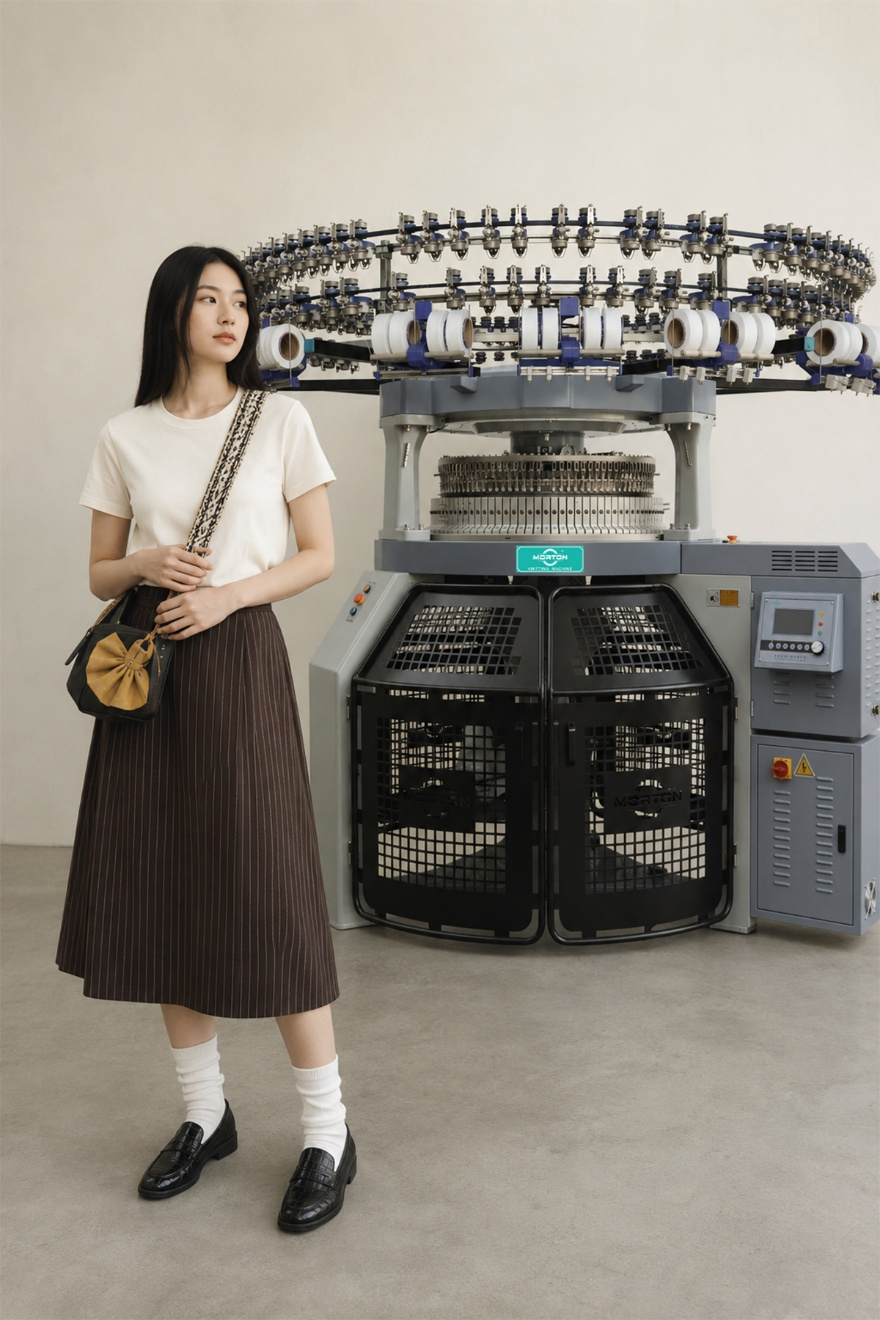
A Circular Machine that holds steady loop geometry across the entire cylinder gives the finishing process a consistent base to work from. An Interlock Machine running a dense, stable structure can support heavier cooling treatments without the fabric losing its hand feel.
Finishing can add performance. But it starts with the knit. Every loop has to be right before anything gets coated onto it.
The Machine Comes First. The Chemistry Comes Second.
At MORTON, we don’t apply cooling finishes. We build the Circular Machines and Interlock Machines that produce the fabric before it ever reaches the finishing plant. Stable tension. Consistent loops. Uniform density. That’s the foundation. The chemistry is somebody else’s job — but how well that chemistry works depends heavily on what the knitting machine delivered.
A cool T-shirt starts way before the tag gets sewn in. It starts on the knitting floor.
MORTON — Advanced Knitting Solutions
Post time: Jul-31-2026