
A customer once sent us two rolls of fabric with a simple question:
“Why do they look different after dyeing?”
Before dyeing, the two fabrics looked almost the same. They used the same yarn composition, had a similar GSM, and were made with a similar knitted structure. Judging from the specifications alone, there was no obvious reason for the finished fabrics to look different.
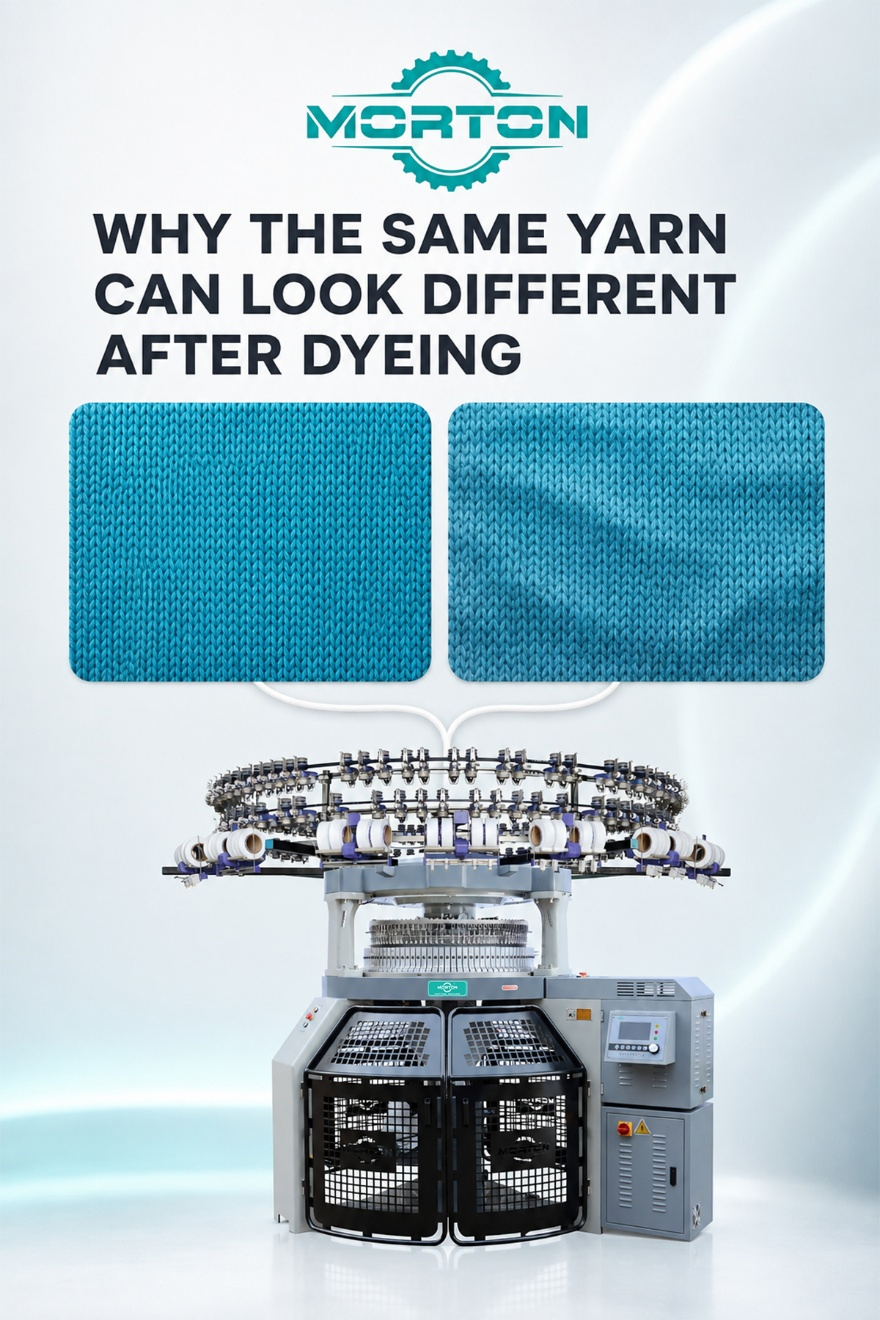
But after dyeing, the difference was easy to see. One roll had a clean, even surface, while the other showed slight shade variation under normal lighting.
Naturally, the dyeing process was the first thing to check. Were the dye formulas the same? Was the temperature stable? Was there any difference in washing, compacting, or finishing?
All of these factors can affect the result. However, problems noticed after dyeing do not always begin in the dyeing machine. In many cases, dyeing simply makes variations in the grey fabric easier to see.
The real difference may have started earlier—during knitting.
What Dyeing Reveals
Grey fabric can hide small structural variations. Without color, slight differences in loop size, density, or yarn distribution may be difficult to notice.
After dyeing, these differences become more visible. A small change in fabric density can affect the way light reflects from the surface. Uneven loop formation may create a slightly different surface texture, making one area appear darker or lighter than another.
This does not mean that every shade problem is caused by knitting. Yarn quality, dyeing conditions, pretreatment, and finishing must also be checked. But when two fabrics use the same yarn and follow the same dyeing process, the grey fabric structure becomes an important part of the investigation.
That is why experienced mills do not judge fabric quality only by its appearance on the knitting floor. They also need to know how it will behave after relaxation, dyeing, washing, and compacting.
The Same Yarn Does Not Guarantee the Same Fabric
Yarn is the raw material, but the circular knitting machine determines how that yarn is formed into fabric.
Two factories can purchase the same cotton yarn, follow the same fabric specification, and target the same GSM. Even so, the finished fabrics may not have exactly the same appearance or hand feel.
The reason is simple: yarn has to pass through a mechanical knitting process before it becomes fabric.
During production, yarn feeding, yarn tension, loop length, take-down tension, machine settings, and the condition of the knitting elements all affect the fabric structure. If these conditions are not stable, small variations can build up over thousands of knitting cycles.
On the machine, the difference may be almost invisible. After dyeing, it may become clear across the entire roll.
For example, inconsistent yarn feeding can change the amount of yarn entering individual courses. Changes in take-down tension can influence stitch density. Worn needles, sinkers, or cams may also affect loop formation and surface uniformity.
Each variation may be small, but circular knitting is a continuous and repetitive process. A small difference repeated thousands of times eventually becomes part of the fabric.
Why Loop Structure Matters
A knitted fabric is made from interconnected loops. Their size and formation influence GSM, width, elasticity, surface appearance, dimensional stability, and hand feel.
This is why two fabrics with the same yarn composition can still behave differently.
If the loop length is not consistent, one fabric may be tighter or looser in certain areas. If yarn tension changes during production, the fabric may not relax evenly. These differences can affect the way the fabric responds during dyeing and finishing.
The required loop structure also depends on the final product.
Single jersey is commonly used for T-shirts because it is lightweight, flexible, and comfortable. Interlock has a smoother surface and greater structural stability. French terry, fleece, rib, and sportswear fabrics each have their own production requirements.
There is no single machine setting that suits every fabric. The correct solution depends on the yarn, fabric construction, target GSM, required width, finishing process, and final garment application.
Testing Should Continue Beyond Grey Fabric
Checking the grey fabric is necessary, but it is not enough.
Knitted fabric continues to change after leaving the circular knitting machine. It relaxes, shrinks, absorbs moisture, and responds to heat and mechanical finishing. Dyeing, washing, compacting, and heat setting can all change its width, weight, surface, and hand feel.
For this reason, a proper fabric trial should follow the complete production route whenever possible.
The mill needs to confirm more than whether the machine can knit the fabric successfully. It should also check:
Whether the shade remains even after dyeing
Whether the finished GSM is within the required range
Whether the finished width meets the specification
Whether shrinkage is acceptable
Whether the hand feel matches the approved sample
Whether repeated production can achieve the same result
After all, the end customer does not buy grey fabric. They buy a finished garment and expect every production batch to be consistent.
Consistency Matters More Than One Good Roll
Producing one good roll is not the hardest part of textile manufacturing. The real challenge is producing the same quality again and again.
A buyer may approve a sample today and place a repeat order several months later. The new production is expected to match the original fabric in shade, weight, width, hand feel, and performance.
This is why machine stability matters so much.
Production speed is important, but speed alone does not create value. A machine must also maintain stable yarn feeding, accurate loop formation, consistent take-down, and reliable operation during long production runs.
The right circular knitting machine is not simply the one that runs the fastest. It is the one that can repeatedly produce the fabric the customer needs.
Machine Follows Fabric
When a customer asks MORTON about a circular knitting machine, we usually start by asking about the fabric.
What fabric will you produce? What yarn will you use? What are the required GSM and width? Will the fabric be tubular or open width? What finishing process will follow? What type of garment will it become?
These details help determine the machine configuration and production solution.
A factory producing single jersey for basic T-shirts has different requirements from one producing interlock, French terry, fleece, or technical sportswear. Even when two customers request the same machine diameter and gauge, their actual production needs may be different.
That is what we mean when we say:
Machine follows fabric.
The purpose of a knitting machine is not simply to produce rolls of grey fabric. It is to create a stable foundation for the dyeing, finishing, and garment processes that follow.
At MORTON, we build circular knitting machines and develop knitting solutions around real fabric requirements. Because when two fabrics made from the same yarn look different after dyeing, the answer may not be found in the dye house alone.
Sometimes, it begins on the knitting floor.
MORTON — Advanced Knitting Solutions
Post time: Aug-22-2026