
Walk through any textile mill today and you’ll hear purchasing managers fixating on the same numbers — RPMs, gauges, feeder counts. Those metrics look clean on a spreadsheet, but they miss the real story on the floor. An industrial circular machine never operates in a vacuum. Every second it runs, it’s locked in a high-friction, high-temperature relationship with the yarn tearing through its needles. Yarn isn’t a dead material like steel or plastic; it stretches, slips, builds up massive static charges, and fights back against the machine.
The biggest leaps in knitwear history didn’t happen because someone drew up a prettier machine frame. They happened because fibers changed, forcing the mechanical hardware to adapt or fail.
Today, production managers are feeding everything from recycled polyester to fragile bio-based filaments into high-speed circular knitting machine lines. At this level, textile chemistry and mechanical engineering collapse into the same problem. If a mill wants to protect its margins, it cannot buy generic hardware. It has to work with a circular machine manufacturer that knows exactly what happens when an unpredictable yarn hits a needle bed at 35 RPM.
For centuries, knitting was at the mercy of agricultural variables. Wool, cotton, silk, linen — these natural staples built the global garment trade, but their physical profiles were completely chaotic. Every single batch arrived at the mill with its own unpredictable tensile personality.
Take cotton. It sheds lint relentlessly. Run it at high speed on a standard circular machine, and the staple yarns release a constant cloud of fly that packs tight into the needle tricks and yarn guides. Leave it alone, and the buildup creates friction spikes. Next thing you know, the afternoon shift is chasing dropped stitches, dealing with micro-breakages, and burning money on replacement needles.
Wool brings its own headaches. Staple yarns have localized weak spots and thick-and-thin variations that snag easily. If the cylinder and cam setup can’t absorb those structural irregularities, the defects show up instantly on the light board.
Then there’s silk — the fiber that taught early machine builders what they really needed to know about precision metallurgy. Quanzhou, the industrial manufacturing hub where MORTON — Advanced Knitting Solutions builds its machinery today, once sat squarely at the center of the historic Maritime Silk Road. High-gloss, low-friction silk filaments moved through our local port for centuries, and they taught the regional industry a hard lesson: running premium filaments demands absolute surface perfection. One micro-burr on a guide or a sinker lip, and a whole batch is ruined by snags. That old-world focus on surface finish isn’t nostalgia — it’s built directly into our current manufacturing process.
When polyester, nylon, and acrylic took over the market in the mid-20th century, they rewrote the manufacturing rulebook. Suddenly mills had access to synthetic filaments with massive tensile strength, perfect uniformity, and water-repellent properties that cotton couldn’t touch. On paper, it sounds like an operator’s dream. In reality, synthetic polymers introduced a whole new class of mechanical headaches — specifically around viscoelastic memory and stress relaxation.
The real trial for modern mills came with the rise of elastane plating for technical activewear. Blending a rigid synthetic carrier yarn with a highly elastic spandex filament sounds straightforward, but doing it under high-speed production tension is a massive engineering challenge. Spandex is wildly sensitive to friction and ambient room temperature. If your circular machine cannot hold the yarn feeder tension perfectly steady — zero micro-fluctuations — the elastane stretches unevenly during loop formation.
The moment that fabric leaves the cylinder and relaxes, those tiny tension variances turn into visible faults. You get “barre” defects — severe horizontal shading across the roll. GSM drifts from edge to edge. The fabric develops internal torquing that wreaks havoc during heat setting and dyeing. Low-end machinery cannot hide from elastane tension faults. The fabric tells the truth about the machine’s stability every single time.
More recently, the shift toward sustainable, regenerated bio-based fibers — Modal, Tencel, bamboo — has added another layer of friction management. These yarns offer a beautiful consumer hand-feel, but they have low wet strength and swell significantly during processing. Push them through a high-speed interlock machine, and they have almost zero tolerance for mechanical abrasion. Any rough edge along the yarn path causes immediate fiber rupture, and you get severe surface pilling before the garment ever leaves the mill.
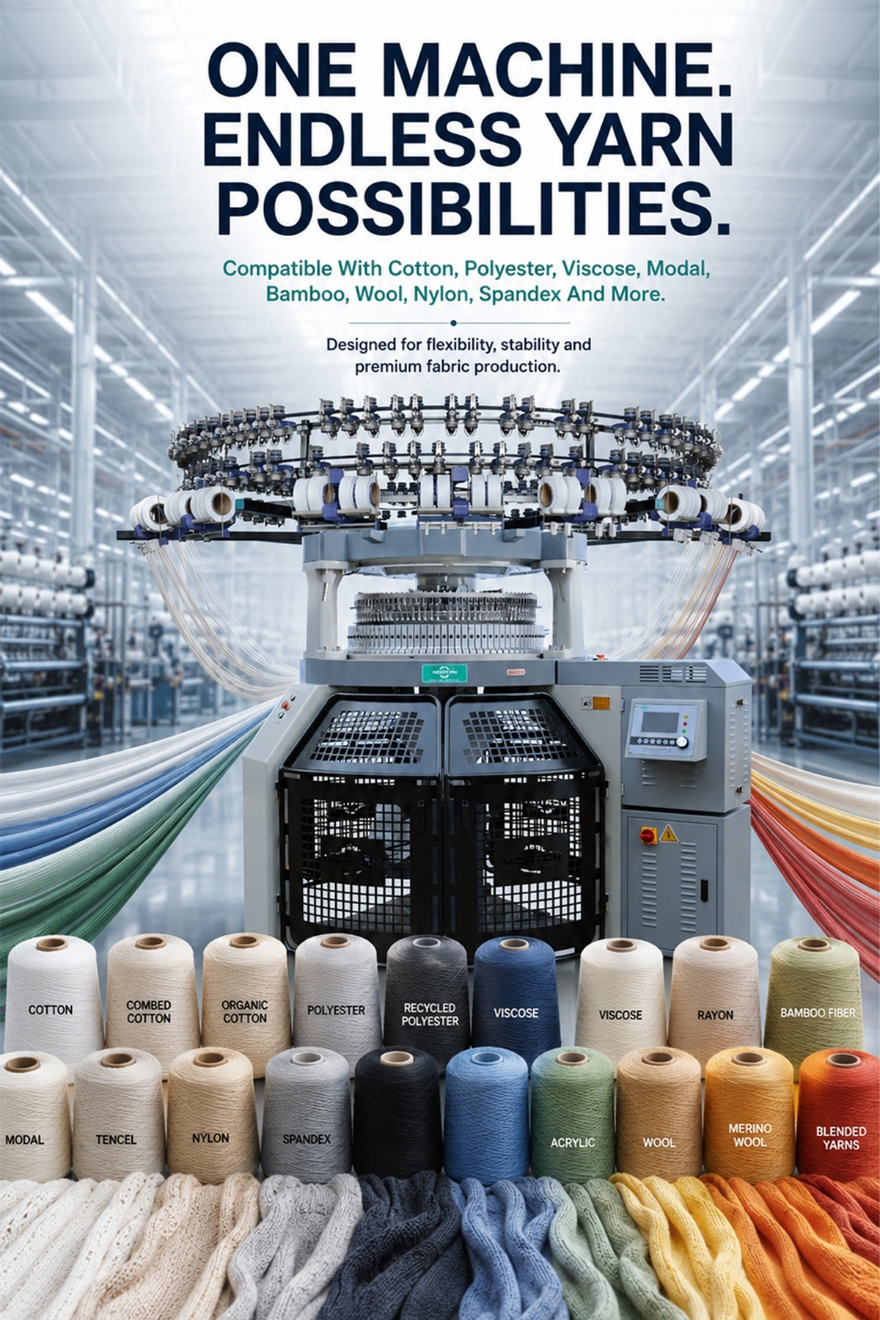
Modern textile operations no longer have the luxury of dedicating one machine line to one fiber type. A flexible factory floor might run 100% combed organic cotton jersey in the morning and switch to a high-twist, recycled micro-poly blend by the afternoon shift. If your equipment doesn’t have a wide, forgiving material-processing window, the downtime will eat your profitability alive.
That operational reality is exactly why the double-knit interlock machine has become the backbone of high-volume activewear manufacturing. It provides the structural rigidity needed to lock diverse, high-tension fiber profiles into dense, double-faced fabrics without losing consistency.
At MORTON — Advanced Knitting Solutions, we don’t engineer our single-jersey and interlock machine lines just to move yarn from point A to point B. We build them to master the physical stress variables of modern material matrices. That means optimizing the details that standard equipment spec sheets ignore.
Technical blends like Polyester-Spandex have jumpy elongation profiles. If your feeder can’t compensate micro-fluctuations, you get shadow lines in the finished fabric. We use synchronized, positive yarn-feeding mechanisms that kill those differentials dead.
Synthetics at high speed generate brutal heat and electrostatic charge. Our needle beds, sinker rings, and cam tracks go through proprietary surface treatments engineered specifically to drop metal-on-yarn drag to an absolute minimum. For delicate fibers like Tencel, that surface finish is the sole difference between a clean run and a scrap batch full of micro-pills.
Pushing high-gauge setups (28G to 32G) with tough synthetics creates massive thermal stress across the cylinder. Thermal expansion is a physical fact — if the frame lacks structural mass and rigidity, your geometric alignment drifts as the machine warms up. We put serious R&D into frame casting so your loops remain mathematically identical, whether the machine is cold at Monday morning startup or fully heat-soaked three shifts deep on a Friday night.
The global apparel market is moving fast toward a closed-loop economy. Biodegradable synthetics, ocean-recycled polymers, conductive smart filaments, and phase-change yarns are no longer lab experiments — mills are being asked to run them at volume right now.
The challenge is raw material forgiveness. These sustainable or functional materials often have compromised tensile strength or irregular surface geometry compared to virgin petroleum-based plastics. Because the fiber itself is less predictable, the burden of ensuring fabric uniformity shifts entirely onto the machinery.
At MORTON, our engineering teams stay locked into these material trends for one simple reason: yarn chemistry changes, but the fundamental physics of loop formation does not. The mills that survive and dominate this decade will be the ones that partner with a circular knitting machine builder who engineers specifically for the violent, unpredictable space where yarn meets steel. That’s exactly where we work.
MORTON — Advanced Knitting Solutions
Post time: Jun-02-2026