
Take a look at what you’re wearing right now.
Your T-shirt.
Your jeans.
Your socks.
Even the waistband of your underwear.
If any of them stretch, there’s a good chance they contain spandex.
The surprising part?
Most garments contain only a tiny amount—sometimes just 3% to 5%.
Yet that small percentage completely changes how clothing feels.
Before Stretch Became Normal
There was a time when people simply accepted that clothes would lose their shape.
A T-shirt collar stretched after a few washes.
Jeans became loose around the knees.
Socks slowly slipped into your shoes.
Nobody thought much about it.
That was simply how clothes behaved.
Back then, manufacturers relied on rubber whenever they needed stretch.
It worked—but only to a point.
Rubber was thick, heavy, trapped heat, and gradually broke down after repeated washing, sunlight, and sweat.
The textile industry knew there had to be a better solution.
One Chemist Changed Everything
In the late 1950s, a DuPont chemist named Joseph Shivers began asking a simple question:
Could a fiber stretch like rubber—but be lighter, thinner, and far more durable?
After years of research, his team developed a polyurethane-based fiber that could stretch several times its original length and still return to its original shape.
In 1962, DuPont introduced it under the brand name Lycra®.
Today, the world simply knows it as spandex.
No one expected such a small fiber to reshape the entire clothing industry.
Why Just Five Percent Matters
One of the most interesting things about spandex is that you rarely need very much of it.
A fabric made from 95% cotton and 5% spandex still feels like cotton.
But it performs completely differently.
The collar keeps its shape.
The sleeves recover after stretching.
The fabric moves naturally with the body instead of fighting against it.
That tiny percentage quietly changed what people expected from everyday clothing.
Once consumers experienced garments that stayed comfortable and held their shape, there was no going back.
It Doesn’t Work Alone
Spandex isn’t designed to become fabric by itself.
Its real strength comes from blending with other fibers.
Cotton adds comfort.
Polyester improves durability.
Modal creates exceptional softness.
Viscose gives the fabric elegant drape.
Different blends create different products—from everyday T-shirts and underwear to sportswear, leggings, and premium loungewear.
But choosing the right yarn is only half the job.
The knitting process matters just as much.
Why Machine Setup Matters
Anyone who has worked in a knitting mill knows that spandex is one of the most demanding yarns to process.
Its tension must remain consistent.
Its feeding has to be precise.
Take-down pressure needs careful adjustment.
Even a small change can affect stretch, recovery, fabric weight, and surface appearance.
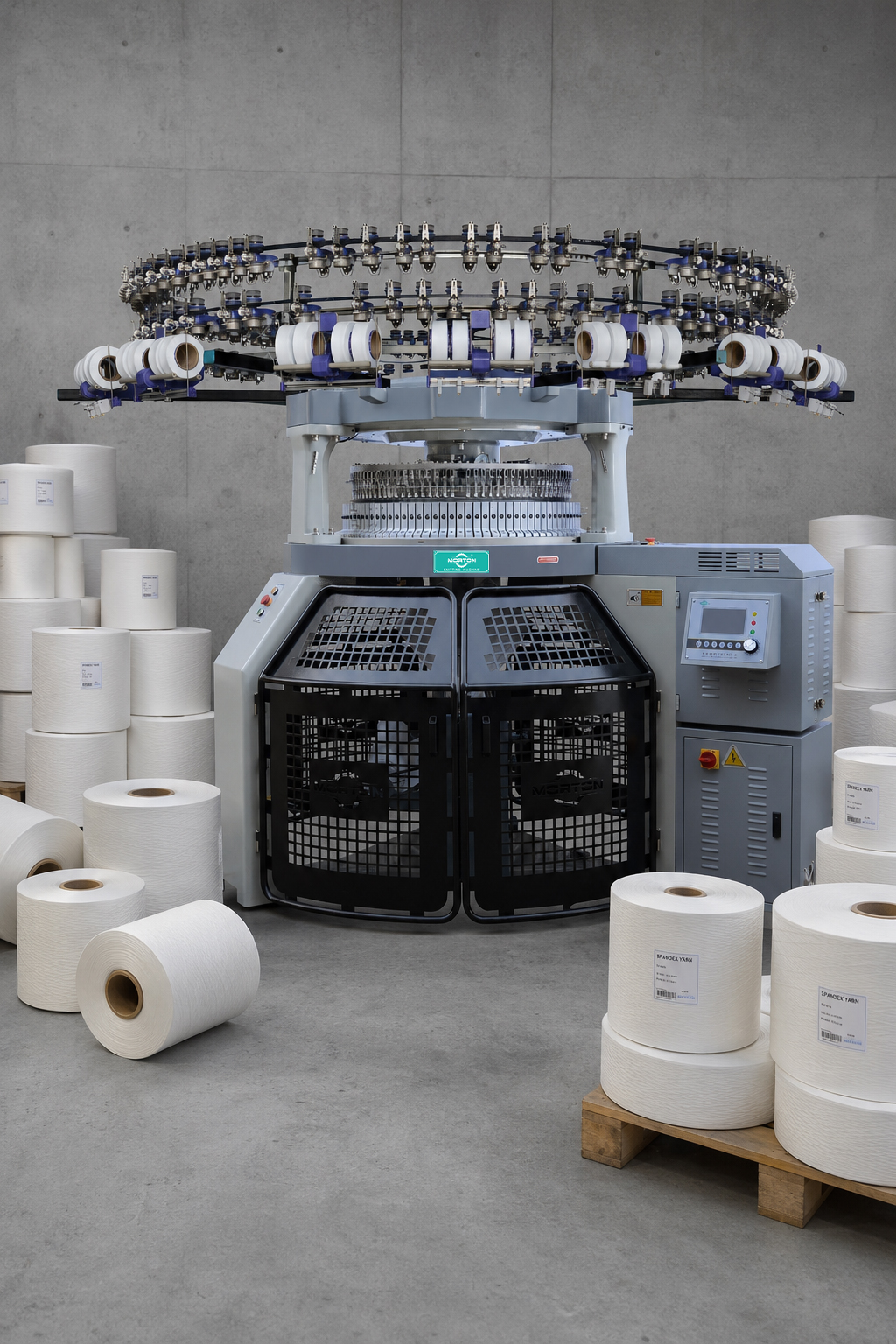
That’s why producing stretch fabrics on a Circular Machine requires a different setup from knitting 100% cotton fabrics.
For applications requiring greater stability and a smoother surface, many manufacturers also choose an Interlock Machine.
The fiber provides the stretch.
The machine determines how that stretch performs in real production.
The Fiber You Never Notice
Most people never check a garment label to see whether it contains spandex.
They simply notice that modern clothes fit better than they used to.
T-shirts stay in shape.
Jeans recover after sitting all day.
Leggings move with the body instead of against it.
Socks stay where they’re supposed to.
Those small improvements have quietly become part of everyday life.
At MORTON, we build Circular Machines and Interlock Machines that help textile mills around the world produce high-quality knitted fabrics containing modern stretch fibers like spandex.
Because sometimes the smallest ingredient makes the biggest difference.
And behind every great stretch fabric is a knitting machine built to produce it consistently.
MORTON — Advanced Knitting Solutions
Post time: Jul-07-2026