
Most people don’t know that the polo shirt was born because athletes were tired of being uncomfortable.
Look around next time you’re at an airport.
Or a hotel.
Or a golf course.
Chances are, someone nearby is wearing a polo shirt.
It’s one of those rare garments that works almost anywhere—casual enough for the weekend, smart enough for work, and comfortable enough to wear all day.
But it wasn’t created for any of those places.
It was created because tennis players wanted something better.
Tennis Before the Polo Shirt
In the late 1800s and early 1900s, tennis players competed wearing long-sleeved woven shirts, ties, and trousers.
They looked elegant.
They felt terrible.
Every serve.
Every sprint.
Every reach across the court.
The shirt pulled against the body.
Woven cotton offered almost no stretch, and as matches became longer, the fabric became hot, stiff, and heavy with sweat.
Instead of helping athletes move, the clothing often worked against them.
René Lacoste Changed the Game
In the 1920s, French tennis champion René Lacoste decided enough was enough.
Rather than accepting the traditional tennis uniform, he designed something completely different.
A soft collar that could be turned up to protect the neck from the sun.
Short sleeves that allowed greater freedom of movement.
A slightly longer back hem that stayed tucked in during play.
But the biggest change wasn’t the collar.
It was the fabric.
Instead of woven cotton, Lacoste chose cotton piqué knit fabric.
That single decision transformed sportswear.
Unlike woven fabric, knitted piqué offered natural flexibility. Its raised texture created thousands of tiny air pockets that improved ventilation, released heat more efficiently, and prevented the fabric from clinging to the body during intense matches.
Players noticed the difference almost immediately.
Before long, people who had never picked up a tennis racket were wearing polo shirts too.
Why Piqué Fabric Works So Well
Most people recognize a polo shirt by its distinctive textured surface.
Few know why it’s there.
Unlike a flat jersey knit, piqué creates a slightly raised geometric structure across the fabric.
Those tiny textures trap air, improve breathability, help manage moisture, and give the shirt its crisp appearance.
The structure also helps the fabric maintain its shape after repeated washing, which is one reason a well-made polo shirt still looks good years later.
It’s a remarkably simple idea.
It just works.
It All Starts on a Circular Machine
Today, nobody is knitting piqué fabric by hand.
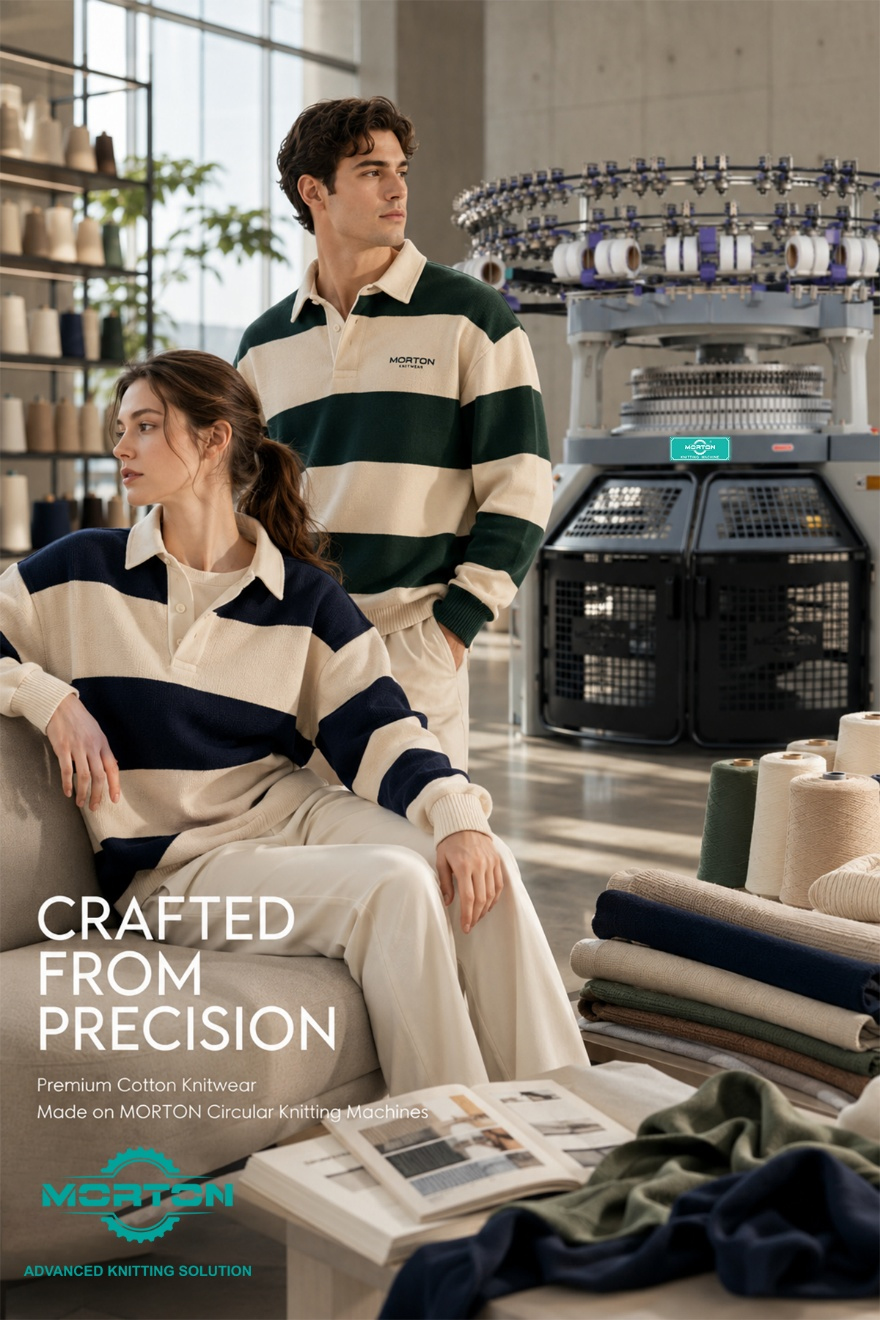
High-quality polo fabrics are produced on carefully configured Circular Machines, designed to create that signature textured surface with consistent quality.
Most people assume great fabric comes from great yarn.
In reality, yarn is only half the equation.
The machine matters just as much.
Machine gauge.
Yarn count.
Feeder arrangement.
Cam configuration.
Knitting tension.
Even small adjustments influence the depth of the piqué texture, the weight of the fabric, and how the finished shirt feels when someone puts it on.
For certain premium applications, manufacturers may also choose Interlock Machines to create fabrics with greater stability, a smoother hand feel, or enhanced durability.
Long before a designer sketches a polo shirt, the engineering has already begun on the knitting floor.
A Shirt That Never Went Out of Style
More than one hundred years after René Lacoste’s original idea, the polo shirt remains one of the world’s most versatile garments.
Fashion trends have changed countless times.
The polo shirt has remained.
Not because it’s fashionable.
Because it works.
Today it’s worn by athletes, students, hotel staff, airline crews, factory managers, office workers, and millions of people who simply appreciate comfortable clothing.
Most people never think about how a polo shirt is made.
They simply notice that it’s breathable.
Comfortable.
Easy to wear.
Long before that shirt reaches a store, however, its fabric has already spent hours on a knitting machine.
That’s where our work begins.
At MORTON, we build Circular Machines and Interlock Machines that help textile manufacturers produce the high-quality knitted fabrics behind classic polo shirts and countless other everyday garments.
We don’t make the polo shirt.
We build the machines that make the fabric behind it.
Because every great polo shirt begins long before it’s sewn together.
It begins on a knitting machine.
MORTON — Advanced Knitting Solutions
Post time: Jul-02-2026