
A customer once showed us a T-shirt that had only been washed a few times.
The fabric still looked good. The color had not faded, and the overall feeling was still comfortable. But the collar had started to lose its original shape. It no longer sat flat like it did when the shirt was new.
The first thought was that the sewing process was not done correctly.
This is a common reaction when people see a garment change after washing.
But in textile manufacturing, many problems that appear at the garment stage actually begin much earlier.
Before a T-shirt is cut.
Before it is sewn.
Before it reaches a clothing store.
The foundation has already been created during the fabric production process.
And behind that fabric is the knitting machine.
# A T-Shirt Looks Simple, But The Fabric Behind It Is Not
A basic T-shirt is one of the most common garments in the world.
People wear them every day without thinking about how they are made.
A white cotton T-shirt may look simple, but producing a fabric that feels comfortable, keeps its shape, and performs well after repeated washing requires careful control.
The reason is the structure of knitted fabric.
Unlike woven fabric, which is created by crossing horizontal and vertical yarns, knitted fabric is formed by connecting thousands of small loops together.
This loop structure gives T-shirts their softness and natural stretch.
It allows the fabric to move with the body instead of feeling stiff.
However, flexibility also creates a challenge.
The same structure that gives comfort must also remain stable.
If the balance inside the fabric changes, problems may appear later.
A twisted collar.
An uneven hem.
A side seam that slowly moves away from its original position.
These issues are often noticed when someone wears the garment, but the cause may have started during knitting.
# Why Does A T-Shirt Collar Twist After Washing?
There are several reasons why a T-shirt collar may lose its shape.
Some are related to garment construction.
Some are related to fabric finishing.
But many are connected to the stability of the knitted fabric itself.
During the knitting process, yarn passes through many components inside the machine.
Needles form loops.
Feeders control yarn delivery.
Cams guide needle movement.
The relationship between these parts determines how evenly the fabric is created.
If the tension is not balanced during production, different areas of the fabric may hold different levels of internal stress.
At the beginning, the fabric may still look normal.
The problem may not be visible immediately.
But after washing, heat and moisture allow the fabric structure to relax.
The hidden tension begins to release.
This is when a customer notices that the collar has changed.
The washing process did not create the problem.
It simply revealed what was already inside the fabric.
# The Yarn Is Important, But It Is Not The Whole Story
When people talk about T-shirt quality, they often start with yarn.
And yarn does matter.
Cotton is popular because of its softness, breathability, and natural comfort.
Polyester is often selected when manufacturers need better durability and quick-drying performance.
Spandex is added when stretch and recovery are required.
Modal is chosen for its smooth feeling and comfortable touch.
However, experienced textile manufacturers know that good yarn alone does not automatically create good fabric.
The same yarn can produce different results in different production environments.
A cotton yarn used on two different machines, or even on the same machine with different settings, may create fabrics with different performance.
The final result depends on how the yarn is controlled during knitting.
This includes:
Yarn feeding consistency
Knitting tension
Loop length
Fabric density
Machine adjustment
In textile manufacturing, the yarn is only the beginning.
The knitting process determines how that yarn becomes a fabric.
# Fabric Structure Determines How A T-Shirt Feels
When someone buys a T-shirt, they usually judge it by simple things.
Is it soft?
Is it comfortable?
Does it feel good against the skin?
But behind these feelings is the structure of the fabric.
For everyday T-shirts, Single Jersey is one of the most commonly used structures.
It provides a lightweight feeling, good breathability, and natural comfort.
However, producing stable Single Jersey fabric requires more than selecting the right yarn.
The machine needs to maintain consistent control throughout production.
Small differences in knitting conditions can influence:
Fabric weight
GSM consistency
Surface appearance
Stretch recovery
Dimensional stability
For garments that require more stability, some manufacturers choose an Interlock Machine to create fabrics with a tighter and more balanced structure.
Interlock fabrics are often used when manufacturers need a smoother surface, better stability, or a more premium hand feel.
The choice is not simply about choosing a faster machine.
It is about choosing the right knitting solution for the fabric.
# Why The Circular Knitting Machine Matters
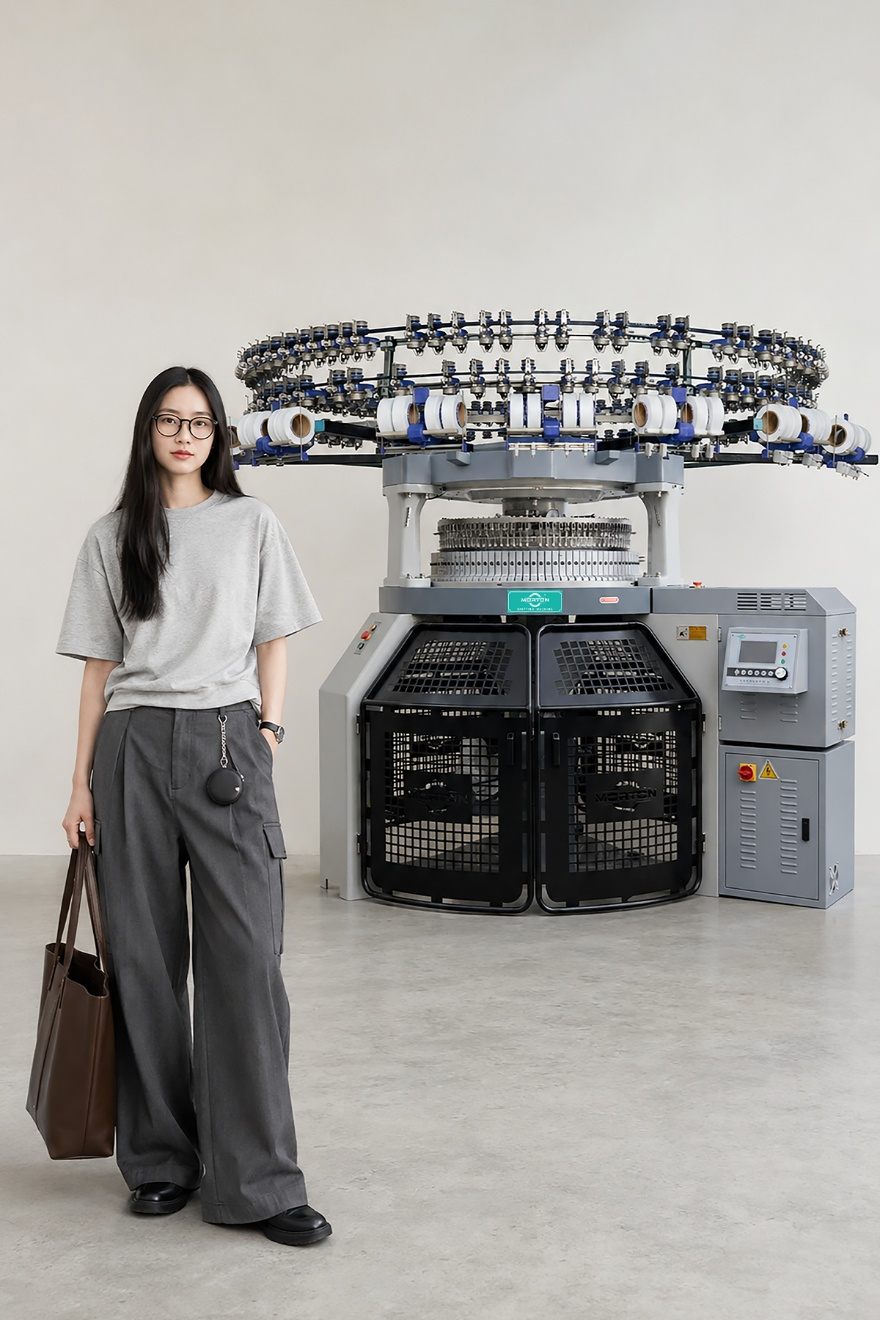
Most modern knitted fabrics are produced using Circular Knitting Machines.
To many people outside the textile industry, a knitting machine may look like a simple production tool.
But inside a Circular Knitting Machine, hundreds of movements must work together continuously.
The machine controls how yarn becomes fabric.
The needles determine loop formation.
The feeders control yarn delivery.
The cams influence knitting movement.
The cylinder and other components maintain fabric structure.
A small adjustment can affect the final result.
This is why experienced knitting mills pay close attention to machine stability.
A fabric order is rarely just one roll of material.
A customer may need thousands of meters with the same appearance, same weight, and same performance.
Consistency becomes one of the most important factors in production.
A good Circular Machine helps manufacturers maintain that consistency over long production periods.
# Why Experienced Mills Focus On Stability
In textile production, speed is easy to understand.
Everyone can see how many meters a machine produces.
But experienced manufacturers know that production speed is only one part of the equation.
The more important question is:
Can the machine continue producing the same fabric tomorrow, next month, and next year?
A fabric that looks good in the first few meters is not enough.
A knitting mill needs reliability across the entire production process.
This is why machine maintenance, adjustment, and testing are important.
A small worn component or incorrect setting may not immediately stop production.
But over time, it can influence fabric consistency.
The best textile manufacturers are not only focused on making more fabric.
They focus on making the same fabric again and again.
# Fabric Testing Comes Before Large Production
Before producing large quantities, many professional textile manufacturers test fabric samples carefully.
This process helps them understand how the fabric behaves.
How does it feel?
How does it stretch?
How does it recover?
How does it perform after washing?
Different garments require different solutions.
A lightweight summer T-shirt has different requirements from a heavyweight streetwear T-shirt.
A sportswear fabric needs different performance compared with casual clothing.
This is why fabric requirements should always come first.
The machine should follow the fabric.
Not the other way around.
# The Real Reason Behind A Better T-Shirt
Most people never see the journey behind a T-shirt.
They see the final garment hanging in a store.
They feel the softness.
They choose the color.
They decide whether they like the design.
But long before that moment, many decisions have already been made.
The choice of yarn.
The fabric structure.
The knitting process.
The machine adjustment.
The testing process.
A T-shirt that keeps its shape after many washes is not created by accident.
It is the result of controlling many small details throughout production.
# Building The Fabric Behind Everyday Clothing
After years working with textile manufacturers, one thing becomes clear:
The machine is not separate from the fabric.
They are connected.
At MORTON, we focus on developing Circular Knitting Machines and Interlock Machines that help textile manufacturers produce stable and reliable knitted fabrics.
We believe the customer is not simply buying a machine.
They are looking for a solution that helps them produce better fabric, maintain consistency, and support long-term production.
Because every garment has a story before it reaches the customer.
A T-shirt begins with yarn.
Yarn becomes fabric.
Fabric becomes a garment.
And behind every fabric, there is a knitting machine.
MORTON — Advanced Knitting Solutions
Post time: Aug-04-2026