
Walk into any clothing store on earth. I don’t care if you’re in Istanbul, Dhaka, São Paulo, or a small town in Nebraska. Look around. Count how many things in that store have cotton in them. The number will surprise you.
Cotton isn’t just the most popular natural fiber on the planet. It dominates in a way that almost nothing else in the textile world does. We’re talking about a plant—a crop—that somehow became the backbone of a global industry worth hundreds of billions of dollars.
How did that happen?
It wasn’t an accident. And it definitely wasn’t overnight.
The Simple Reason Cotton Won
Let me start with the obvious stuff.
Cotton is comfortable. It breathes. It absorbs moisture. It doesn’t make you itch the way wool does, and it doesn’t trap heat the way early synthetics did.
But comfort alone doesn’t explain a global takeover.
The real reason cotton won?
It was the first fiber that could be mass-produced, mass-processed, and mass-consumed at scale.
Think about it. Before the Industrial Revolution, most clothing was made from whatever fiber was locally available—wool in cold climates, linen in parts of Europe, silk in China, hemp in many places. But none of those could scale the way cotton did.
Here’s what cotton had that nothing else did:
- ✓ It grew in multiple climates (not just one region)
- ✓ Eli Whitney’s cotton gin (1793) made processing fast and cheap
- ✓ The invention of the power loom made weaving it into fabric even faster
- ✓ It dyed well. It washed well. It lasted.
By the mid-1800s, cotton was already on its way to becoming the world’s dominant textile fiber. And that was before modern knitting machines existed.
The Machine Age Made Cotton King
Here’s where it connects to what we actually do.
When circular knitting machines started appearing in the early 20th century, cotton was already the obvious choice.
Why? Because cotton yarn was:
The circular machine didn’t make cotton popular. But it made cotton unbeatable.
A good circular machine running cotton single jersey can produce fabric at speeds that would have been unimaginable a hundred years ago. And when the world wanted more T‑shirts—cheaper, faster, better—cotton was the fiber that made it possible.
Then People Started Asking Question
Look, cotton isn’t perfect.
The last twenty years have brought some hard questions:
- • Water. Cotton farming uses a lot of it. In places where water is scarce, that’s a real problem.
- • Chemicals. Conventional cotton farming uses pesticides and fertilizers. The numbers aren’t pretty.
- • Land. Cotton takes up a lot of agricultural land.
This is where things get more interesting than the usual “cotton is good, synthetics are bad” argument.
The industry response has been real:
Organic cotton went from a niche to a serious market segment. Better farming practices (drip irrigation, integrated pest management) have made a dent. And on the machinery side, modern knitting machines are designed to handle cotton more efficiently—less waste, better yield, higher speeds that offset the higher cost of better-quality cotton.
The best cotton fabric in the world is still grown, spun, and knitted by people who know what they’re doing.
The Real Challenge: Cotton Today
Here’s the honest truth that a lot of “content marketing” won’t tell you:
Cotton now competes with a flood of synthetics that didn’t exist 60 years ago. Polyester, nylon, elastane—these fibers have taken huge market share, especially in activewear and fast fashion.
But cotton is holding its ground. And in some segments, it’s growing.
Why?
Because consumers, especially younger ones, are starting to care about what their clothes are made of. Not in a pretentious way—they just want fabric that feels good and doesn’t fall apart after three washes.
Cotton delivers that.
And the market has gotten smarter. Blended fabrics—cotton-polyester, cotton-elastane, cotton-modal—give you the best of both worlds. The feel and breathability of cotton with the stretch and durability of synthetics.
Modern knitting machines handle these blends like a dream. A good interlock machine with the right yarn setup? You can produce premium blended fabric that feels expensive, wears well, and actually justifies the price tag.
This Matters If You’re Making Fabric
I’ll get straight to the point.
If you’re running a textile mill—or planning to start one—cotton is still your safest bet. Not because it’s the cheapest (it’s not). Not because it’s the easiest (synthetics are easier). But because:
- ▪ The demand is steady — cotton consumption has grown every decade for over a hundred years
- ▪ The infrastructure exists — cotton yarn suppliers, dyers, finishers—the whole chain is mature
- ▪ The machinery is proven — circular and interlock machines running cotton are the most well-understood production setup in the industry
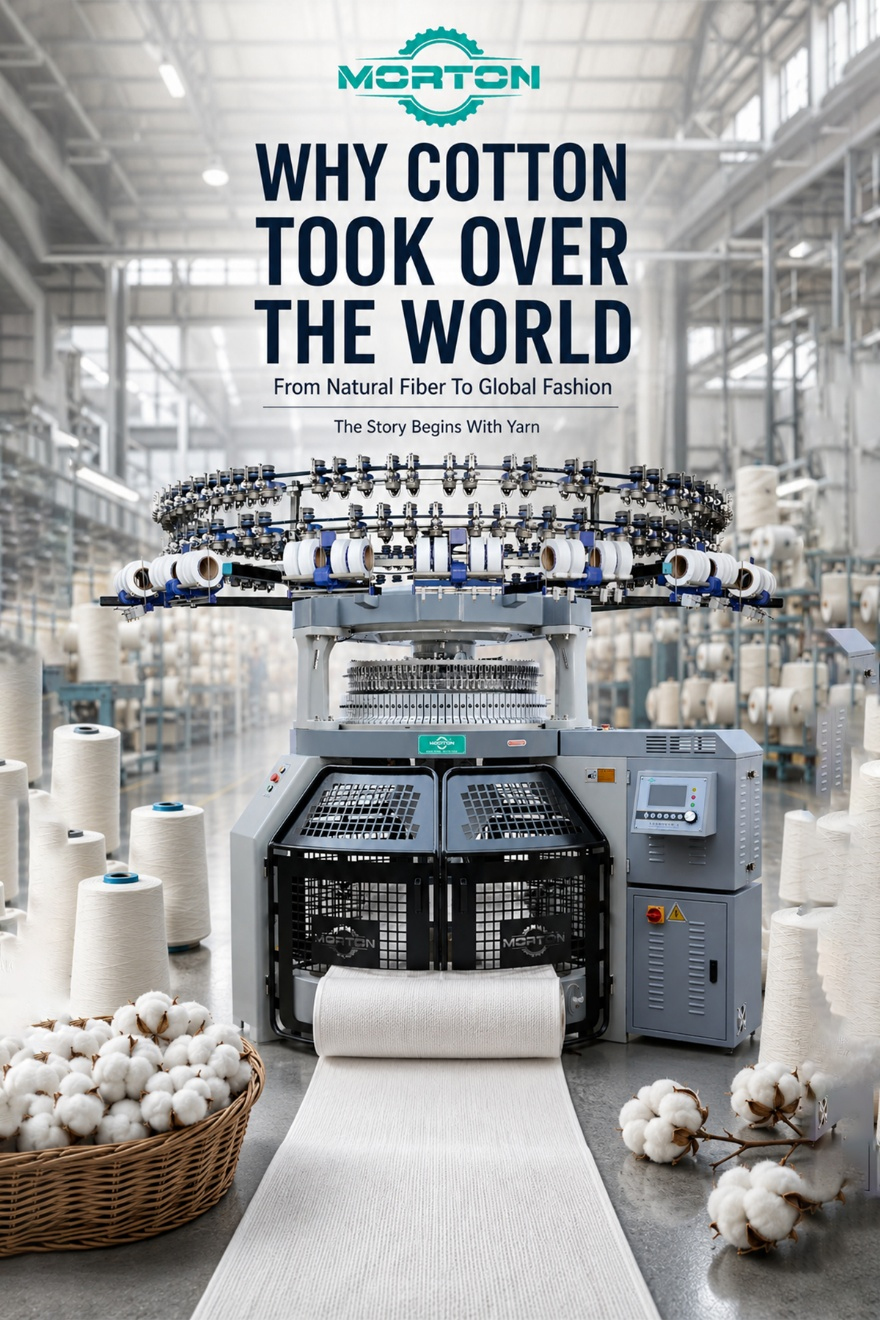
At Morton, we build machines that are optimized for exactly these realities. Our circular machines handle cotton single jersey at high speeds with minimal downtime. Our interlock machines produce premium cotton and cotton-blend fabrics that compete at the high end of the market.
We’ve been doing it long enough to know what works.
Cotton didn’t become the world’s favorite fiber by accident.
It earned it. Through a combination of natural advantages, industrial innovation, and the simple fact that it makes people feel good when they wear it.
And if you’re in the business of making cotton fabric?
The machines you choose still make all the difference.
Post time: Jun-11-2026