
Cut a piece of ordinary T-shirt fabric and leave it on a table.
At first, it looks perfectly flat. Then the edges begin to move. One side may roll inward, another may curl toward the back, and before long the neat rectangle you cut no longer looks very rectangular at all.
If you have never worked with knitted fabric, it is easy to assume something is wrong.
Maybe the fabric was knitted badly. Maybe it was stretched during production. Maybe the finishing was incorrect.
Sometimes those things can cause problems, but edge curling itself is often much simpler than that.
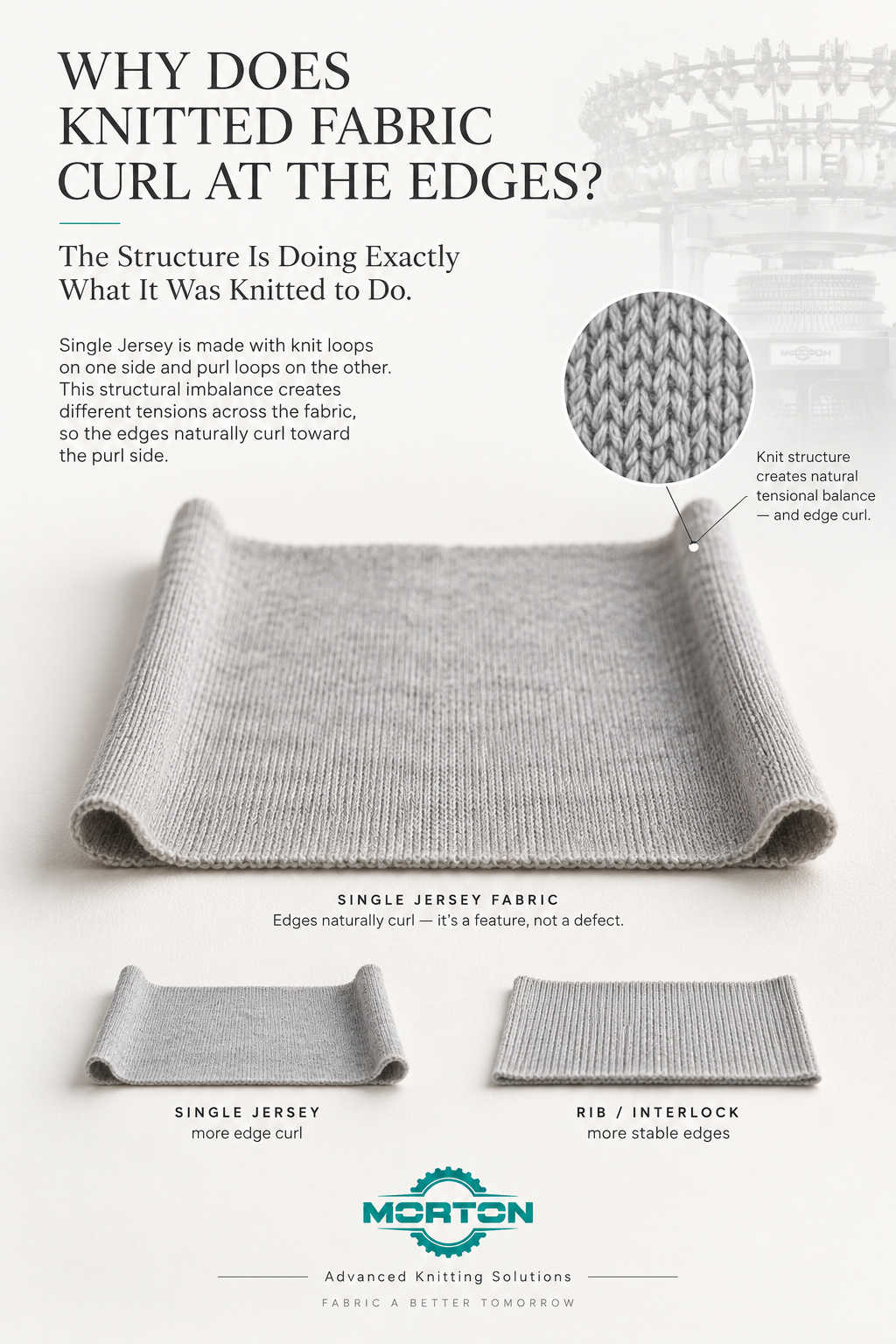
For many Single Jersey fabrics, curling is a natural consequence of the way the loops are built into the fabric.
The cloth is not misbehaving.
It is behaving exactly like Single Jersey often does.
The Fabric Remembers How It Was Knitted
A knitted fabric is not a flat sheet in the same way a piece of paper is flat.
It is made from yarn that has been bent repeatedly into loops. Those loops connect to the loops beside them and to the rows above and below, forming the structure we eventually recognize as fabric.
While the fabric remains inside a roll, under tension, or connected to a larger piece, those forces help hold it in place. Once the material is cut, the balance changes. The loops near the edge are no longer supported by fabric on every side, so they begin to relax.
That relaxation is what makes the edge curl.
Single Jersey is especially well known for this behaviour because its front and back are structurally different. Look closely at the face of the fabric and you will normally see a relatively smooth series of vertical knit wales. Turn it over and the back looks different, with the loop structure more visible.
That difference between the two sides creates an imbalance.
When the fabric is free to move, it tries to find a lower-stress position. The result is the familiar rolling edge that garment factories have dealt with for generations.
It is one of those textile behaviours that seems strange until you understand the structure underneath it.
Why Woven Fabric Usually Behaves Differently
This becomes easier to understand if you compare a knitted T-shirt with a woven shirt.
Cut a piece from many woven fabrics and the edge may fray, but it usually does not roll into the same tight curl seen in Single Jersey.
That is because woven and knitted fabrics are built in completely different ways.
Woven fabric is made by crossing yarns in two main directions. Warp yarns run along the length of the fabric, while weft yarns pass across them. The structure behaves more like a grid.
Knitted fabric is based on interconnected loops.
That looped construction gives knitted fabric many of the qualities people like in T-shirts, underwear and casual clothing. It can stretch, move with the body and feel softer than many woven structures.
The same loop structure also brings its own characteristics.
Curling happens to be one of them.
Why Does It Curl in Different Directions?
If you watch a freshly cut piece of Single Jersey carefully, you may notice that not every edge rolls the same way.
The edges running in one direction may curl toward the face, while the edges running in another direction behave differently.
This is another result of the way loops are arranged inside the fabric.
The fabric has lengthwise and widthwise directions, and the forces inside the loops are not identical in both. When those loops are released at a cut edge, they relax according to their structure.
Does Curling Mean the Fabric Is Low Quality?
Not necessarily.
This is probably the most important misunderstanding around this subject. A customer sees fabric curling and may immediately think the machine setting is wrong. Someone else may blame the yarn. Another person may assume the fabric has not been finished properly.
But a certain amount of curling is normal for many Single Jersey constructions.
The existence of curling alone does not tell you whether the fabric is good or bad.
Rib and Interlock Behave Differently
Rib and Interlock are formed using different arrangements of needles and loops. Their structures are more balanced between the two sides of the fabric than ordinary Single Jersey.
Because of that balance, they generally show less of the strong edge curling associated with Single Jersey.
Can a Knitting Mill Reduce Curling?
To some extent, yes. But it is better to think in terms of controlling curling rather than completely eliminating a natural property of the structure.
There is rarely one button on a Circular Knitting Machine labeled “stop curling.” The machine creates the knitted structure under controlled conditions, but the final behaviour of the fabric comes from the combination of yarn, structure, knitting settings, relaxation and finishing.
The next time you see the edge of a T-shirt fabric rolling up on itself, you do not necessarily need to straighten it immediately. Look at it for a moment. That small curl is showing you something about the loops hidden inside the cloth.
MORTON — Advanced Knitting Solutions
Post time: Sep-18-2026