
Pick up almost any T-shirt and run your fingers over the collar. Then touch the fabric a few centimeters lower on the chest. They may be the same color and made from the same cotton, but they do not feel quite the same.
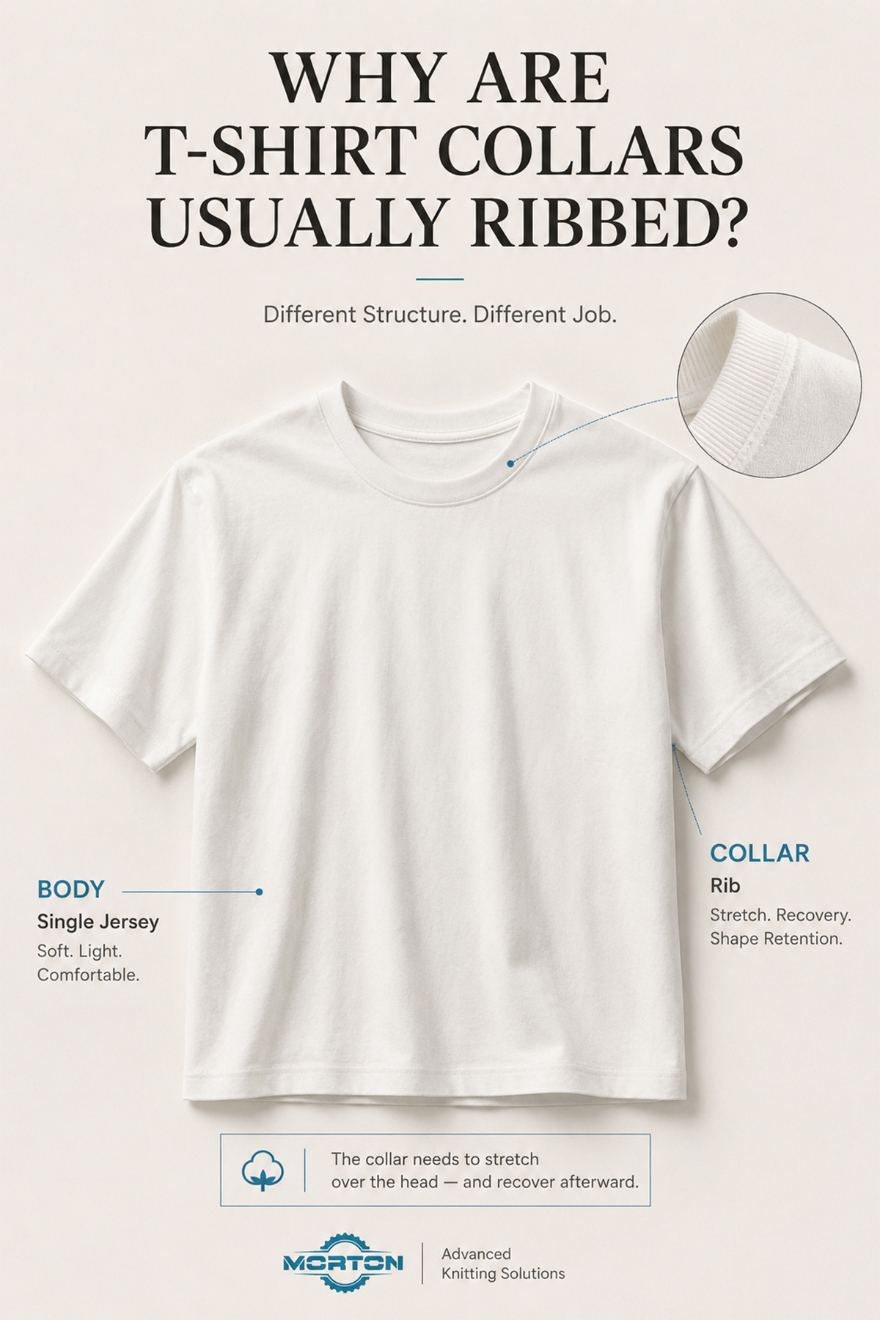
The body is usually soft and relatively flat. The collar feels thicker, has visible vertical lines and, most importantly, stretches much more easily when you pull it. Once you let go, it tries to return to its original shape.
That difference is intentional.
A T-shirt collar has a harder job than most of the fabric around it. Every time the shirt is put on, the opening has to stretch wide enough to pass over the head. Afterward, it needs to recover and sit reasonably close to the neck. Repeat that process through months of wearing and washing, and it becomes clear why simply using the same fabric as the body is not always the best solution.
That narrow strip around your neck is usually a different knitted structure: Rib.
One T-Shirt Can Contain More Than One Kind of Knitted Fabric
From a distance, a basic cotton T-shirt looks like one piece of fabric with sleeves attached. In manufacturing, it is more useful to think of it as several components that have different jobs.
The body of a common T-shirt is often made from Single Jersey Machine. It is lightweight, comfortable and familiar enough that most people probably have several examples in their wardrobe without knowing the name of the structure.
The collar has a different requirement.
It needs to stretch every time the garment is pulled over the head, but stretch alone is not enough. If the opening becomes larger and stays larger, the collar will gradually lose the shape that made it fit properly in the first place.
Rib fabric is useful here because of the way its knitted structure behaves. Look closely and you can often see the characteristic vertical ribs running along the surface. When stretched across its width, the structure can open up considerably and then contract again after the force is removed.
That behaviour makes it particularly useful in places where a garment needs both flexibility and recovery.
Collars are one example. Cuffs and waistbands are others.
Once you start looking for Rib in your wardrobe, you will probably find much more of it than you expected.
Why Not Just Make the Collar From the T-Shirt Fabric?
It can be done, and not every T-shirt collar is constructed in exactly the same way. Fashion designers and garment manufacturers have plenty of options depending on the look, cost and performance they want.
But there is a simple reason Rib became so common.
Imagine putting on a T-shirt hundreds of times. Each time, the neckline is pulled outward as it passes over the head. The fabric is also exposed to washing, drying and the ordinary pulling that happens while the shirt is being worn.
The body of the shirt does not experience quite the same repeated deformation in one concentrated area.
A neckline therefore asks more from the fabric than it first appears.
Using a structure with suitable stretch and recovery gives the garment maker more control over how the collar behaves. Depending on the product, manufacturers may also use yarn containing Spandex or make other adjustments to improve recovery. There is no single recipe for every T-shirt, but the basic design problem remains the same: the opening has to become larger temporarily without permanently looking larger afterward.
This is also why judging a collar only by how stretchy it feels in a new garment can be misleading.
The more interesting question is how it behaves after being stretched again and again.
Those Little Vertical Lines Come From the Knitting Structure
The appearance of Rib is not a decorative pattern printed onto the fabric. It comes from the way the loops themselves are arranged.
This is where the difference between Single Jersey and Rib becomes more interesting.
Single Jersey can be produced using one set of needles on a circular knitting machine. Rib structures use a different knitting arrangement involving cylinder and dial needles. The relationship between knit and purl wales creates the characteristic ribbed appearance and gives the fabric its distinctive behaviour across the width.
To someone buying a T-shirt, this technical difference is invisible. The label might simply say 100% cotton, even though the body and collar do not behave the same way at all.
That is one of the reasons fiber composition tells only part of the story of a fabric.
Two pieces of material can use the same cotton yarn and still feel, stretch and recover differently because the yarn has been knitted into different structures.
It is a useful thing to remember the next time two garments both say “100% Cotton” on the label but feel completely different in your hands.
The yarn matters, but the structure matters too.
A Good Collar Is Easy to Ignore
There is a funny thing about T-shirt collars: we usually notice them only when something goes wrong.
When the collar sits properly, nobody thinks about it. You put the shirt on and go about your day.
When it becomes loose, twisted, wavy or stretched out, suddenly it is the first thing you see.
People sometimes describe this as a “bad collar,” but several things can contribute to the final result. The Rib structure itself matters, but so do yarn selection, knitting conditions, collar dimensions, cutting, sewing and finishing. Washing and garment care also affect what happens over time.
Even the relationship between the collar and body fabric needs consideration. A collar that looks perfectly flat before washing may behave differently if the body fabric and Rib change dimensions differently during processing or laundering.
For a manufacturer, this means producing a good collar is not simply a matter of making the Rib as tight as possible.
Too loose is obviously a problem, but tighter is not automatically better. The collar still has to stretch comfortably over the head, return to shape and work with the rest of the garment without creating unwanted puckering around the neckline.
Like many things in knitting, the best result usually comes from balance rather than from pushing one parameter to an extreme.
Why Do Some Collars Contain Spandex?
Check the labels on a few T-shirts and you may occasionally notice that the body is listed as cotton while the Rib collar contains a small amount of Spandex.
There is a practical reason for that.
Spandex can help improve stretch and recovery, which is useful in a component that is repeatedly pulled out of shape during normal wear. It does not mean that every good collar needs Spandex. Rib structures already have considerable mechanical stretch because of their construction, and many collars are successfully produced without it.
The decision depends on the garment the manufacturer wants to make.
A heavy T-shirt with a substantial neckline may need a different collar specification from a very light summer tee. Sportswear, children’s clothing and fashion garments can introduce their own requirements. Yarn, Rib structure, width, density and finishing all have to work together with the design of the garment.
This is why there is no universal “best T-shirt collar” specification that can simply be copied from one product to another.
The finished garment decides what the fabric needs to do.
The Collar Starts Long Before the Sewing Machine
When people see a worker sewing Rib around a neckline, it is tempting to think that this is where the collar is made.
In reality, much of its behaviour has already been decided.
Before the Rib ever reaches the garment factory, someone has selected the yarn and decided what structure to knit. A knitting machine has been configured for that fabric, the material has gone through dyeing and finishing, and its width, weight, stretch and recovery characteristics have already begun to take shape.
Sewing turns that material into a collar, but sewing cannot completely rewrite the fabric underneath it.
This is a pattern we see repeatedly in textile manufacturing. A problem that becomes visible in the finished garment may have roots much earlier in production, while a small detail that feels particularly good may also owe much of its performance to decisions made before cutting and sewing began.
The more you understand fabric, the more difficult it becomes to look at clothing as simply “cotton,” “polyester” or “spandex.”
There is another layer underneath those fiber names: structure.
From Single Jersey to Rib
For knitting mills, changing from a Single Jersey fabric to a Rib fabric is not the textile equivalent of selecting a different pattern from a menu.
The machine configuration is different because the structures are formed differently.
A Single Jersey Circular Knitting Machine is commonly used for the fabric found across the body of everyday T-shirts. Rib and other double-knit structures require cylinder and dial needle systems capable of creating the required loop arrangement. Machine gauge, diameter, yarn and the desired finished fabric all influence how a production solution should be configured.
This is one reason that when a customer sends MORTON a garment or fabric sample, we are interested in more than the material composition printed on its label.
“100% cotton” is not enough.
We want to see the fabric.
Sometimes one garment can tell us several different stories. The body might point toward Single Jersey. The collar points toward Rib. A sweatshirt might reveal another structure when we turn it inside out. What appears to the consumer as one simple piece of clothing may actually be the result of several different knitting and finishing decisions.
That is the part of textile manufacturing most people never get to see.
Check Your Collar the Next Time You Put On a T-Shirt
The next time you get dressed, stretch the collar of your T-shirt gently before putting it on.
Look at the vertical ribs. Feel how easily the opening expands. Then let it go and watch what happens.
It is a tiny demonstration of knitted fabric engineering sitting in your wardrobe.
Nobody buying a basic T-shirt needs to know how cylinder and dial needles work, just as someone driving a car does not need to understand every part of the transmission. But for those of us who make textile machinery and work with knitting mills, these ordinary details are often the most interesting ones.
They remind us that a garment begins much earlier than the sewing line.
At MORTON, we build Circular Knitting Machines for different knitted structures and production requirements, but the starting point of the conversation is still the fabric a customer wants to make. A machine specification only becomes meaningful when we understand what that fabric needs to do after it leaves the knitting floor.
In the case of a T-shirt collar, the requirement sounds simple: stretch when you need it to, and come back when you don’t.
Achieving that simple behaviour is where the knitting becomes interesting.
MORTON — Advanced Knitting Solutions
Post time: Sep-05-2026