
Think about the running shoes you lace up every morning, the trainers waiting in your gym bag, or the casual sneakers that get you through a long workday. Have you ever wondered how that breathable, high-performance mesh upper is actually made?
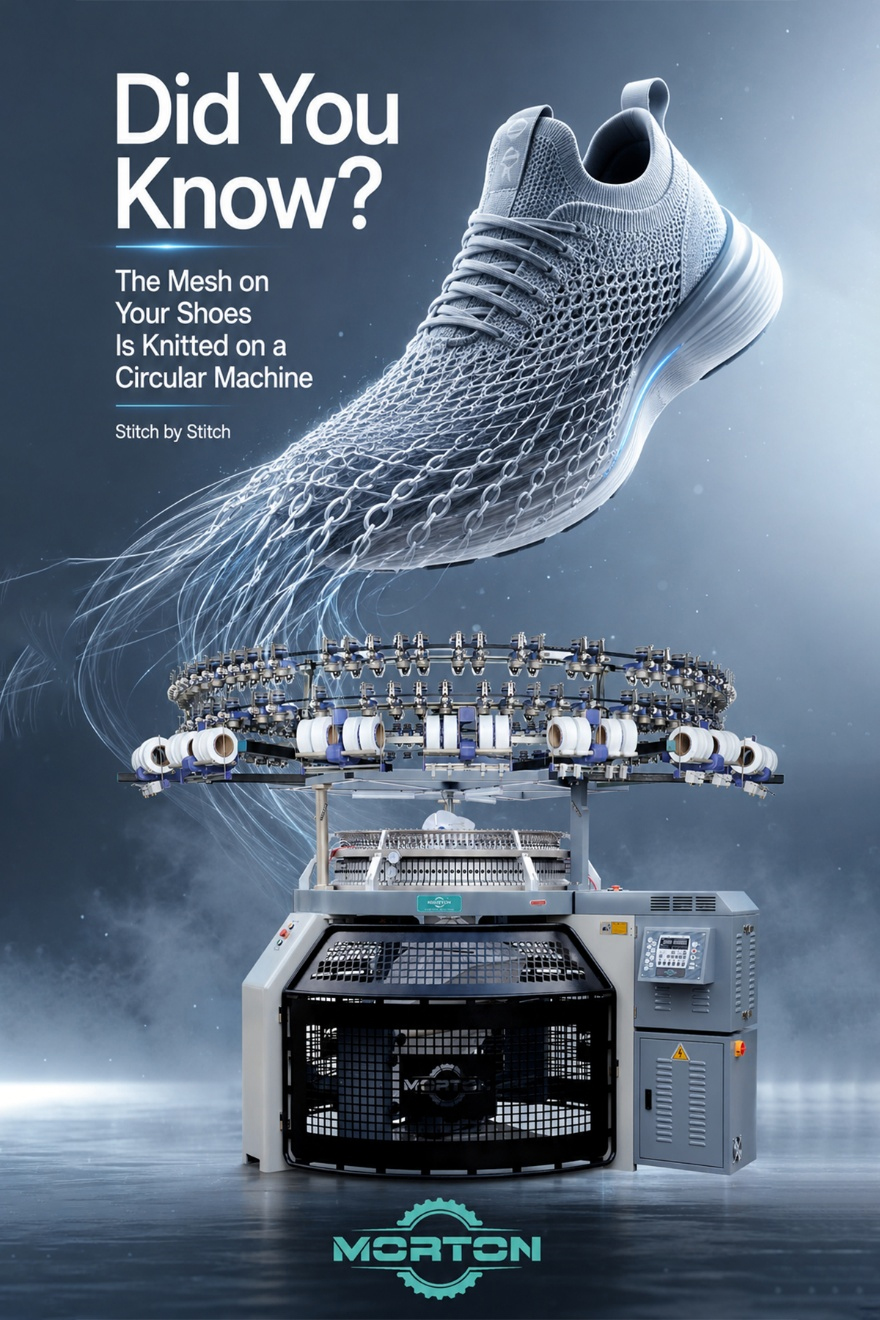
It’s not stamped out from a flat sheet of synthetic fabric, nor is it a patchwork of dozens of tiny, stitched-together pieces. In fact, its origin story is remarkably similar to the knitted sweater in your wardrobe. It all begins with a single cone of yarn, fed into a high-speed circular machine. The equipment loops the yarn into a seamless fabric tube, which is only later shaped and transformed into the shoe upper.
From Heavy Leather to Breathable Mesh: The Footwear Evolution
Before the 1970s, athletic shoe uppers were dominated by leather and canvas—materials that offered support but lacked ventilation. That blueprint changed forever when the global running boom sparked a demand for lighter, more breathable footwear.
While nylon mesh initially made its debut via warp knitting tech, it was the versatility of the weft-knitting circular machine that truly unlocked large-scale, cost-effective, and highly elastic mesh production.
Today, the vast majority of sports, running, and hiking shoes rely heavily on circular-knitted fabrics, ranging from structural sandwich mesh to lightweight single-jersey and advanced 3D spacer materials. While proprietary tech like Nike’s Flyknit or Adidas’ Primeknit utilizes flat-bed knitting, those innovations capture the premium, niche end of the market. Beneath that tier, across the massive mid-range and high-performance footwear segments, circular-knitted mesh remains the undisputed backbone of the global footwear supply chain.
Why Do Footwear Brands Demand Flawless Circular Knitting?
The performance of a mesh upper hinges entirely on consistency. In the knitting process—whether running a specialized mesh setup or a high-precision interlock machine for double-knit structural integrity—even a microscopic drop in yarn tension or a single micro-breakage creates immediate visual defects. You get horizontal striping, uneven pores, or structural thin spots.
These flaws might seem minor on a roll of raw fabric, but they become catastrophic once the material hits the shoe factory. Because shoe uppers are fundamentally three-dimensional, they undergo intense heat pressing, molding, and lasting. If the base fabric lacks uniformity, the finished upper will twist, develop color shading, or tear under mechanical stress.
This is why top-tier footwear textile mills place such brutal demands on their circular machine setups:
- Ultra-Stable Yarn Delivery: When running polyester DTY or premium nylon, even a fraction of a gram of tension variance alters the mesh pore size, ruining both breathability and visual uniformity.
- Precision Gauge & Feeder Matching: To achieve a featherlight feel without sacrificing tear strength, modern interlock machine models and single-jersey machines are typically configured as high-gauge (often 28G to 32G) with optimized feeder counts.
- A Zero-Tolerance Surface: The slightest burr or rough edge on a needle bed can snag the yarn, creating micro-pilling or pulled threads—defects that modern sports brands will reject instantly during quality control.
A Great Shoe Starts with a Perfect Loop
At the MORTON — Advanced Knitting Solutions testing workshop, we often share a perspective with our footwear clients: “Every single ventilation hole coming off this machine is destined to become a cooling point for a runner’s foot.”
Ensuring that every roll of mesh delivers identical breathability, weight consistency, and stretch recovery isn’t something you can fix with a post-production inspection. It has to be engineered into the mechanical stability of the machine while it runs. This brings us back to the core philosophy we live by: machine precision dictates factory retention.
Every tiny burr our engineers hand-file during assembly, every yarn feeding angle we meticulously calibrate, and every alignment check we refuse to rush—it all translates into words that a footwear material buyer can say with total confidence: “This batch is perfect.”
Engineering Under Your Laces
The next time you tie your shoelaces, run your fingers across that mesh upper. Behind that seamless patch of fabric are thousands of high-speed needles moving in perfect synchronization, synthetic yarns racing through feeders, and a technician who leaned over to double-check a tolerance before the machine ever left our factory floor.
It all starts with a single strand of yarn
MORTON
Advanced Knitting Solutions
Post time: May-28-2026