
Pick up two T-shirts in a store.
They might look almost identical.
Same color.
Same style.
Maybe even the same price.
But as soon as you touch them, you’ll notice something different.
One feels smoother.
Softer.
It hangs better and somehow still looks new after dozens of washes.
Most people assume it’s simply better cotton.
Very often, it isn’t.
There’s a good chance you’re holding a fabric made with Modal.
And surprisingly, the story of Modal doesn’t begin in a textile mill.
It begins in a forest.
When Someone Looked at a Tree and Saw Fabric
By the end of the nineteenth century, the textile industry was under pressure.
Cotton production couldn’t always keep pace with growing demand, while silk remained too expensive for everyday clothing.
Manufacturers wanted a fiber that was soft, affordable, and available in large quantities.
That raised an unusual question:
Could wood become fabric?
At first, the idea sounded impossible.
But scientists discovered that the cellulose inside wood pulp could be extracted, dissolved, and spun into fibers.
The result was rayon—the world’s first regenerated cellulose fiber.
For its time, it was an incredible achievement.
Yet anyone who worked with rayon knew its weaknesses.
A rayon shirt often lost strength when it became wet.
It wrinkled easily.
After enough washing, it simply didn’t feel the same.
The idea had enormous potential.
The material just wasn’t there yet.
A Better Answer Came from Austria
In the 1950s, Austrian fiber manufacturer Lenzing wasn’t trying to invent a luxury fabric.
Their goal was much simpler.
They wanted to solve the problems rayon couldn’t.
After years of development, they introduced a new regenerated fiber made from sustainably sourced beechwood pulp.
They called it Modal.
Compared with traditional rayon, Modal felt noticeably softer, stayed stronger when wet, held color better, and kept its shape after repeated washing.
It wasn’t trying to replace cotton.
It simply became another excellent choice.
Why Textile Mills Like Working with Modal
Walk through a modern knitting mill and you’ll find Modal almost everywhere.
Premium T-shirts.
Underwear.
Loungewear.
Baby clothing.
Sportswear.
The reason is simple.
Modal gives manufacturers a combination that’s surprisingly difficult to achieve.
It’s soft without feeling delicate.
It drapes naturally without becoming heavy.
It accepts dye exceptionally well, producing rich, vibrant colors.
And after months of wear, it still looks remarkably fresh.
Many brands blend Modal with cotton for everyday comfort.
Others combine it with elastane to produce stretch fabrics for activewear.
Either way, it’s a fiber that performs exceptionally well in knitted fabrics.
The Machine Matters More Than Most People Realize
People often think a great fabric comes down to choosing the right yarn.
Anyone working in a knitting mill knows that’s only part of the story.
The same Modal yarn can produce very different fabrics depending on the machine that’s knitting it.
Machine gauge.
Yarn tension.
Cam settings.
Feeder arrangement.
Even small adjustments can change how the finished fabric feels in your hand.
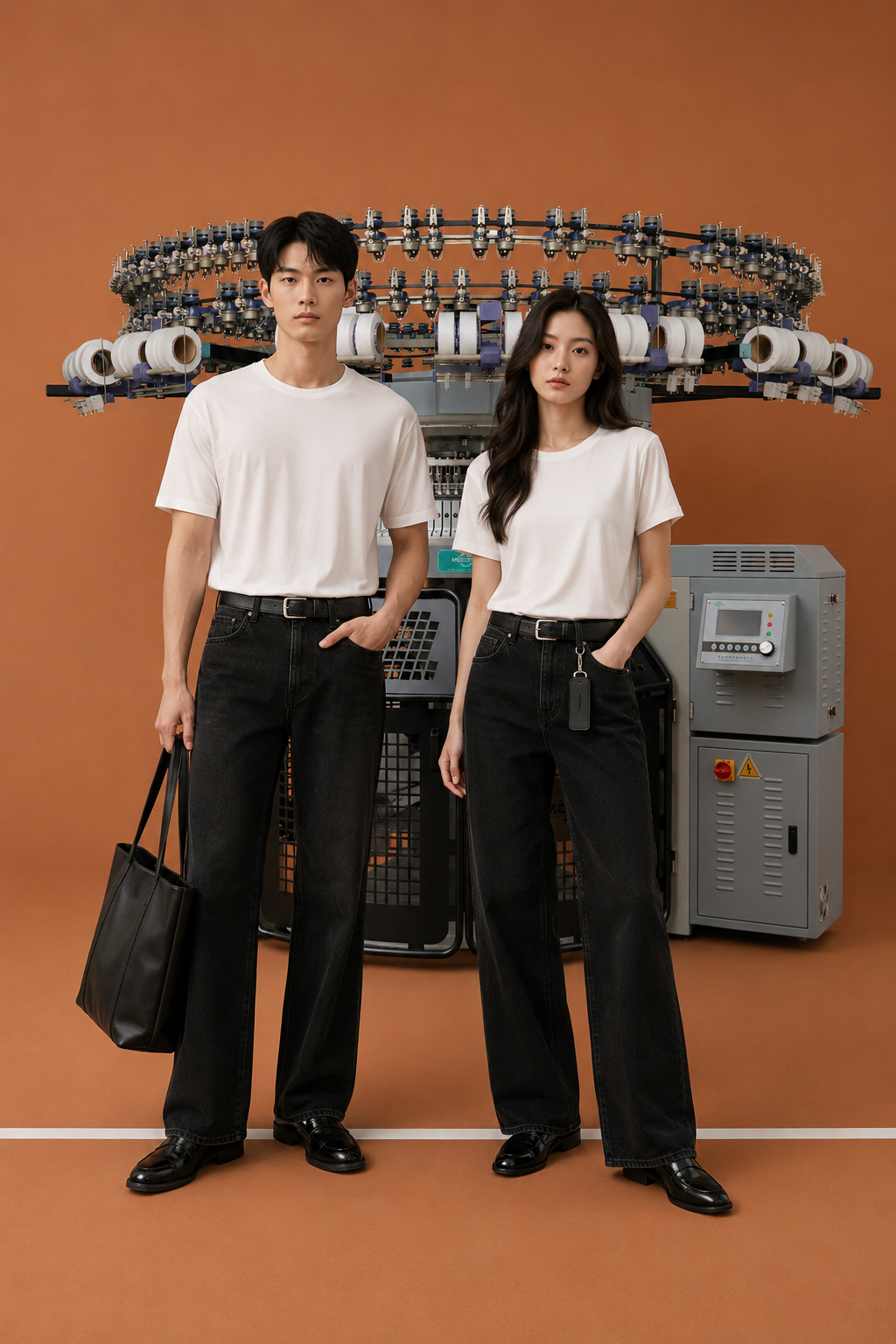
A well-configured Circular Machine produces smooth, consistent jersey fabric that’s perfect for premium T-shirts.
An Interlock Machine creates a denser and more stable construction, making it a popular choice for high-quality basics and performance apparel.
The fiber provides the potential.
The machine determines how much of that potential becomes fabric.
From Forest to Fabric
It’s remarkable when you think about it.
A beech tree growing quietly in a managed forest eventually becomes a T-shirt hanging in a clothing store thousands of miles away.
Between those two moments lies an extraordinary journey.
Wood becomes pulp.
Pulp becomes fiber.
Fiber becomes yarn.
Yarn becomes fabric on a Circular Machine or an Interlock Machine.
Only then does it become clothing.
Most people will never think about that journey.
They’ll simply notice that their favorite T-shirt feels softer than the others.
At MORTON, that’s the part of the story we help create.
We build Circular Machines and Interlock Machines that enable textile mills around the world to transform innovative fibers like Modal into premium knitted fabrics.
Because every comfortable T-shirt has a story.
And long before it reaches your wardrobe, that story begins on a knitting machine.
MORTON — Advanced Knitting Solutions
Post time: Jul-06-2026