
A customer approves a fabric sample. The GSM is correct, the width is within tolerance, and the hand feel is exactly what the garment brand wants.
The first production order goes well.
A few months later, the customer returns with what seems like a straightforward request:
“Please produce the same fabric again.”
The mill uses the same fabric specification and the same yarn composition. The finished fabric looks close to the approved sample, but it is not quite the same. It may feel slightly firmer, finish a little narrower, or show a different level of shrinkage after washing.
For a garment factory, these are not minor details. A change in fabric width affects marker planning and fabric consumption. Different shrinkage can change garment measurements, while a change in hand feel may be noticed immediately by the brand or the final customer.
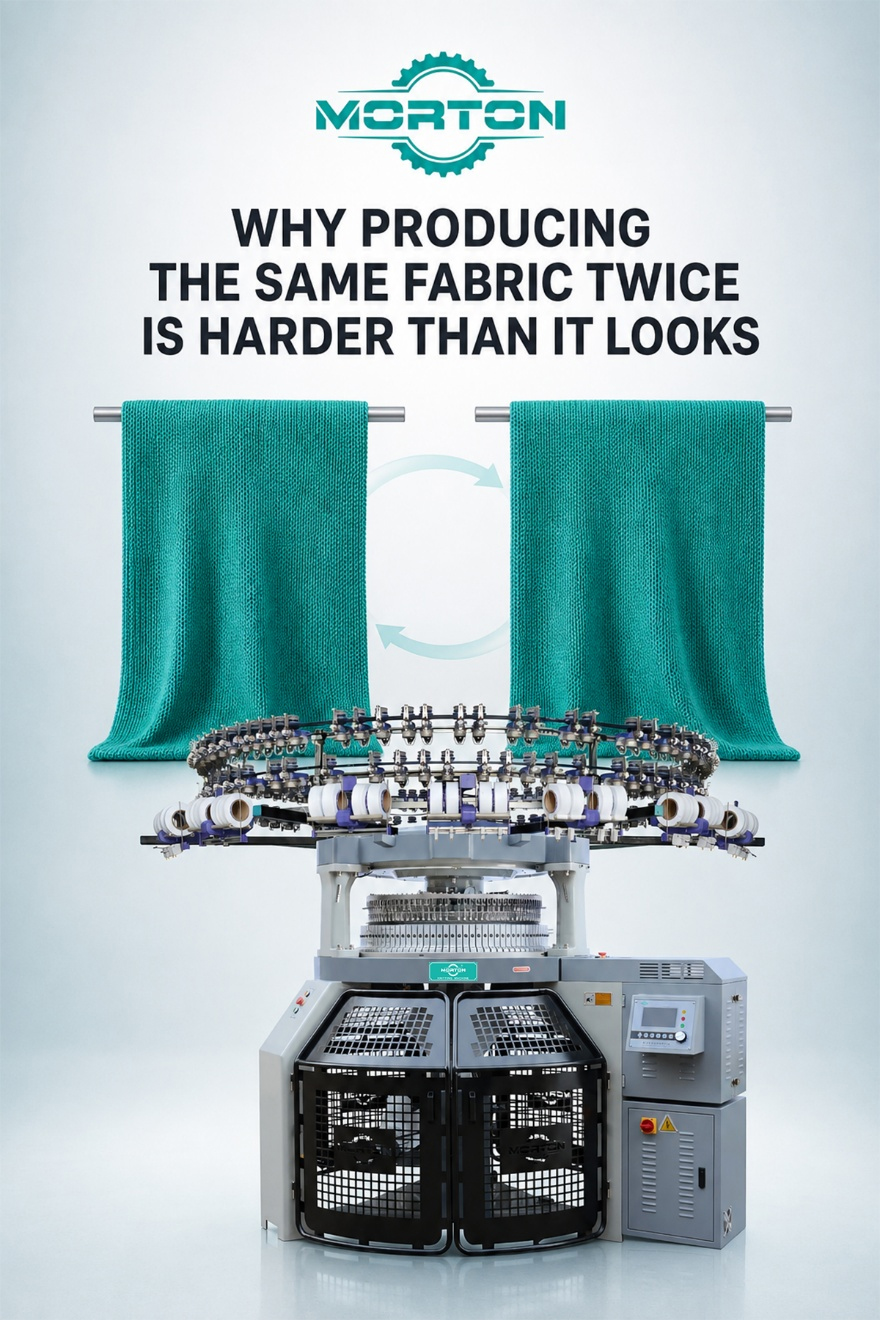
This is why repeat orders can be more difficult than first-time development. Producing a good sample once proves that the result is possible. Producing it again requires the mill to recreate the conditions that made that result possible.
A Specification Sheet Cannot Record Everything
A fabric specification usually includes the yarn composition, yarn count, machine diameter and gauge, fabric structure, target GSM, and finished width. These details are essential, but they do not describe the complete production history.
The approved fabric may have been made from a particular yarn lot, at a certain stitch length and machine speed, under specific knitting and finishing conditions. The take-down setting, yarn feeding tension, grey fabric relaxation time, dyeing process, and compacting conditions may all have contributed to the final result.
If these details were not recorded during sampling, the repeat order becomes partly dependent on memory.
Experienced mills therefore treat an approved sample as more than a piece of fabric. It becomes a production reference. Along with the physical sample, the mill should keep the main knitting settings, yarn information, grey fabric data, dyeing recipe, and finished test results.
The more information that is preserved, the easier it is to investigate any difference later.
The Same Yarn Description Does Not Mean Identical Yarn
A repeat order may use the same cotton count, polyester specification, or spandex brand, but the yarn itself can still behave differently.
Natural fibres are especially difficult to reproduce exactly. Cotton from different lots may vary slightly in fibre length, strength, moisture content, or colour. Even synthetic and blended yarns can show small differences between production batches.
These variations affect the way yarn runs on a circular knitting machine. One lot may require a small tension adjustment, while another may produce more fly or respond differently during dyeing and finishing.
For this reason, it is not enough to confirm that the yarn label is the same. The mill also needs to check the yarn lot and observe how it behaves during production.
The yarn supplies the raw material, but the knitting process determines the loop structure. That structure has a direct influence on fabric weight, density, stretch, width, and dimensional stability.
Machine Settings Must Be Reproduced, Not Guessed
On a circular knitting machine, small setting changes can affect a large quantity of fabric.
A slight difference in yarn feeding or stitch length may not be obvious when the first few metres come off the machine. Once the fabric is relaxed, dyed, washed, and compacted, however, the difference can become easier to see and measure.
Repeat production therefore requires accurate records. Depending on the fabric, the mill may need to confirm:
Yarn supplier, specification, and lot number
Machine diameter, gauge, and number of feeders
Needle, sinker, and cam arrangement
Stitch length or yarn consumption
Yarn feeding tension
Take-down settings
Machine speed
Grey fabric GSM and width
Dyeing and finishing conditions
Finished GSM, width, shrinkage, and hand feel
These records do not eliminate every variable, but they give the production team a reliable starting point.
Machine condition also matters. Needles and sinkers wear with use, knitting components require cleaning and lubrication, and fibre accumulation can affect long production runs. A machine may continue operating normally even when small changes are beginning to appear in the fabric.
Regular maintenance is therefore part of fabric consistency, not simply a way to prevent breakdowns.
Operators Still See What Data Cannot
Modern circular knitting machines provide better control and monitoring than earlier generations, but experienced operators remain important.
An operator who knows the machine may notice an unusual sound, a change in yarn movement, or a faint line in the grey fabric before it develops into a larger problem. These observations are difficult to capture on a specification sheet.
At the same time, experience should not replace production records. Relying only on an operator’s memory makes repeat orders more difficult, especially when staff, yarn lots, or production schedules change.
The most reliable mills combine both: machine data provides a measurable reference, while operator experience helps identify changes as they happen.
Knitting Is Only Part of the Repeat Order
A fabric can leave the knitting floor within specification and still finish differently.
Relaxation time, pretreatment, dyeing temperature, washing, drying, heat setting, and compacting all influence the final result. Even when the dyeing recipe remains the same, differences in grey fabric structure may change the appearance or dimensions after finishing.
Environmental conditions can also play a role. Temperature and humidity affect yarn behaviour, especially in factories where production conditions change between seasons.
The goal is not to remove every variable. That would be unrealistic. The goal is to understand which variables matter and keep them within a controlled range.
This is also why testing should continue throughout production. Checking only the first sample or the final roll leaves too much room for problems to develop unnoticed.
Grey fabric GSM, width, surface appearance, finished shrinkage, stretch recovery, and hand feel should be checked at suitable intervals. If a difference is found early, the mill still has time to adjust the process. If it is discovered after the whole order is finished, the cost is much higher.
Stable Production Matters More Than Maximum Speed
Machine speed is an important production figure, but the highest possible RPM does not always produce the lowest cost.
If excessive speed causes more yarn breaks, fabric defects, adjustment time, or rejected rolls, the apparent increase in output may disappear quickly. A stable production speed that maintains the approved fabric standard can be more efficient over the complete order.
For repeat orders, the better question is not simply:
“How fast can the machine run?”
It is:
“At what speed can the machine continue producing this fabric consistently?”
The answer will depend on the yarn, fabric structure, gauge, machine condition, and quality requirement.
Consistency Is a Production System
At MORTON, we usually begin a machine discussion by asking about the fabric. A mill producing lightweight single jersey for T-shirts has different requirements from one producing interlock, French terry, fleece, or technical sportswear.
The yarn composition, GSM, structure, finishing method, and final garment application all influence the machine configuration and production plan.
This is what we mean by:
Machine follows fabric.
Customers are not investing in textile machinery simply to add another machine to the factory. They need equipment that can support stable production over many orders and many years.
An approved sample shows what the mill can produce once. Good process control, experienced operators, accurate records, and a stable circular knitting machine make it possible to produce that fabric again.
That is the real test of a knitting mill—not one perfect roll, but the ability to deliver the same expected quality when the customer returns.
MORTON — Advanced Knitting Solutions
Post time: Aug-22-2026