
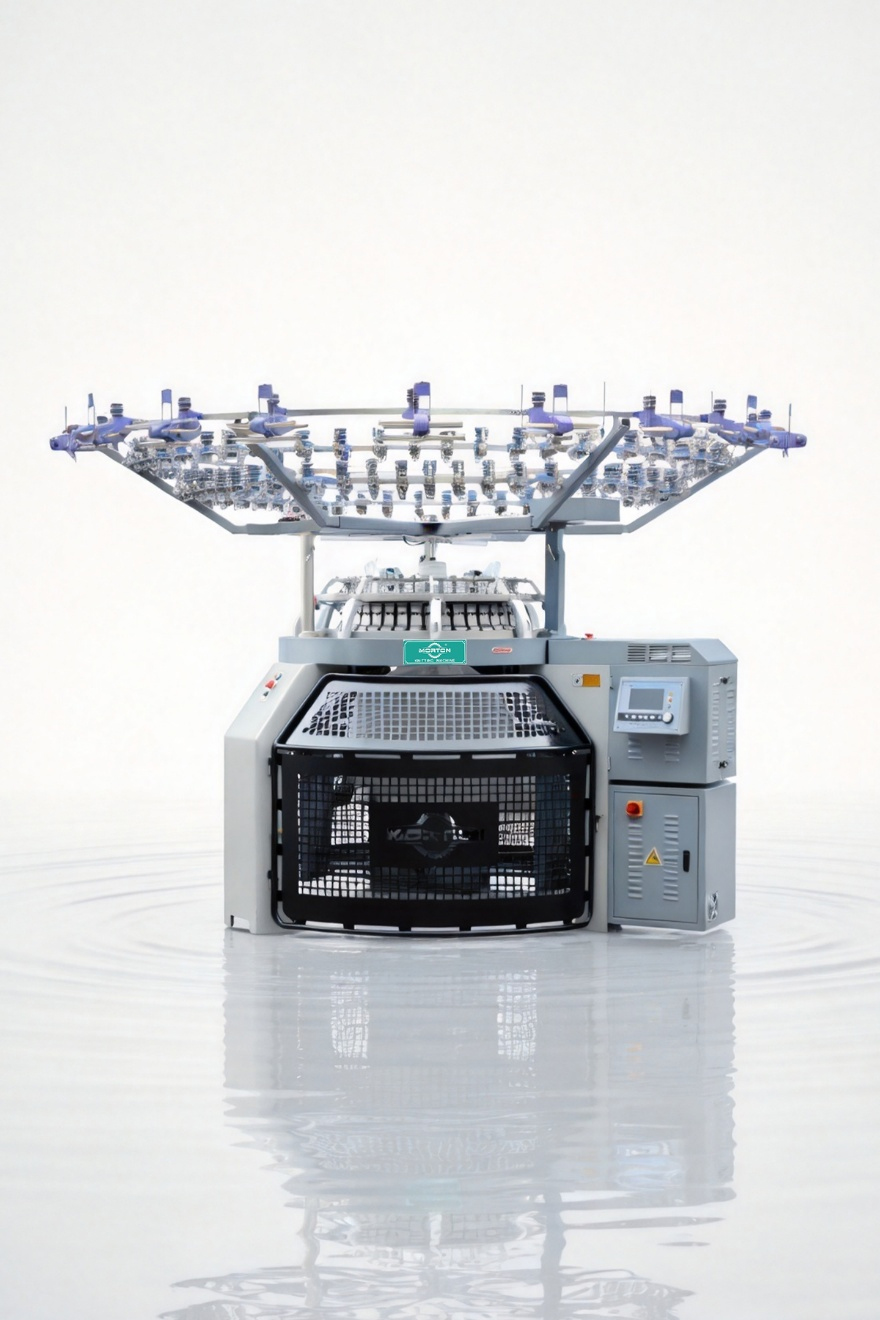
By the time a Circular Machine or Interlock Machine is fully assembled on our floor in Quanzhou, everything mechanical checks out. It runs. It's stable. From the outside, it looks ready to crate up.
But we don't sign off at "it runs."
Because what the customer is buying isn't a machine that turns on. They're buying a machine that spits out the right fabric, roll after roll. So before it goes anywhere, we put it through something that takes a bit more time: real fabric testing.
We Load Yarn and Watch What Comes Out
We don't just blip the motor and call it done. We load the actual yarn, set the parameters, and let the Circular Machine or Interlock Machine knit. Not for two minutes—long enough to see how it behaves as things warm up and settle in.
The first few meters of fabric tell you a lot. Everyone gets quiet for a second, watching it drop. We look at the surface. We feel the hand. Sometimes it comes out right straight away. That's always a nice moment. But more often, there's something. Something subtle.
When There's Oil on the Fabric — That's a Real Thing
Here's a scenario that doesn't make it into most brochures: oil spots.
Sometimes, on a fresh build or after a certain adjustment, you'll see a trace of oil on the fabric. It's not a mechanical failure—it's just a bit of residue from assembly or a needle that's been over-lubricated and is leaving a mark. In the trade, we just call those "oil needles."
When that happens, we don't panic. We also don't ship.
Usually, we'll let the machine run a bit longer. Give it time to work through the excess until the fabric comes down clean. If it doesn't clear up on its own, we stop. One of the guys will go in and clean the needle cylinder, wipe down the cam track, and make sure the knitting zone is spotless. Then we restart. And we keep checking.
It's a small thing, but those tiny oil marks can drive a customer crazy. We know that. So we deal with it here, in Quanzhou, not on their production floor.
Side by Side with the Customer's Sample
If the customer sent us a fabric sample—and we usually ask for one—it sits right next to the machine during all of this. Every new panel we knit gets laid down beside the original. Same light. Same angle.
We're not just looking. We're rubbing the fabric, stretching it, checking if the surface catches the light the same way. If it feels stiffer, we tweak. If the interlock structure doesn't have that clean, tight uniformity, we adjust. Cam timing. Yarn tension. Take-down speed. Sometimes it's one tidy fix. Sometimes it's an afternoon of tiny, stubborn changes.
I've seen a technician spend forty-five minutes chasing a barely-perceptible unevenness on an Interlock Machine that, honestly, most buyers might never notice. But he noticed. And that was enough to keep him at it.
Nobody Says "Perfect" — But We All Know When It's Right
There's no formal announcement. It's more like a moment where the fabric we're producing finally matches what the customer expects, and everyone standing around the machine just nods. That's the cue.
Only then do we move to pack.
Is it the fastest way to do things? No. But skipping this gauntlet means the customer becomes the tester. And that's not fair to them. So we take the extra time here—running out stray oil, fine-tuning the surface, comparing swatches until we can't spot a difference.
Because when a Circular Machine or Interlock Machine leaves Quanzhou Morton Machinery, it shouldn't need guessing. It shouldn't need a two-week "running-in" period. It should just produce.
From the very first meter.
MORTON — Advanced Knitting Solutions from Quanzhou, China.
Post time: Apr-29-2026