
1. Noise: The Problem
Nobody Puts on the Floor Plan
When a new knitting mill gets laid out, people argue about machine rows, yarn storage, walkways, loading docks. Noise almost never makes it onto the drawing. That’s a mistake.
A typical circular knitting floor running 50 single jersey machines sits somewhere between 82 and 92 dB(A) all shift long. That’s the same acoustic environment as standing next to a highway for eight hours. Do it day after day without protection, and the hearing loss doesn’t come back. On top of that, you get operators who can’t hear each other over the machines, warning calls that get missed, and an accident risk that climbs quietly in the background.
For mills in Turkey, Uzbekistan, and other hubs shipping to European and American brands, noise compliance has moved from optional to mandatory. Brands now check ambient noise levels as part of social compliance audits. If your floor runs above 85 dB(A) and you don’t have a documented hearing conservation program, expect corrective action requests. Orders on hold. Contracts pulled. Buyers don’t negotiate on this stuff anymore.
2. What Circular Knitting Machines Actually Produce
The noise coming off a Circular Machine doesn’t have a single source. It’s a mix.
Needle-to-cam interaction inside the cylinder track accounts for 40 to 50 percent of the total. Gear trains and belt drives add another 25 to 30 percent. Fabric take-down rollers contribute 10 to 15 percent. Fans and motor cooling fill in the rest.
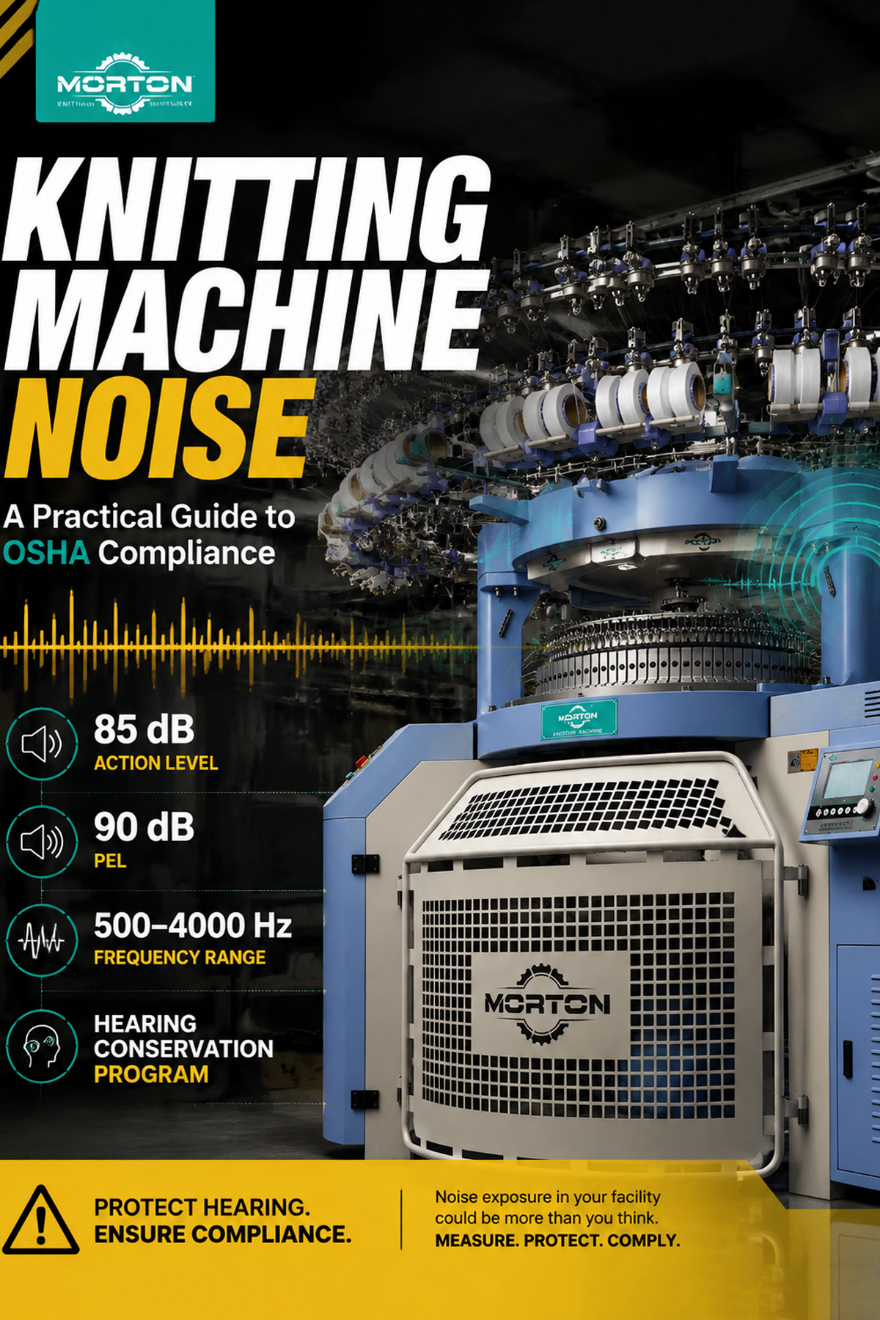
The frequency range you need to care about is 500 Hz to 4,000 Hz. Unfortunately, that’s exactly the band where human ears are most sensitive.
A single jersey Circular Machine running 28 to 30 RPM with 102 feeders will typically measure 84 to 90 dB(A) at one meter from the cylinder. An Interlock Machine or double-knit unit runs 2 to 4 dB(A) higher — dual cam systems and tighter mechanical paths. Jacquard machines with electronic selection are the loudest of the bunch. Those solenoid actuators fire off sharp, high-frequency clicks during pattern changes that can peak at 94 to 97 dB(A). You can hear them cutting through the floor noise from across the hall.
Noise levels by machine type (measured 1 meter from cylinder):
| Machine Type | dB(A) at 1m | Dominant Frequency (Hz) | What It Sounds Like |
| Single Jersey (28G, 28 RPM) | 84-88 | 1,000-2,500 | Steady hum |
| Single Jersey (32G, 26 RPM) | 82-86 | 1,250-3,150 | Higher pitch, lower volume |
| Double Knit / Interlock Machine (24G, 22 RPM) | 86-91 | 800-2,000 | Mixed harmonics, dual cam |
| Rib Machine (18G, 24 RPM) | 83-87 | 630-1,600 | Low-end rumble |
| Terry / Fleece (22G, 22 RPM) | 85-90 | 1,000-3,150 | Sinker noise adds 3-5 dB |
| Jacquard (Electronic, 18 RPM) | 88-94 | 2,000-4,000 | Intermittent sharp peaks |
3. OSHA and EU Regulations: What Actually Applies to Your Floor
OSHA Standard 29 CFR 1910.95 (US)
OSHA sets the permissible exposure limit at 90 dB(A) for an 8-hour time-weighted average. They use a 5 dB exchange rate, which means every 5 dB above 90 cuts your allowable exposure time in half. At 95 dB(A) you get 4 hours. At 100 dB(A), it’s 2 hours. At 105, it’s 1 hour. At 115, you’re done in 15 minutes.
The action level hits at 85 dB(A) TWA. Once you cross that line, a full hearing conservation program kicks in — annual audiometric testing, hearing protection provided, employee training. For a knitting mill running ambient levels around 88 dB(A), that means every operator enters the program. Doesn’t matter if they say the noise doesn’t bother them.
EU Directive 2003/10/EC
The EU doesn’t mess around. Lower exposure action value at 80 dB(A) — already you’re required to provide hearing protection and training. Upper exposure action value at 85 dB(A) — protection becomes mandatory and audiometric testing starts. Exposure limit value at 87 dB(A), and this one accounts for the attenuation of the PPE. You can’t exceed 87 dB(A) at the ear, period.
Quick reference:
- OSHA PEL: 90 dB(A) TWA, 5 dB exchange
- OSHA Action Level: 85 dB(A) TWA — hearing conservation program required
- EU Lower Action Value: 80 dB(A) — protection, info, training
- EU Upper Action Value: 85 dB(A) — mandatory protection, testing
- EU Exposure Limit: 87 dB(A) — absolute ceiling including PPE
- Peak limits: OSHA 140 dB(C), EU 137 dB(C) for impulse noise
4. Hearing Protection That Actually Works on a Knitting Floor
Hearing protection is the last line of defense. In a mill, where you can’t always drop source noise as much as you’d like, it becomes a daily essential. Ratings differ — NRR in the US, SNR in the EU — but the principle is the same.
| Protection Type | NRR (dB) | Real Attenuation (dB) | Where It Fits |
| Disposable foam earplugs | 29-33 | 11-13 | Short shifts, visitors |
| Reusable silicone earplugs | 22-27 | 8-10 | Daily use, washable |
| Over-ear earmuffs | 22-31 | 8-12 | Frequent removal, easy to check fit |
| Electronic level-dependent | 20-26 | 7-10 | Maintenance techs who need to talk |
| Custom-molded earplugs | 25-30 | 10-13 | Long-term operators, best seal |
5. Engineering Controls: What You Can Change at the Machine Level
On the Circular Machine itself
A Circular Machine or Interlock Machine built with noise in mind from day one will outperform one that got noise treatment as an afterthought. Precision-ground cam tracks with optimized needle-butt profiles drop mechanical impact noise by 2 to 4 dB(A) compared to older cam designs. Helical gears instead of straight-cut gears cut gear mesh noise by 3 to 5 dB(A). Belt drives versus direct gear drives shave another 2 to 3 dB(A) off motor noise transmission. Cylinder guard panels with damping material reduce radiated noise by 3 to 6 dB(A). And keeping needle lubrication dialed in can pull out 1 to 2 dB(A) of friction noise that nobody notices until it’s gone.
On the factory floor
Acoustic ceiling panels (minimum NRC 0.75) can drop RT60 to 1.0-1.5 seconds and knock ambient levels down by 3 to 6 dB(A). Hanging baffles between machine rows breaks up the direct noise path. This is especially effective when you’ve got rows of Interlock Machines running dense fabrics — those lower frequencies travel right through open air.
6. Machine Placement: Don’t Just Line Them Up
Keep at least 3.5 meters between machine rows, center-to-center. Compared to a tight 2.5-meter spacing, that extra meter cuts 2 to 4 dB(A) of cross-machine noise. Put the loudest equipment — Jacquards, high-gauge Interlock Machines — at one end of the hall, not spread across the entire floor. Containing the noise footprint keeps ambient levels from climbing everywhere your operators stand.
7. Building a Quieter Operation Starts with the Machine Purchase
At MORTON — Advanced Knitting Solutions, noise isn’t an afterthought we deal with after the machine ships. Cam track geometry, gear specifications, cylinder balancing — these get engineered into the design from the beginning. Our single jersey Circular Machine and Interlock Machine lines consistently deliver noise output in the lower end of the industry range, typically 84 to 90 dB(A) depending on configuration and gauge.
Here’s the thing most mill owners realize too late: specifying noise performance at procurement is the cheapest noise control you’ll ever buy. Retrofitting a noisy floor costs a lot more than buying a quiet machine up front. If you’re choosing a supplier, ask for decibel numbers before you sign. If they can’t give you a straight answer, that’s an answer in itself.
Frequently Asked Questions
Q: How often should we measure noise on the floor?
Once a year, minimum — area monitoring plus personal dosimetry on a representative operator sample. Whenever you install new Circular Machines or rearrange the layout, run a fresh measurement immediately. Don’t wait for the annual cycle.
Q: Do older machines get louder over time?
Yes. Component wear typically adds 2 to 5 dB(A) over an 8- to 10-year lifespan. Preventive maintenance on rotating parts — gears, bearings, cam tracks — is the only thing that keeps an older machine close to its original noise level.
Q: What does a hearing conservation program cost?
For a 100-operator mill, figure $3,000 to $5,000 a year. Compare that to a single occupational hearing loss claim, which averages $25,000 to $40,000. The math isn’t complicated.
Q: If we double the number of machines, does noise double?
No. Noise follows a logarithmic curve. Doubling from 25 to 50 machines in a reflective hall adds about 3 dB(A) to ambient levels. Layout and acoustics can shift that number, but that’s the rule of thumb.
Q: Does maintenance quality actually affect noise?
Absolutely. Machines that go past 200 operating hours between lubrication cycles will run 1.5 to 3 dB(A) louder. Worn needle latches produce a metallic clicking that sits 2 to 4 dB above baseline. A quiet floor starts with a disciplined maintenance schedule.
MORTON — Advanced Knitting Solutions
Post time: Jul-20-2026