
A customer once sent us two pieces of sweatshirt fabric.
Both were made with cotton yarn. The color was almost the same, and the fabric weight looked similar on the specification sheet.
But the moment we touched them, the difference was obvious.
One fabric felt soft and full. The surface looked clean, while the loops on the back were even and well formed.
The other fabric felt harder. Some areas were thicker than others, and the loop structure on the reverse side was not consistent.
The customer wanted to know why.
They had used similar yarn, similar fabric weight, and a similar finishing process. On paper, the two fabrics should have been close.
They were not.
This is something many knitting mills eventually discover when producing French Terry or fleece fabric: good yarn is important, but yarn alone does not decide the result.
The fabric structure matters.
The knitting process matters.
And the machine behind the fabric matters more than most people realize.
A Hoodie Looks Simple Until You Study the Fabric
Take a hoodie from your wardrobe and turn it inside out.
The outside usually looks smooth, much like an ordinary knitted fabric. The inside, however, tells a different story.
You may see small loops covering the back of the fabric. On warmer sweatshirts, those loops may have been brushed into a soft, fuzzy surface.
This structure is one of the reasons hoodies feel different from ordinary T-shirts.
A basic Single Jersey fabric is light, flexible, and suitable for everyday clothing. French Terry is designed to provide more body, better moisture absorption, and a warmer feeling without becoming as heavy as a winter fleece.
It is widely used in:
Hoodies
Sweatshirts
Jogging pants
Casual jackets
Children’s clothing
Sportswear
Workwear
Most customers judge this type of fabric by touch.
They notice whether it feels soft, whether it has enough weight, and whether the inside loops look clean. They may not know the technical reason, but they can usually tell when the fabric has been produced well.
What they are feeling is not just cotton.
They are feeling the result of yarn selection, loop formation, fabric density, machine adjustment, and finishing.
What Is French Terry Fabric?
French Terry is a knitted fabric with a smooth face and loops on the reverse side.
Those loops are not a defect. They are part of the fabric design.
The front side gives the garment a clean appearance, while the looped back helps absorb moisture and creates a fuller hand feel. Depending on the yarn, GSM, and finishing process, French Terry can be made light enough for summer clothing or heavy enough for premium streetwear.
It often contains cotton, but manufacturers may also use Polyester, Spandex, or blended yarns to change the fabric’s performance.
Cotton provides comfort and moisture absorption.
Polyester can improve durability and help the fabric dry faster.
Spandex may be added when the garment requires better stretch and recovery.
The material choice is important, but it is only one part of the process.
Two knitting mills can purchase the same yarn and still produce very different French Terry fabric.
The difference often begins with how the loops are formed.
The Three Yarns Behind Three Thread Fleece
Many sweatshirt and fleece fabrics are produced on a Three Thread Fleece Knitting Machine.
The name comes from the use of three yarn systems working together to create the fabric structure.
These are commonly described as the ground yarn, the binding yarn, and the fleece yarn.
The ground yarn forms the main surface of the fabric.
The binding yarn helps connect and stabilize the structure.
The fleece yarn creates the loops on the back.
Each yarn has a different job, but they must work together.
If the fleece yarn is not controlled correctly, the back loops may become uneven. If the binding structure is unstable, the fabric may lose strength or behave poorly during finishing. If the ground yarn tension changes, the front surface may show lines or irregularities.
This is why producing Three Thread Fleece is not simply a matter of feeding more yarn into a Circular Machine.
The relationship between the three yarns has to be carefully controlled.
A small adjustment may change the fabric more than expected.
Why Loop Formation Matters
When we examine a French Terry sample, one of the first things we look at is the reverse side.
Are the loops even?
Do they have a consistent height?
Are some areas tighter than others?
Does the structure remain stable when the fabric is stretched?
These details provide useful clues about the knitting process.
The loops on the back influence more than appearance. They affect fabric weight, softness, moisture absorption, and the result of brushing.
If the loops are too short, the fabric may feel thin and hard.
If they are too long, they may become unstable or create problems during production and finishing.
If the loop length changes across the fabric, the final GSM may also vary.
The correct setting depends on the fabric the customer wants to produce.
A lightweight summer sweatshirt does not require the same structure as a 400 GSM heavyweight hoodie. The yarn count, loop length, fabric density, and finishing plan all need to be considered together.
This is why we often say:
Machine follows Fabric.
The machine configuration should begin with the finished fabric requirement, not with a standard setting copied from another order.
The Difference Between French Terry and Brushed Fleece
French Terry and brushed fleece often begin with a related knitted structure, but the final feeling is different.
French Terry usually keeps the loops visible on the reverse side.
Brushed fleece goes through an additional finishing process. The loops are brushed or raised to create a soft, warm surface.
This brushing process may look simple, but it places additional demands on the fabric.
The loops must be suitable for raising.
The structure must remain stable.
The yarn needs to open properly during brushing without creating excessive damage or unevenness.
A poorly formed loop structure cannot always be corrected during finishing.
In some cases, finishing makes the problem more visible.
Uneven loops may produce an uneven brushed surface. Weak binding can cause fiber loss. Inconsistent fabric density may lead to different shades or hand feel across the roll.
The finishing machine can change the surface, but it cannot completely rebuild the knitted structure underneath.
That structure is created on the knitting floor.
Why GSM Does Not Tell the Whole Story
GSM is one of the first specifications customers ask about.
It is important because it describes the weight of the fabric in grams per square meter.
A 220 GSM French Terry feels different from a 350 GSM sweatshirt fabric. A heavier GSM is often associated with a fuller and more substantial garment.
But GSM alone does not tell us whether the fabric is good.
Two fabrics can have the same GSM and still feel completely different.
One may achieve the weight through a balanced structure and suitable yarn selection.
Another may feel dense but stiff because the loops are too tight or the fabric has been over-compacted during finishing.
When we evaluate a sweatshirt fabric, we need to look beyond the number.
We consider the surface.
The loop structure.
The stretch.
The recovery.
The width.
The shrinkage.
The fabric should not only reach the target GSM. It should also behave correctly during cutting, sewing, washing, and wearing.
A specification sheet can describe a fabric, but it cannot replace touching and testing it.
What Happens When Yarn Feeding Is Unstable?
A Circular Knitting Machine may have many feeders working at the same time.
Each feeder needs to deliver yarn consistently.
If one feeder is slightly different from the others, the change may appear as a visible line, an uneven loop, or a difference in fabric density.
Sometimes the problem is easy to see while the fabric is running.
Sometimes it only becomes clear after dyeing.
That is what makes knitting control difficult.
A small variation in grey fabric can become much more noticeable after finishing.
For Three Thread Fleece, the challenge is greater because several yarn systems must be coordinated.
The ground yarn may be stable while the fleece yarn changes.
The front of the fabric may look acceptable, while the back shows irregular loops.
An experienced knitting mill does not only inspect the face of the fabric. The operators also watch the yarn path, feeder performance, take-down condition, needle movement, and the structure coming out of the machine.
The earlier a problem is found, the less fabric needs to be rejected later.
The Role of Take-Down Tension
After the fabric is knitted, it needs to be drawn away from the knitting area.
This is controlled by the take-down system.
The take-down tension influences fabric formation and production stability.
If the tension is too high, the loops may be pulled too tightly. The fabric can become narrower, denser, or harder than expected.
If the tension is too low, fabric accumulation and irregular formation may occur.
The correct take-down setting depends on the fabric structure, yarn, machine diameter, gauge, and production speed.
There is no single setting that works for every order.
This is one reason experienced operators make adjustments gradually. They watch the fabric, measure it, and compare the result after relaxation.
Grey fabric taken directly from the Circular Machine may change after resting. It may change again after dyeing, washing, compacting, or brushing.
Production decisions have to consider the entire process, not only what the fabric looks like at the machine.
Why Machine Stability Matters During Long Production
A sample roll may look good.
The more difficult question is whether the next fifty rolls will look the same.
Knitting mills are not only paid to produce fabric once. They need to repeat the result over long production periods.
A clothing brand may place another order several months later and expect the same weight, width, hand feel, and appearance.
This is where machine stability becomes important.
A reliable Three Thread Fleece Knitting Machine should maintain consistent movement across the knitting system. Yarn feeding, needle movement, cam performance, lubrication, and take-down all need to remain controlled during production.
Wear in a small component may gradually influence the fabric.
A feeder that does not rotate smoothly can change yarn delivery.
A damaged needle may create a vertical defect.
Incorrect lubrication can affect machine movement and increase wear.
These are ordinary production realities. Good textile manufacturing is often about finding small changes before they become large problems.
Experienced mills understand that consistency is not created by one adjustment.
It is maintained through machine design, correct operation, regular inspection, and disciplined maintenance.
Fabric Problems Often Appear After Finishing
One of the difficult parts of sweatshirt fabric production is that some problems remain hidden until later.
A roll of grey fabric may look acceptable when it leaves the knitting machine.
After dyeing, however, horizontal lines may become visible.
After compacting, the GSM may change more than expected.
After brushing, the inside surface may look uneven.
After garment washing, shrinkage or twisting may appear.
This does not always mean the finishing process caused the problem.
Sometimes finishing reveals variation that already existed in the knitted fabric.
For this reason, fabric testing should not stop at the grey fabric stage.
A useful test needs to follow the material through the production process.
The mill should check what happens after dyeing, drying, compacting, brushing, washing, and relaxation.
The customer is not buying grey fabric.
They are buying the finished performance.
Why We Ask Customers for Fabric Samples
When a customer asks about a Circular Knitting Machine, one of the most useful things they can provide is a fabric sample.
A sample tells us more than a machine name.
It shows the structure the customer wants to produce.
We can examine the front and back, estimate the fabric construction, study the yarn combination, and discuss the expected GSM and finishing process.
A customer may ask for a Three Thread Fleece Knitting Machine, but that description still covers many possible fabrics.
Are they producing lightweight French Terry?
Heavy brushed fleece?
Cotton sweatshirts?
Polyester sportswear?
Fabric with Spandex?
The correct machine solution depends on these details.
Without understanding the fabric, it is easy to recommend a machine that can run but does not produce the exact result the customer needs.
Running is not the same as producing well.
The goal is not only to make fabric come out of the machine.
The goal is to make the right fabric consistently.
The Machine Is Part of the Fabric Design
People often think garment design begins with a sketch.
In reality, much of the garment’s character has already been decided before a designer cuts the first panel.
A soft hoodie needs the right fabric structure.
A heavyweight streetwear sweatshirt needs enough body without becoming stiff.
A sports hoodie may need Polyester and Spandex for moisture management and movement.
These requirements lead back to the knitting process.
The yarn selection, machine gauge, feeder arrangement, cam configuration, loop length, and take-down setting all influence the final result.
The knitting machine is not separate from fabric development.
It is one of the tools used to design the fabric.
This is especially clear with French Terry and fleece, where the reverse structure has such a strong influence on comfort and performance.
What Knitting Mills Are Really Buying
A knitting mill does not buy a machine because it wants another piece of Textile Machinery on the factory floor.
It buys a machine because it has fabric orders to produce.
The mill needs to meet GSM requirements, control defects, reduce waste, deliver on time, and repeat the same fabric quality for future orders.
That changes the way a machine should be evaluated.
Production speed matters, but it is not the only question.
The mill also needs to consider whether the Circular Machine is suitable for the target fabric, whether adjustments can be made accurately, and whether the machine can remain stable during long-term production.
The customer is not simply buying steel, needles, cams, and feeders.
They are buying a way to turn yarn into fabric.
Behind Every Hoodie Is a Knitting Decision
Most people never think about the machine behind a hoodie.
They notice the color, the shape, and the feeling when they put it on.
A good hoodie feels natural. It is soft without feeling weak, heavy without becoming uncomfortable, and warm without limiting movement.
Reaching that balance takes more than good cotton yarn.
It requires the right knitted structure and a production process that can repeat it.
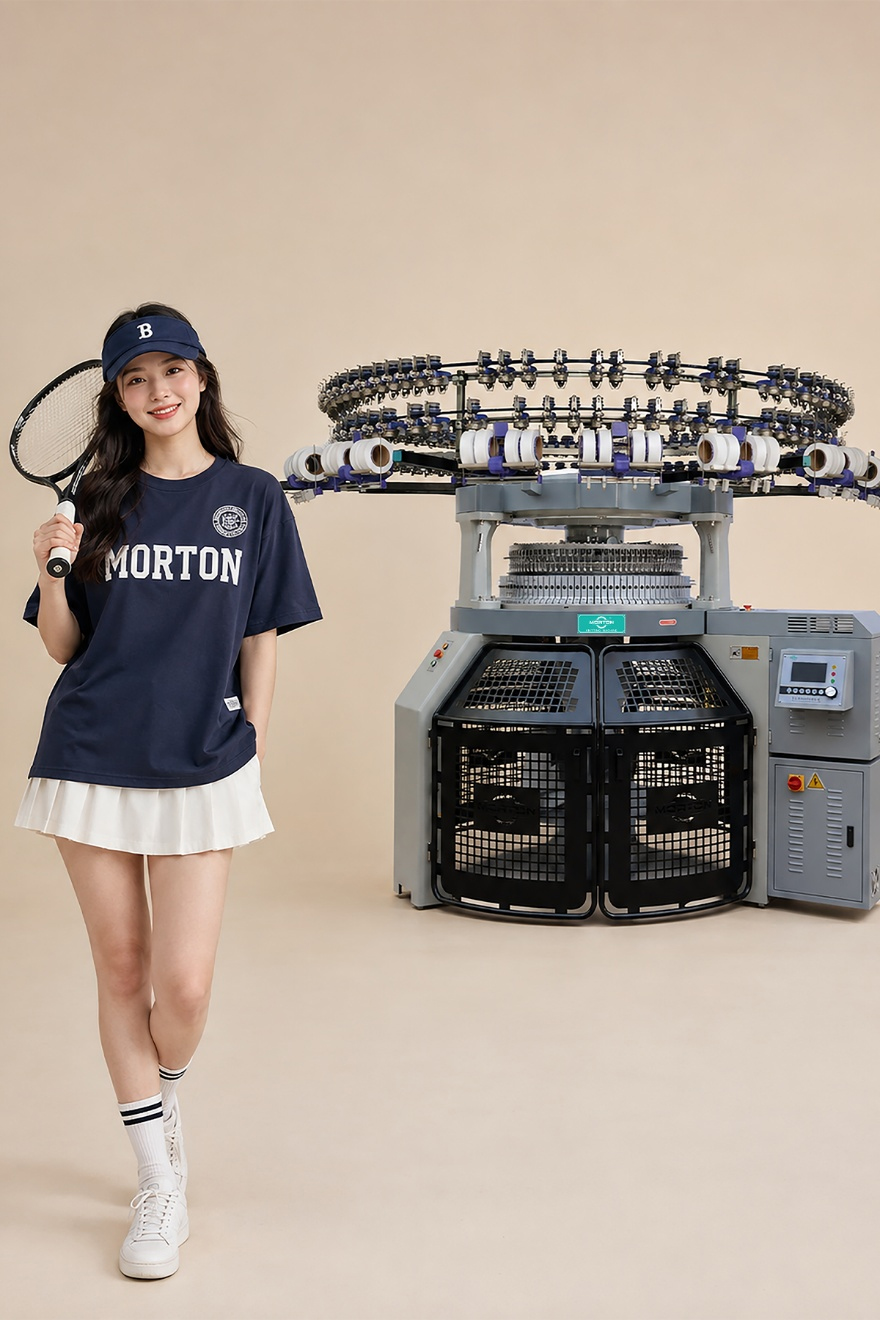
At MORTON, we develop Circular Knitting Machines and Three Thread Fleece Knitting Machines around the fabric our customers need to produce.
That often begins with a sample, not a catalogue.
We look at the yarn, the structure, the fabric weight, and the expected finishing process before discussing the machine solution.
Because a machine should not decide what fabric the customer makes.
The fabric should decide how the machine is configured.
The next time you put on a hoodie, turn it inside out.
Those loops on the back may look simple, but they carry the work of the yarn, the knitting mill, the finishing process, and the machine that brought them together.
Long before the hoodie reached your wardrobe, its comfort had already been engineered on a knitting floor.
MORTON — Advanced Knitting Solutions
Post time: Aug-07-2026