
A circular knitting machine rarely develops a serious problem overnight. In most factories, the warning signs appear much earlier: lint slowly builds up around the yarn feeding system, a belt begins to lose its correct tension, oil flow becomes less reliable, or needles gradually show signs of wear. The machine may still be running, and the fabric may still look acceptable, so these small changes are easy to ignore.
That is exactly why routine maintenance matters.
For a knitting mill, maintenance is not simply about extending the service life of a Circular Knitting Machine. It is also part of fabric quality control. A positive yarn feeder that does not rotate smoothly may eventually contribute to horizontal lines on the fabric. A take-down system that begins to slip can affect fabric tension, while lint and fiber waste left around working areas can interfere with normal machine operation.
Waiting until a machine stops is usually the most expensive way to maintain it.
A better approach is to divide maintenance into different intervals. Some areas need attention every shift, others can be inspected weekly, while deeper cleaning and inspection belong to monthly or semi-annual maintenance.
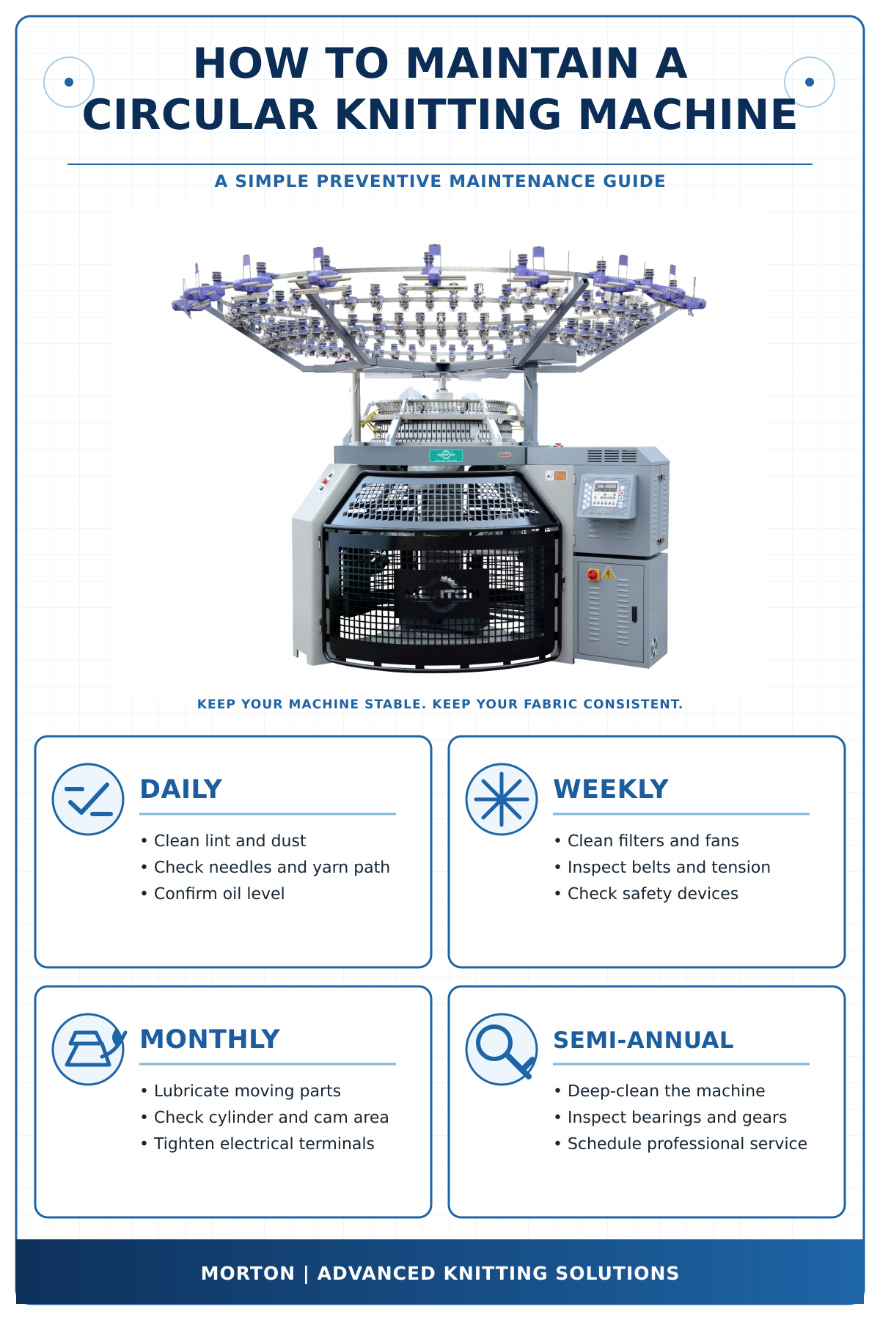
Based on the maintenance routine we use and recommend for circular knitting machines, here is how those different levels fit together.
Daily Maintenance: Small Checks During Every Shift
Daily maintenance should begin with cleanliness. Circular knitting produces a considerable amount of lint and loose fiber, especially during continuous production. In a factory operating morning, afternoon and night shifts, fiber waste should be removed regularly from the creel and the machine rather than being allowed to accumulate for several days.
This is not only about keeping the factory looking clean. Lint eventually finds its way into places where it should not be. Keeping the creel, knitting area and take-down system clean gives the machine a better environment for stable operation and also makes abnormal conditions easier for operators to notice during inspection.
The yarn feeding system deserves particular attention during shift changes. The positive yarn feeder should be checked for lint accumulation or blockage, and the operator should make sure it can rotate normally. When fiber waste builds up around the feeder and prevents smooth rotation, yarn feeding can become unstable. One possible result is the appearance of horizontal lines or other irregularities on the knitted fabric.
This is a good example of why maintenance and fabric quality should not be treated as two separate subjects. What looks like a fabric defect may have started with something as ordinary as lint accumulating around a yarn feeding component.
Daily inspection should also include the stop-motion system and safety gear guards. These devices should be checked during every shift, and any abnormal condition should be repaired or the affected component replaced rather than left for the next operator to deal with. A functioning stop-motion system is particularly important because its purpose is to respond when abnormal knitting conditions occur.
The lubrication system is another part of the daily routine. During shift handover or normal inspection, operators should check the main dial and make sure the relevant oil lines remain clear and function properly. Lubrication is easy to take for granted when everything is working, but it supports the continuous movement of the machine and should therefore be treated as a routine inspection item rather than something checked only after a problem appears.
None of these jobs is complicated. That is partly why they are sometimes underestimated. In practice, however, daily maintenance is where many potential problems can be found while they are still small.
Weekly Maintenance Goes Beyond Cleaning
Daily inspection deals mainly with the areas that can change quickly during normal production. Weekly maintenance gives the factory an opportunity to look more carefully at systems that may not require attention during every shift but still influence how smoothly the Circular Machine operates.
One of these areas is the speed control disc. Lint and fiber waste should be cleaned from the disc every week so that buildup does not gradually interfere with normal operation. In a knitting factory, fiber waste never really stops appearing, so cleaning is not something that can be completed once and forgotten.
The transmission system should also be inspected. Belt tension needs to remain properly adjusted, and the transmission should run smoothly without unusual noise or vibration. Operators who work around the same Knitting Machine every day often become familiar with its normal sound and behaviour. When something begins to sound or feel different, it deserves attention even if the machine has not yet stopped.
The fabric take-down system is another important part of weekly maintenance. The first thing to observe is whether fabric tension remains stable. From there, the rubber rollers should be checked for slipping, and the gear positions should be inspected to make sure they remain secure without slipping or disengagement.
The take-down system may sit below the knitting area, but its role should not be overlooked. Knitting does not end when a needle forms a loop; the newly produced fabric still needs to be drawn away in a controlled manner. If the take-down mechanism is not working correctly, the production process is no longer behaving as intended.
Weekly maintenance therefore serves a slightly different purpose from daily cleaning. It gives the factory time to look for gradual mechanical changes before they become part of normal production.
Monthly Maintenance Requires a Deeper Inspection
Once a month, maintenance should move beyond the parts that can be inspected easily during ordinary production.
The cam box is one of the main areas that deserves a more thorough cleaning. The cam assembly should be removed from the machine so that the tracks and components can be cleaned properly and accumulated lint and fiber can be removed.
This deeper cleaning is important because wiping the outside of a machine does not tell you what is happening inside the working areas. Fiber and residue can collect over time in places that are difficult to inspect during normal production. A scheduled monthly routine makes sure these areas are not ignored simply because the machine continues to run.
The dust-removal system should also be checked. Operators should confirm that the airflow direction is correct and remove dust that has accumulated on equipment surfaces. A dust-removal system can only do its job properly when it is itself kept in suitable working condition.
Electrical components form the third part of the monthly routine. Lint should be removed from these areas using an air gun, and the stop-motion system should be tested to confirm that it is functioning normally.
The important point here is that monthly maintenance should not become another quick visual inspection. It is an opportunity to access areas that daily operators do not normally open, clean or test in detail.
A machine can look clean from the outside while fiber waste is accumulating elsewhere. Scheduled maintenance helps prevent that difference between what the operator can see and what is actually happening inside the machine.
What Should Be Done Every Six Months?
Semi-annual maintenance is where the inspection becomes more comprehensive. By this point, the objective is not simply to remove the lint produced during the last shift or check whether a belt is running normally. The machine has been operating for a considerable period, so components that are subject to wear and systems that are normally left assembled need closer attention.
The cam box assembly should first be removed and thoroughly cleaned. With the assembly removed, the knitting needles can also be taken out and inspected carefully for signs of wear or damage.
Needles perform repetitive mechanical work throughout production, and their condition directly affects the knitting process. A needle does not have to be completely broken before it deserves attention. The purpose of periodic inspection is to identify wear before it develops into a more obvious production problem.
The lubrication system should also receive a deeper inspection than it does during daily maintenance. All oil lines should be checked to make sure they remain clear and function properly, while the oiling unit itself should be cleaned.
At the same time, the condition of the main gear oil should be observed through the sight glass to determine whether replacement is required. This is different from automatically replacing oil simply because six months have passed; the inspection is used to judge its condition and decide whether replacement is necessary.
Electrical components should also be cleaned during the semi-annual service. Lint and oil residue need to be removed so that the electrical system remains clean and suitable for stable, safe operation.
These jobs require more time than a normal shift inspection, but that is the purpose of having a separate maintenance interval. Daily maintenance keeps production areas under control, while semi-annual maintenance creates an opportunity to inspect parts that cannot realistically be dismantled every week.
Maintenance Should Follow the Machine, Not Just the Calendar
A maintenance schedule is useful because it creates discipline. Without one, it is easy for cleaning and inspection to be postponed when production is busy.
However, a calendar should not replace observation.
If a positive yarn feeder is blocked today, there is no reason to wait until the next scheduled maintenance day. If the transmission develops abnormal noise, the fact that it was inspected earlier in the week does not make the noise less important. The same applies to a problem with the stop-motion system, lubrication or fabric take-down.
Routine maintenance works best when scheduled inspection and operator observation support each other. The daily, weekly, monthly and semi-annual intervals provide a structure, while the people working with the machine still need to respond when its behaviour changes.
This is particularly important in a knitting mill because production conditions are not always identical. Machines may operate for different hours, process different yarns and work under different production schedules. A three-shift factory naturally places different demands on its equipment from a machine that operates only occasionally.
The maintenance plan gives operators a baseline. Actual machine condition tells them whether something needs attention sooner.
Why Maintenance Shows Up in the Fabric
When people discuss Circular Knitting Machine maintenance, the conversation often focuses on service life and machine reliability. Those are important reasons to maintain the equipment, but there is another reason that matters just as much to a knitting mill: the fabric.
Consider the daily and weekly maintenance items again. A positive yarn feeder that is obstructed by lint can affect yarn feeding and may lead to horizontal fabric defects. An unstable take-down system can interfere with consistent fabric tension. Needles that show wear or damage need to be identified during deeper inspection. Lubrication and transmission systems, meanwhile, need to remain in suitable working condition for the machine to operate smoothly.
These are machine-maintenance issues, but their consequences do not necessarily remain inside the machine.
Eventually, some of them can appear in production.
That is why an experienced factory does not wait for a complete breakdown before deciding that maintenance is necessary. A Circular Knitting Machine can still rotate and produce fabric while a smaller problem is already beginning to develop.
Keeping the machine running is only part of the job. Keeping it in a condition where it can continue producing stable fabric is the more useful goal.
A Maintenance Routine Is Also a Production Routine
There is nothing particularly exciting about removing lint from a creel at the end of a shift or checking whether a rubber roller is slipping. These jobs rarely appear in machine brochures, and customers visiting a factory are more likely to notice a new Circular Machine than the maintenance routine behind it.
Yet much of reliable textile manufacturing depends on work exactly like this.
The daily routine keeps fiber buildup, yarn feeding, safety devices and lubrication under observation. Weekly maintenance brings transmission and fabric take-down into the inspection. Monthly maintenance allows the cam box, dust-removal system and electrical components to receive more detailed attention. Every six months, the machine can be inspected more deeply for needle wear, lubrication condition and contamination around electrical components.
Taken individually, these are simple jobs. Taken together over months and years of production, they become part of how a knitting mill protects its equipment and maintains a more stable production environment.
This is also why maintenance should not be treated as something that begins when a machine becomes old. A new machine produces lint. A new machine still has a yarn feeding system, transmission, take-down system, lubrication lines and electrical components that need inspection.
Good maintenance starts with production, not with failure.
How MORTON Looks at Circular Knitting Machine Maintenance
When we discuss a Circular Knitting Machine with a customer at MORTON, our conversation is naturally about the machine, but ultimately the customer has a different goal. The knitting mill needs to keep producing fabric day after day, and the machine has to support that production over the long term.
Machine design and manufacturing provide the foundation, while correct operation and regular maintenance protect that foundation during actual factory use.
This is why basic jobs such as cleaning fiber waste, inspecting the positive yarn feeder, checking belt tension, watching the take-down system and keeping oil lines clear should not be dismissed as minor housekeeping. They are part of the normal discipline of running Textile Machinery.
A good maintenance routine does not guarantee that a knitting mill will never encounter a problem. Machines work continuously, components wear, yarn conditions change and production environments are never perfectly static.
What maintenance does is give the factory a better chance to notice those changes early, before a small issue turns into an unnecessary stop or begins affecting fabric production.
For a Circular Knitting Machine, that is what good maintenance should achieve: keep the machine clean, keep its main systems under observation, and keep production as stable as possible.
MORTON — Advanced Knitting Solutions
Post time: Aug-27-2026